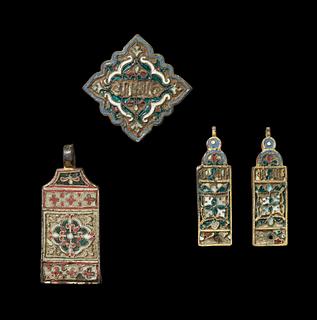
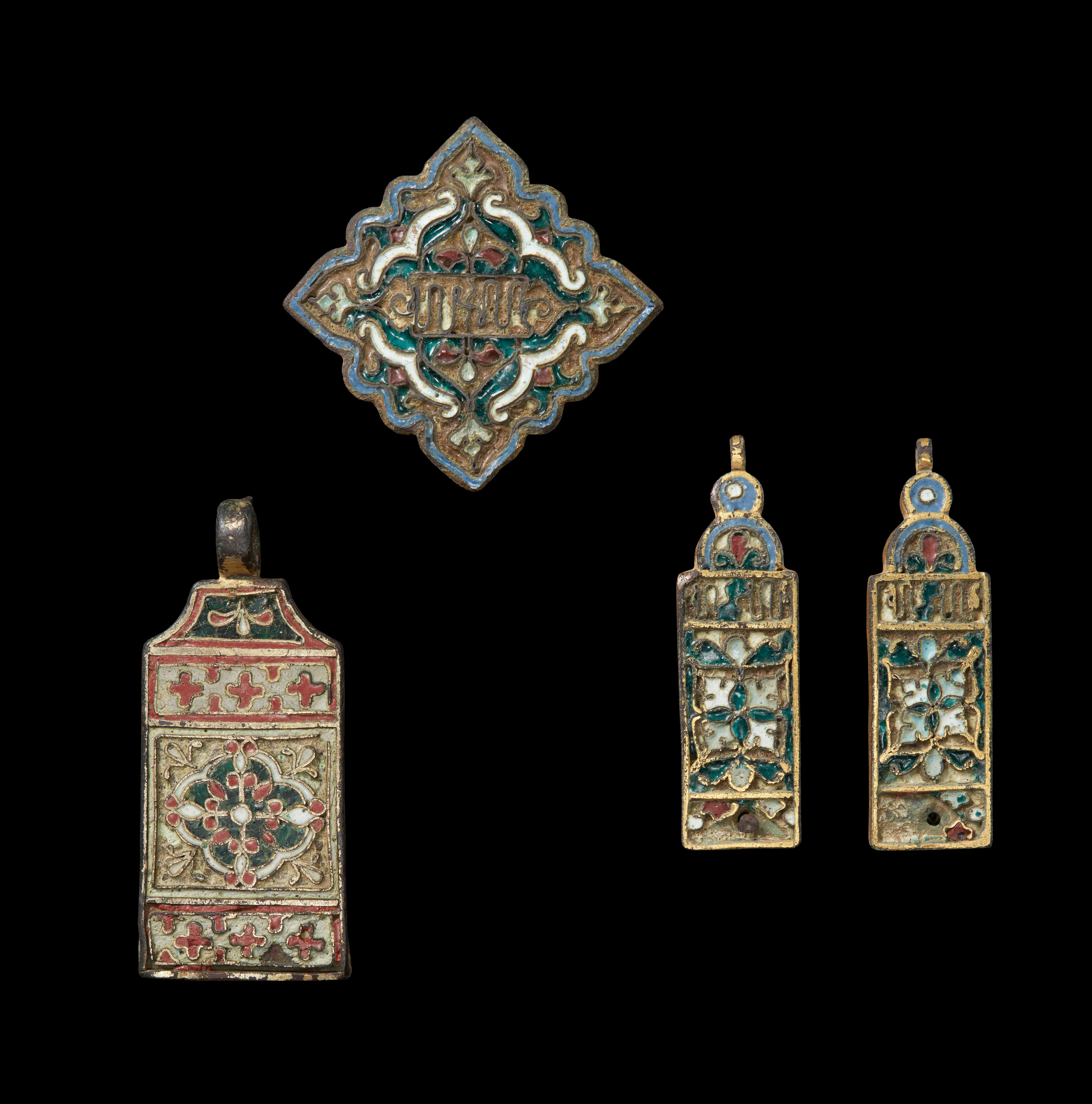
Four buckles, gilded bronze with enamel decoration
Spain, Andalusia; 14th-15th century
Largest buckle: L: 7.2; W: 3 cm
Inventory number 25a-d/1995
Enamel work is much rarer in Islamic art before c. 1500 than in Europe, and is known mostly from Egypt and Spain. Later, richly decorated and masterfully executed objects were made in Mughal India and in Safavid and Qajar Iran.
These buckles, which were attached to leather strips and used for belts, for hanging weapons, or for harnesses, were made in the cloisonné technique, in which thin metal strips are soldered onto the ground and separate the different enamel colors. The metal partitions also form the pattern. In addition to geometric and floral patterns, they create a script-like ornament that has been read as Allah (God).
These buckles, which were attached to leather strips and used for belts, for hanging weapons, or for harnesses, were made in the cloisonné technique, in which thin metal strips are soldered onto the ground and separate the different enamel colors. The metal partitions also form the pattern. In addition to geometric and floral patterns, they create a script-like ornament that has been read as Allah (God).
Published in
Published in
Kjeld von Folsach, Torben Lundbæk and Peder Mortensen (eds.): Sultan, Shah and Great Mughal: the history and culture of the Islamic world, The National Museum, Copenhagen 1996, cat.no. 199;
Kjeld von Folsach: Art from the World of Islam in The David Collection, Copenhagen 2001, cat.no. 577;
Kjeld von Folsach: Art from the World of Islam in The David Collection, Copenhagen 2001, cat.no. 577;