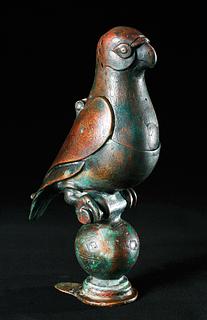
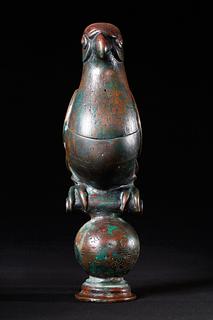
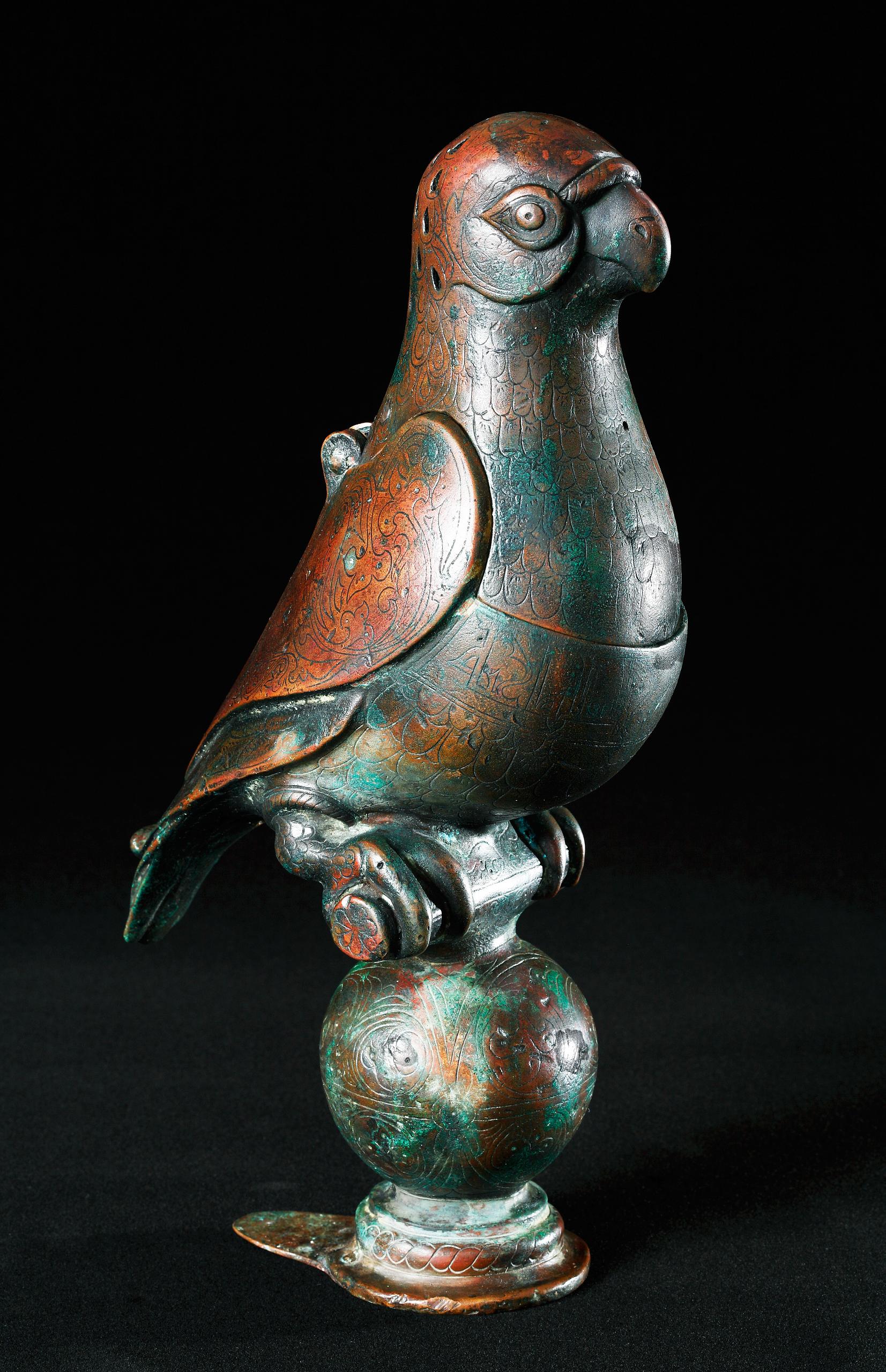
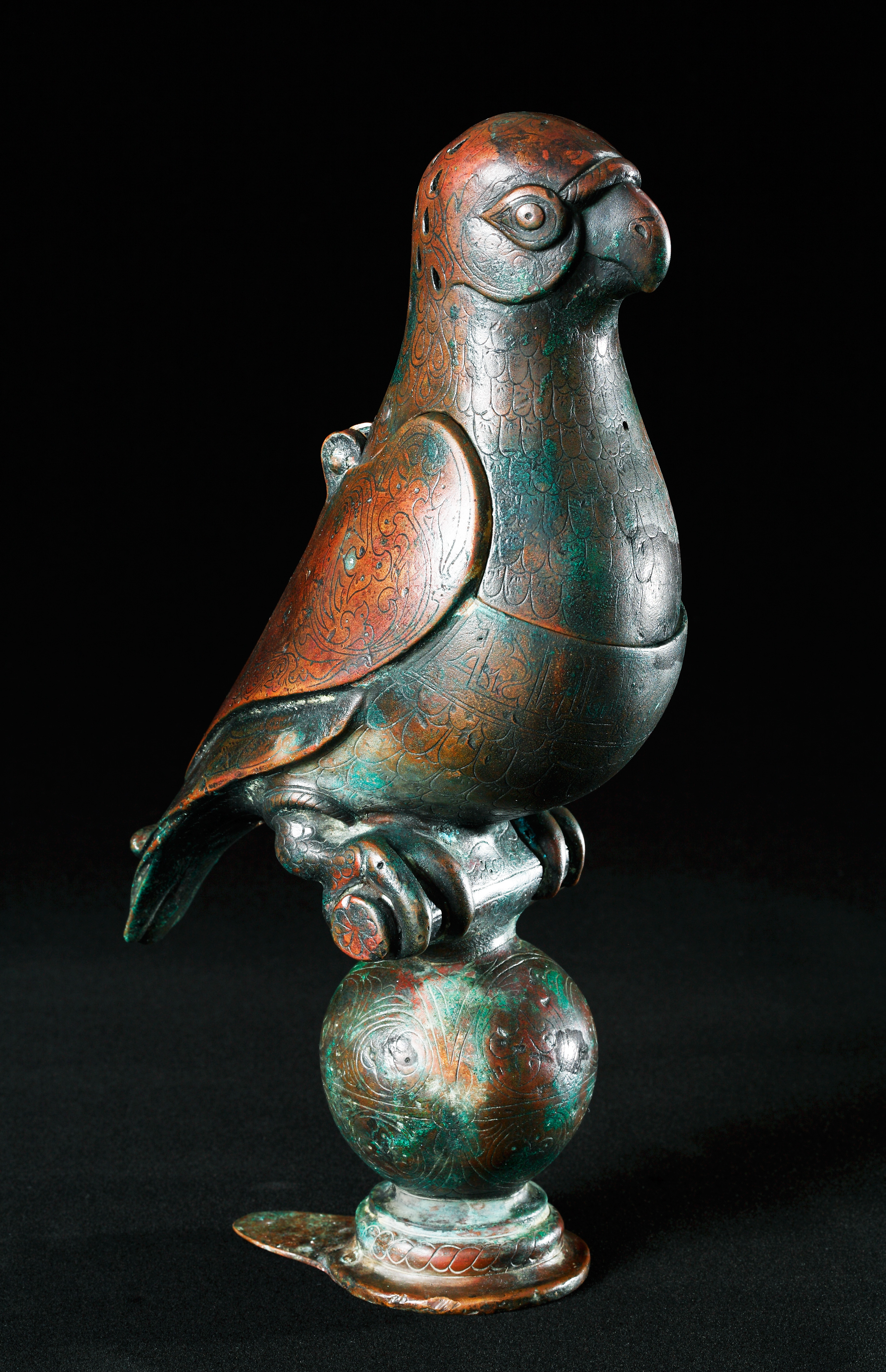
Incense burner, cast, punched, and engraved bronze
Sicily or southern Italy; end of 11th – beginning of 12th century
H: 35.5 cm
Inventory number 10/2005
This incense burner in the form of a stylized but well-modeled parrot or falcon belongs to a small group of bronze sculptures that can be ascribed with a fairly great degree of probability to Sicily or southern Italy in around 1100.
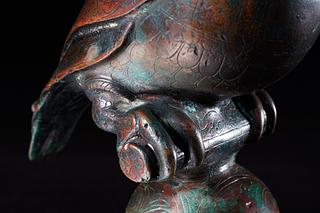
The bird is holding on with strong claws to a perch across a sphere that might have been placed on a tall pedestal. The beautifully shaped head can be lifted to gain access to the inside of the bird. Three protrusions once supported a grating, now missing, for charcoal and the incense whose fragrance was released through 33 drop-shaped perforations. The bird’s entire body is engraved with feathers, elegant curved palmettes, and a Kufi inscription.
The bird is holding on with strong claws to a perch across a sphere that might have been placed on a tall pedestal. The beautifully shaped head can be lifted to gain access to the inside of the bird. Three protrusions once supported a grating, now missing, for charcoal and the incense whose fragrance was released through 33 drop-shaped perforations. The bird’s entire body is engraved with feathers, elegant curved palmettes, and a Kufi inscription.
Published in
Published in
Sotheby’s, London 19/10 2005, lot. 293;
Susan Moore: “The Art Market: Trotting All the Way to the Bank,” Apollo, 161, 2005, pp. 104-105;
Joachim Meyer: “The Body Language of a Parrot: An Incense Burner from the Western Mediterranean,” Journal of the David Collection, 4, 2014, fig. 1, 5-8, pp. 26-41;
Daniel C. Waugh: “Featured Museum I: The David Collection,” The Silk road, 12, 2014, fig. 1;
Joachim Meyer: Sensual Delights. Incense Burners and Rosewater Sprinklers from the World of Islam, The Davids Collection, Copenhagen 2015, cat. 2;
Julian Raby: “The Inscriptions on the Pisa Griffin and the Mari-Cha Lion: From Banal Blessings to Indices of Origin,” in Anna Contadini (ed.): The Pisa Griffin and the Mari-Cha Lion. Metalwork, Art and Technology in the Medieval Islamicate Mediterranean, Pisa 2018, pp. 305-360;
Rachel Ward: “The Animal Medallions on the Pisa Griffin and the Mari-Cha Lion,” in Anna Contadini (ed.): The Pisa Griffin and the Mari-Cha Lion. Metalwork, Art and Technology in the Medieval Islamicate Mediterranean, Pisa 2018, fig. 9, p. 300;
Elizabeth C. Kelly: Zoomorphic Incense Burners of Medieval Khurasan. A Study of Islamic Metalwork, Oxford 2024, fig. 7.16A;
Susan Moore: “The Art Market: Trotting All the Way to the Bank,” Apollo, 161, 2005, pp. 104-105;
Joachim Meyer: “The Body Language of a Parrot: An Incense Burner from the Western Mediterranean,” Journal of the David Collection, 4, 2014, fig. 1, 5-8, pp. 26-41;
Daniel C. Waugh: “Featured Museum I: The David Collection,” The Silk road, 12, 2014, fig. 1;
Joachim Meyer: Sensual Delights. Incense Burners and Rosewater Sprinklers from the World of Islam, The Davids Collection, Copenhagen 2015, cat. 2;
Julian Raby: “The Inscriptions on the Pisa Griffin and the Mari-Cha Lion: From Banal Blessings to Indices of Origin,” in Anna Contadini (ed.): The Pisa Griffin and the Mari-Cha Lion. Metalwork, Art and Technology in the Medieval Islamicate Mediterranean, Pisa 2018, pp. 305-360;
Rachel Ward: “The Animal Medallions on the Pisa Griffin and the Mari-Cha Lion,” in Anna Contadini (ed.): The Pisa Griffin and the Mari-Cha Lion. Metalwork, Art and Technology in the Medieval Islamicate Mediterranean, Pisa 2018, fig. 9, p. 300;
Elizabeth C. Kelly: Zoomorphic Incense Burners of Medieval Khurasan. A Study of Islamic Metalwork, Oxford 2024, fig. 7.16A;