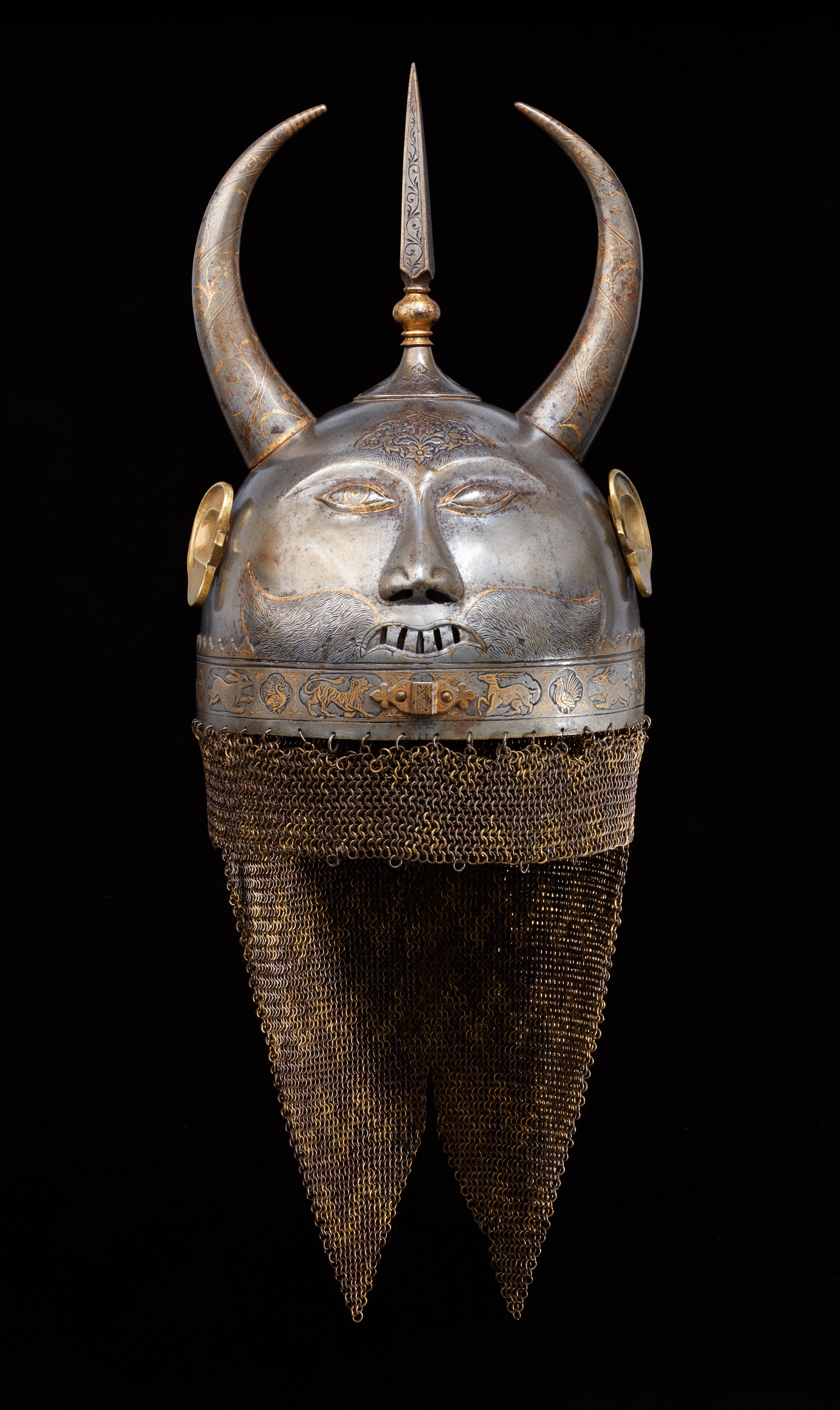
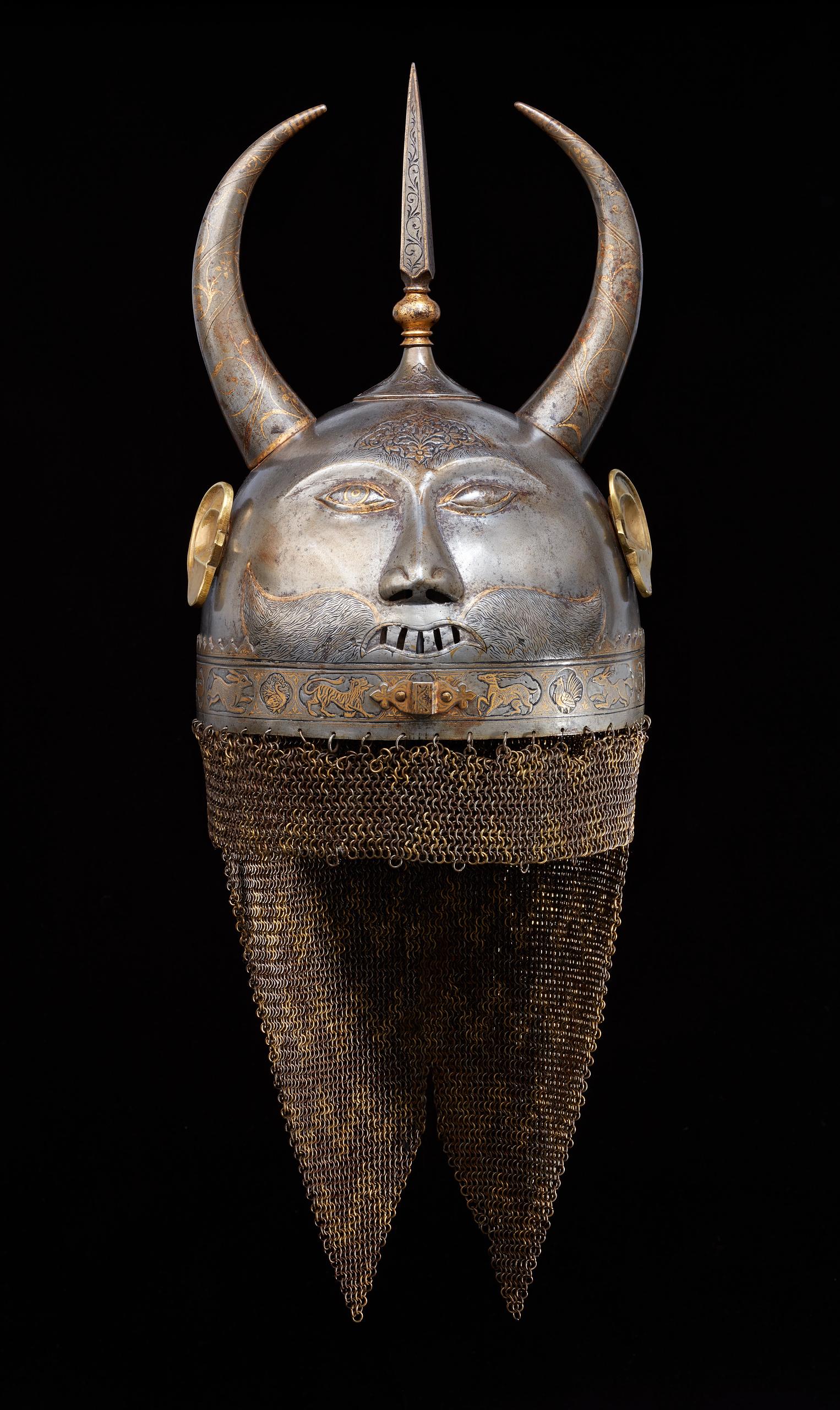
Helmet of steel and brass with engraved and openwork decorations overlaid with gold
Iran or India; 19th century
H (with aventail): 55.5; Diam: 19 cm
Inventory number 30/1977
With its bizarre demonic face, curved horns and brass ears riveted onto its sides, this helmet is a clear example of how traditional armour took on a more decorative and imaginative quality in the nineteenth century as the development and spread of firearms rendered it increasingly useless on the battlefield.
Besides the fact that it would not have been suitable for actual combat, it is difficult to say what function such a helmet served. It may have been worn in ceremonial contexts, for example as a prop for the annual Shiite passion plays (taziya), but it is also possible that it was made as a purely decorative item intended to be sold in the bazaar or exported to Europe.
Just as the function of the helmet is not known, the exact meaning of the demon face is unclear, but similar visages appear on many other Iranian and Indian helmets from the same period. The phenomenon may be linked to contemporary depictions of the legendary Iranian hero Rustam. Many Shahnama editions from the 19th century show him wearing a helmet made of the head of a fearsome demon, The White Div.1
Under the demon face, the lower band of the helmet is adorned with a long frieze featuring animal figures, overlaid in gold, of a type mainly known from Indian metalwork (8/1984). Indeed, an inscription on the back of the helmet indicates that it was made in Lahore in present-day Pakistan.
Besides the fact that it would not have been suitable for actual combat, it is difficult to say what function such a helmet served. It may have been worn in ceremonial contexts, for example as a prop for the annual Shiite passion plays (taziya), but it is also possible that it was made as a purely decorative item intended to be sold in the bazaar or exported to Europe.
Just as the function of the helmet is not known, the exact meaning of the demon face is unclear, but similar visages appear on many other Iranian and Indian helmets from the same period. The phenomenon may be linked to contemporary depictions of the legendary Iranian hero Rustam. Many Shahnama editions from the 19th century show him wearing a helmet made of the head of a fearsome demon, The White Div.1
Under the demon face, the lower band of the helmet is adorned with a long frieze featuring animal figures, overlaid in gold, of a type mainly known from Indian metalwork (8/1984). Indeed, an inscription on the back of the helmet indicates that it was made in Lahore in present-day Pakistan.
Published in
Published in
Annika Richert (ed.): Islam: konst och kultur / art and culture, Statens historiska museum, Stockholm 1985, p. 151, cat.no. 21;
Kjeld von Folsach: Fabelvæsner fra Islams Verden, Davids Samling, København 1991, cat.no. 72;
Kjeld von Folsach, Joachim Meyer and Peter Wandel: Fighting, Hunting, Impressing. Arms and Armour from the Islamic World 1500-1850, The David Collection, Copenhagen 2021 , cat.no. 66 and Appendix, p. 277;
Kjeld von Folsach: Fabelvæsner fra Islams Verden, Davids Samling, København 1991, cat.no. 72;
Kjeld von Folsach, Joachim Meyer and Peter Wandel: Fighting, Hunting, Impressing. Arms and Armour from the Islamic World 1500-1850, The David Collection, Copenhagen 2021 , cat.no. 66 and Appendix, p. 277;
Footnotes
Footnotes
1.
Kjeld von Folsach, Joachim Meyer, Peter Wandel: Fighting, Hunting, Impressing: Arms and Armour from the Islamic World 1500–1850, Copenhagen 2021, cat. 66.
_The-David-Collection_Copenhagen_photo-Pernille-Klemp.jpg)