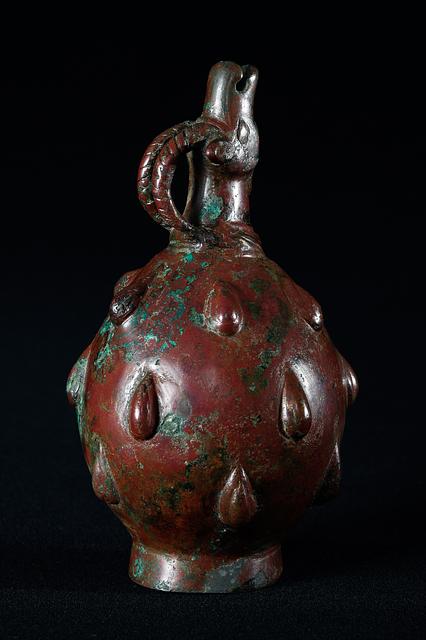
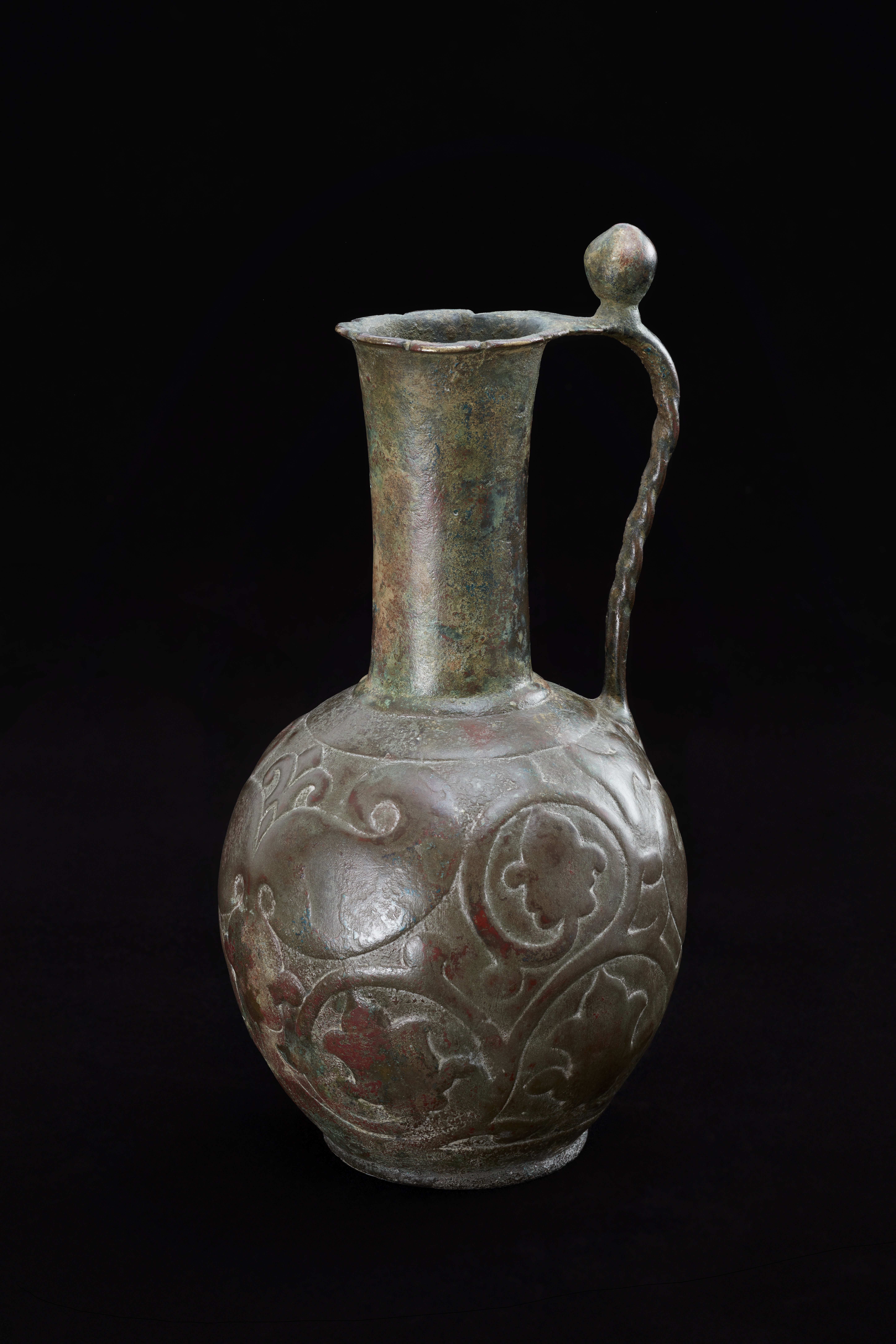
Ewer, cast bronze
Iraq or Iran; 9th century
H with knob: 27.7 cm
Inventory number 17/2001
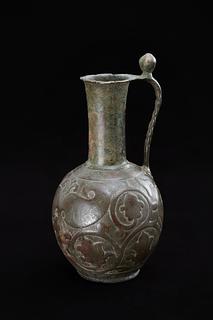
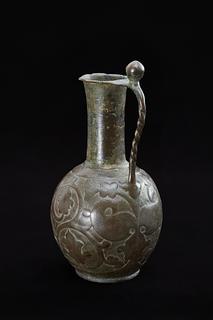
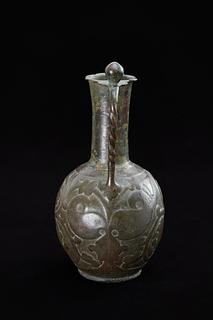
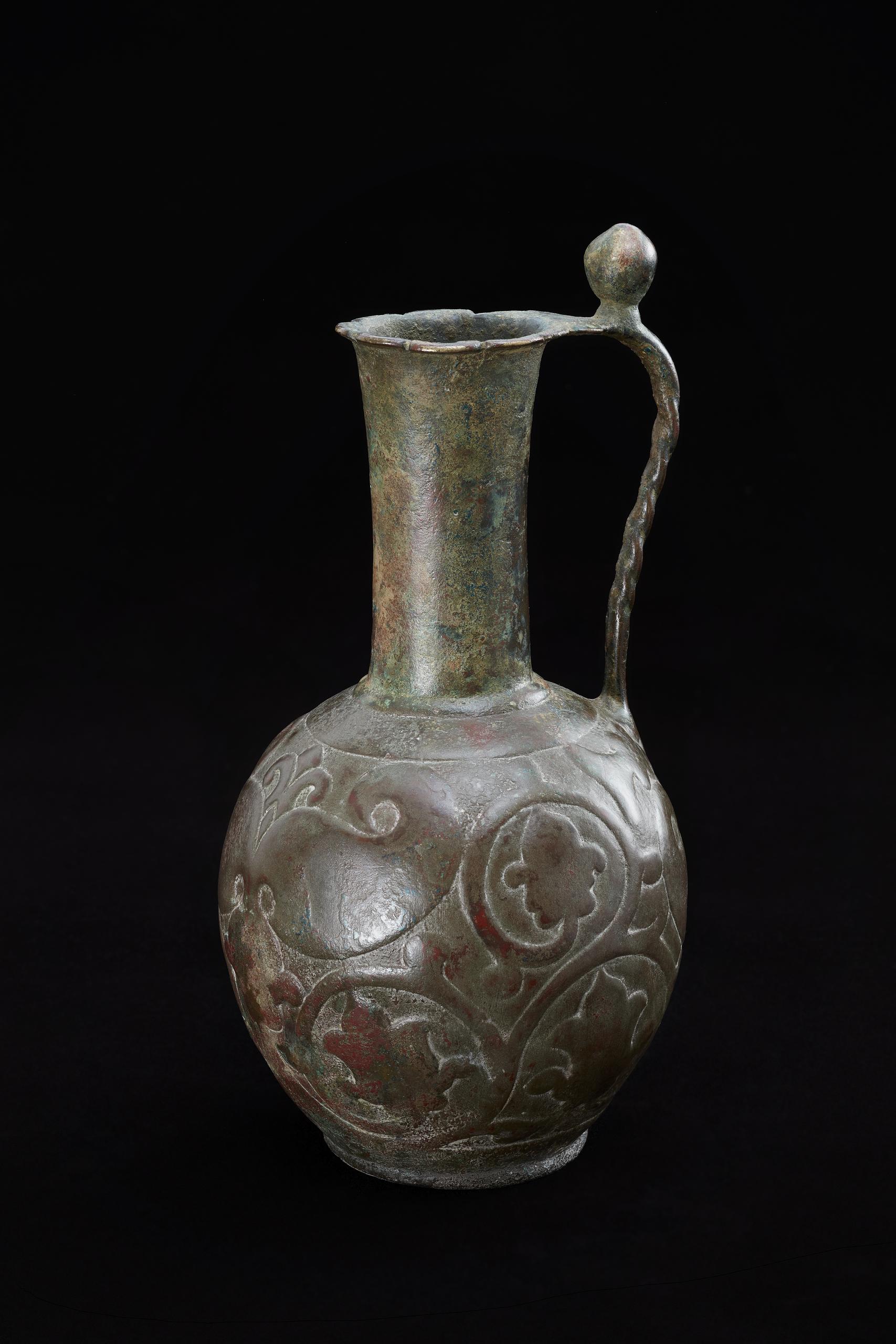
The shape of this ewer, an ovoid body and a straight neck, was common in the 9th-10th century. The handle, which was most often composed of bead-like elements, is twisted here, and the knob is almost spherical, while in other cases it is shaped like a pomegranate. The undecorated neck has an eight-lobed, scalloped rim.
The unusual thing about the piece is the decoration on the body, which was cast in relief and not engraved. A lush vine with laciniate leaves covers most of it, except for the front and back, which are dominated by splendid, sweeping winged palmettes. These palmettes were taken directly from Sasanian models and are found in various forms in the art of the Abbasids and Samanids.
The unusual thing about the piece is the decoration on the body, which was cast in relief and not engraved. A lush vine with laciniate leaves covers most of it, except for the front and back, which are dominated by splendid, sweeping winged palmettes. These palmettes were taken directly from Sasanian models and are found in various forms in the art of the Abbasids and Samanids.
Published in
Published in
Christie's, London, 1/5-2001, lot 222;
Sheila S. Blair and Jonathan M. Bloom (eds.): Cosmophilia. Islamic Art from the David Collection, Copenhagen, McMullen Museum of Art, Boston College, Boston 2006, cat.no. 75;
Sheila S. Blair and Jonathan M. Bloom (eds.): Cosmophilia. Islamic Art from the David Collection, Copenhagen, McMullen Museum of Art, Boston College, Boston 2006, cat.no. 75;