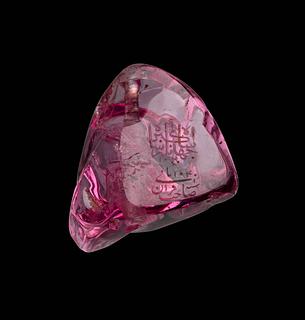
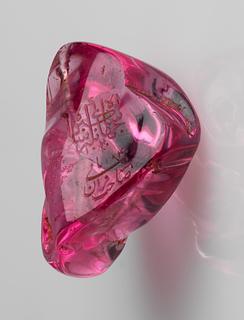
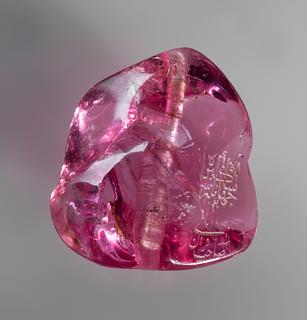
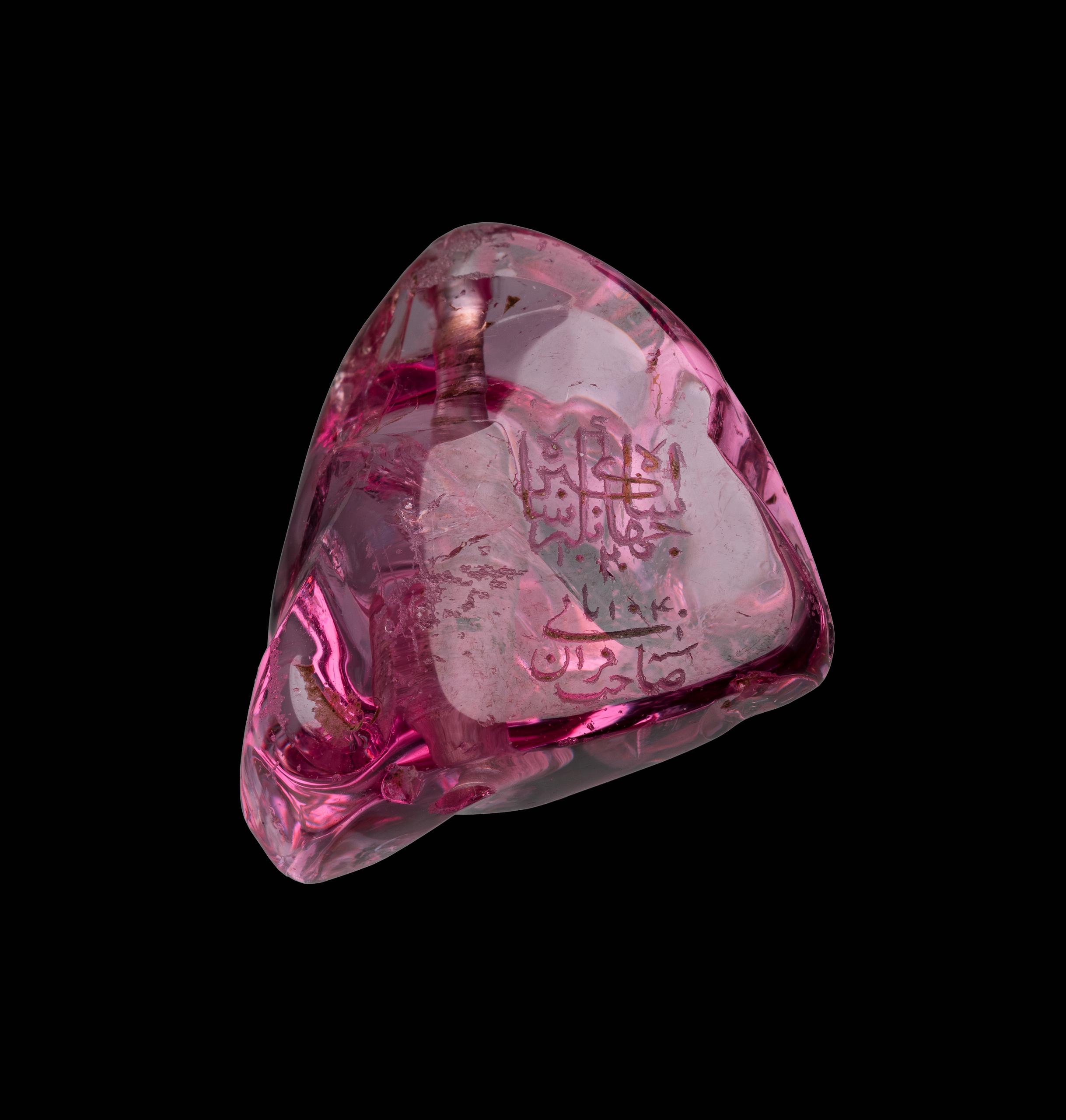
Cut, engraved spinel
India; c. 1600
2 × 1.8 × 0.8 cm
Inventory number 1/2014
A spinel is a red precious stone that is slightly softer than a ruby, with which it is often confused. Spinel was mined in northern Afghanistan and was especially admired in Iran and India.
Particularly in India under the Mughals, the finest pieces – distinguished by their color and size – were cut without facets, engraved with the owner’s name, and kept in his treasury.
The engraved inscriptions on this spinel show that it belonged to the Mughal emperors Jahangir and Shah Jahan. Inscriptions of this kind were highly prized if the spinel was later bestowed upon a deserving subject, who could choose to have it mounted in a piece of jewelry.
Particularly in India under the Mughals, the finest pieces – distinguished by their color and size – were cut without facets, engraved with the owner’s name, and kept in his treasury.
The engraved inscriptions on this spinel show that it belonged to the Mughal emperors Jahangir and Shah Jahan. Inscriptions of this kind were highly prized if the spinel was later bestowed upon a deserving subject, who could choose to have it mounted in a piece of jewelry.
Published in
Published in
Kjeld von Folsach, Joachim Meyer: The Human Figure in Islamic Art – Holy Men, Princes, and Commoners, The David Collection, Copenhagen 2017, fig. 44, p. 185;
Joachim Meyer, Rasmus Bech Olsen and Peter Wandel: Beyond words: calligraphy from the World of Islam, The David Collection, Copenhagen 2024, cat. 109, p. 278;
Joachim Meyer, Rasmus Bech Olsen and Peter Wandel: Beyond words: calligraphy from the World of Islam, The David Collection, Copenhagen 2024, cat. 109, p. 278;
.jpg)
.jpg)
.jpg)
.jpg)
.jpg?disposition=attachment)