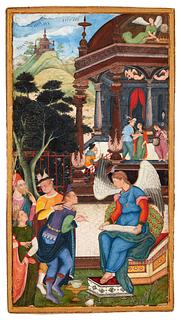
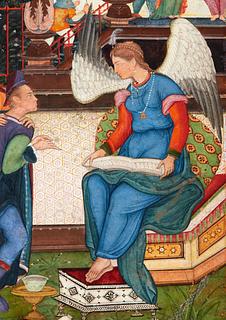
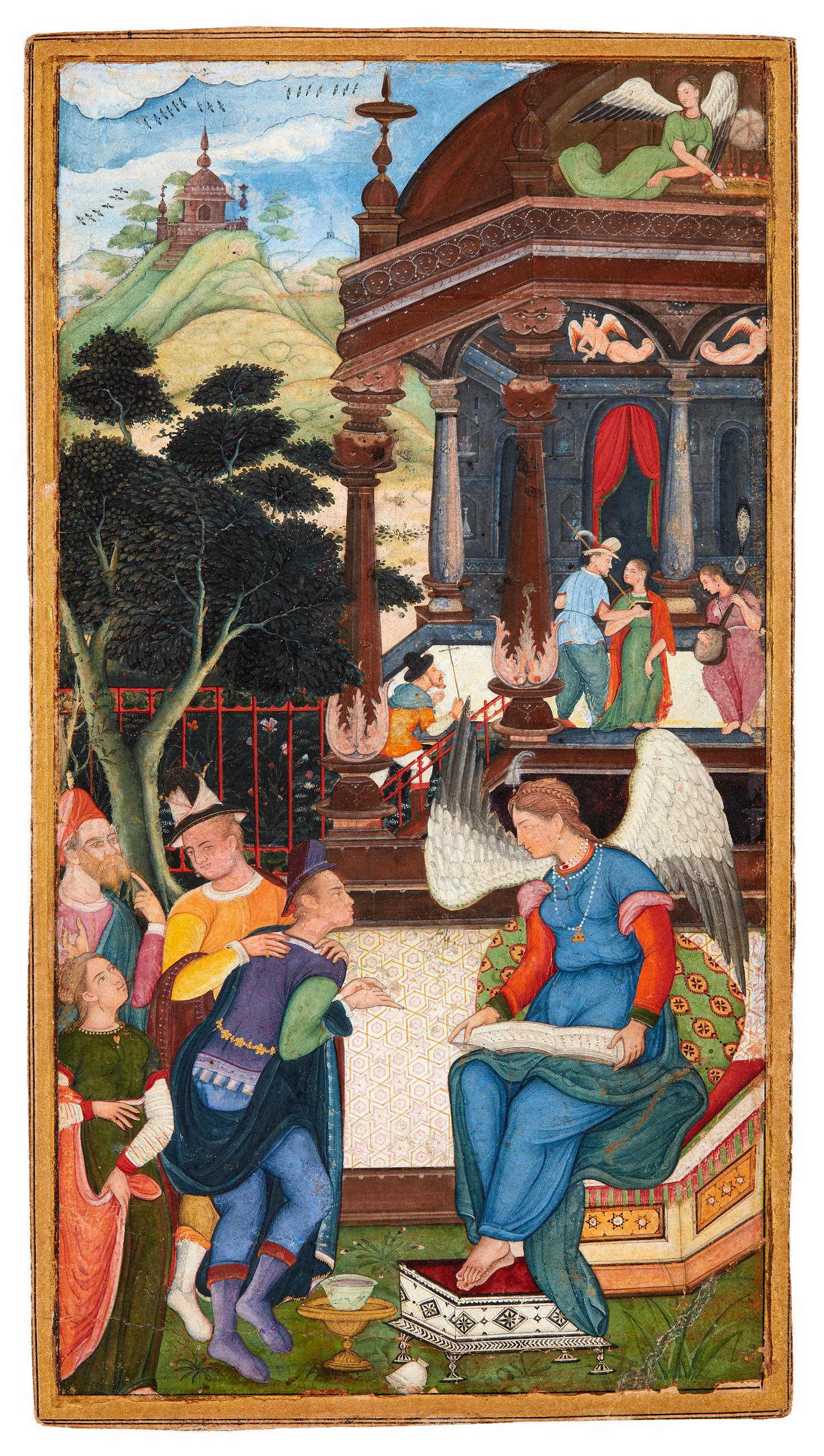
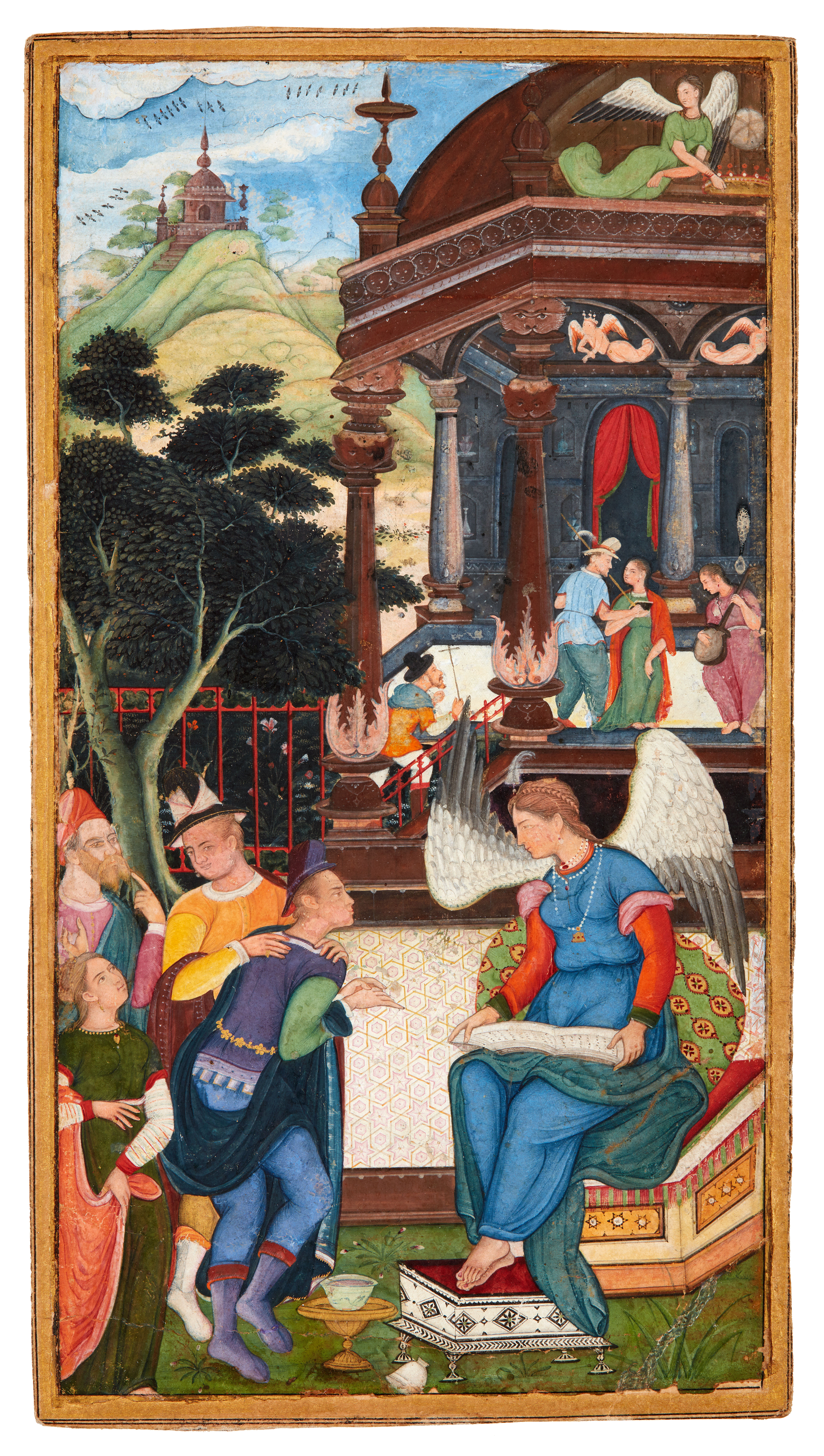
Miniature. ‘An Angel Conversing with a Group of Europeans’
India, Allahabad?; 1602–1604
Miniature: 17.9 × 9.5 cm
Inventory number 6/1981
The Great Mughals Akbar and Jahangir were both religiously tolerant and interested in other faiths, including Christianity. In their meetings with missionaries, they became acquainted with European art, which was more true to life and exerted a decisive influence on Mughal art at an early stage.
In this curious miniature, which is a free paraphrase of an engraving by the German artist Georg Pencz, the Indian artist endeavored to render the domed building with linear perspective, without much success. He did a better job at using aerial perspective, in which the intensity of the colors decreases as distance increases.
In this curious miniature, which is a free paraphrase of an engraving by the German artist Georg Pencz, the Indian artist endeavored to render the domed building with linear perspective, without much success. He did a better job at using aerial perspective, in which the intensity of the colors decreases as distance increases.
Published in
Published in
Edwin Binney: Indian miniature painting from the Collection of Edwin Binney, 3rd. 1, The Mughal and Deccani schools with some related Sultanate material, Portland Art Museum, Portland, 1973, cat.no. 29c;
Kjeld von Folsach: Islamic art. The David Collection, Copenhagen 1990, cat.no. 46;
Kjeld von Folsach: Fabelvæsner fra Islams Verden, Davids Samling, København 1991, cat.no. 65;
Gauvin Alexander Bailey: Counter reformation symbolism and allegory in Mughal painting, Dissertation, Harvard University, 1996, Ann Arbor 1996, fig. 53;
Kjeld von Folsach, Torben Lundbæk and Peder Mortensen (eds.): Sultan, Shah and Great Mughal: the history and culture of the Islamic world, The National Museum, Copenhagen 1996, cat.no. 323;
Kjeld von Folsach: Art from the World of Islam in The David Collection, Copenhagen 2001, cat.no. 68;
Jorge Flores and Nuno Vassallo e Silva (eds.): Goa and the Great Mughal, Calouste Gulbenkian, Lissabon 2004, cat.no. 91;
Kjeld von Folsach: For the Privileged Few: Islamic Miniature Painting from The David Collection, Louisiana, Humlebæk 2007, cat.no. 100;
Gian Carlo Calza (ed.): Akbar : the Great Emperor of India 1542-1605, Fondazione Roma Museo, Milano 2012, cat.no. V.15;
Kjeld von Folsach, Joachim Meyer: The Human Figure in Islamic Art – Holy Men, Princes, and Commoners, The David Collection, Copenhagen 2017, cat.no. 74;
Rui Oliveira Lopes: “Artistic eclecticism in Mughal miniature painting from 1526 to 1707”, Orientations, 51:5, 2020, fig. 9, p. 72
Kjeld von Folsach: Islamic art. The David Collection, Copenhagen 1990, cat.no. 46;
Kjeld von Folsach: Fabelvæsner fra Islams Verden, Davids Samling, København 1991, cat.no. 65;
Gauvin Alexander Bailey: Counter reformation symbolism and allegory in Mughal painting, Dissertation, Harvard University, 1996, Ann Arbor 1996, fig. 53;
Kjeld von Folsach, Torben Lundbæk and Peder Mortensen (eds.): Sultan, Shah and Great Mughal: the history and culture of the Islamic world, The National Museum, Copenhagen 1996, cat.no. 323;
Kjeld von Folsach: Art from the World of Islam in The David Collection, Copenhagen 2001, cat.no. 68;
Jorge Flores and Nuno Vassallo e Silva (eds.): Goa and the Great Mughal, Calouste Gulbenkian, Lissabon 2004, cat.no. 91;
Kjeld von Folsach: For the Privileged Few: Islamic Miniature Painting from The David Collection, Louisiana, Humlebæk 2007, cat.no. 100;
Gian Carlo Calza (ed.): Akbar : the Great Emperor of India 1542-1605, Fondazione Roma Museo, Milano 2012, cat.no. V.15;
Kjeld von Folsach, Joachim Meyer: The Human Figure in Islamic Art – Holy Men, Princes, and Commoners, The David Collection, Copenhagen 2017, cat.no. 74;
Rui Oliveira Lopes: “Artistic eclecticism in Mughal miniature painting from 1526 to 1707”, Orientations, 51:5, 2020, fig. 9, p. 72
Mughal India
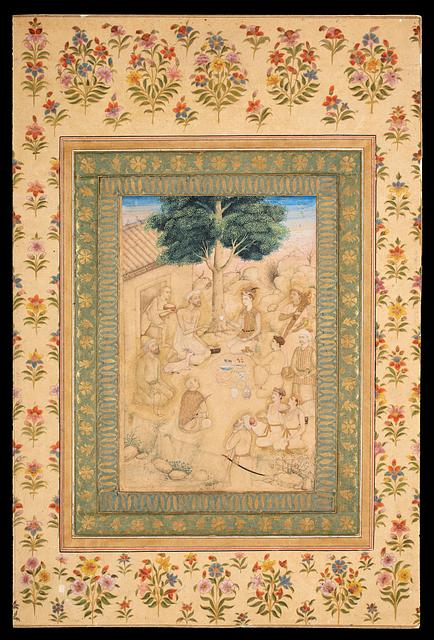
Miniature pasted on an album leaf. ‘A Prince Visiting a Holy Man’
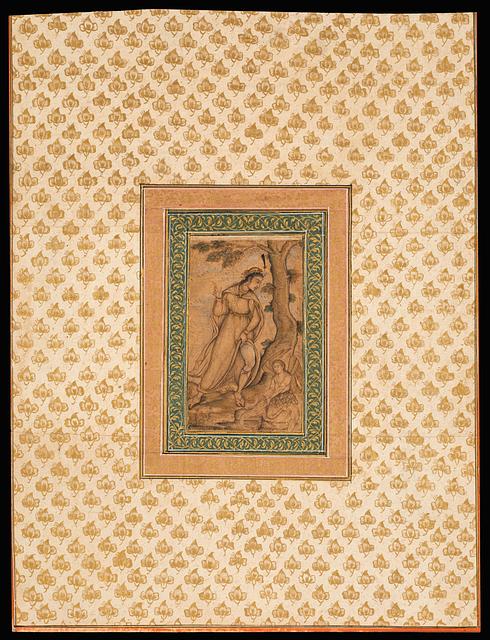
Brush drawing heightened with gold and watercolors, pasted on an album leaf. ‘Tobias and the Angel’
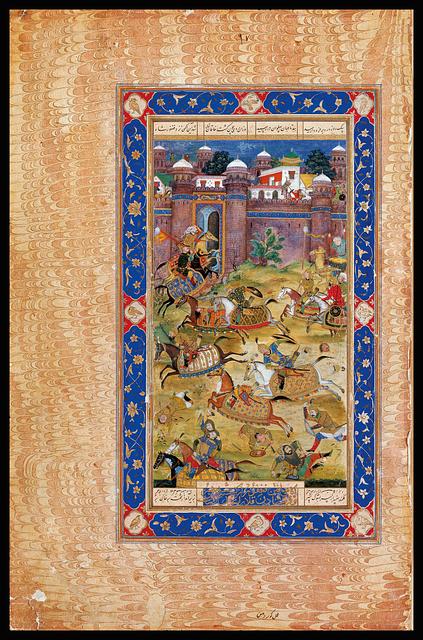
Miniature from a copy of Tusi’s Garshaspnama pasted on an album leaf. ‘Nariman Killing the Son of the Khan of Chin’

A mirror case with three paintings from a manuscript of Sadi’s Gulistan