Miniature pasted on cardboard. ‘A European in a landscape’
India, Mughal; c. 1595
Miniature H: 14.7; W: 8.5. Leaf H: 19.1 W: 12.9 cm
Inventory number 38/2017
The dignified man with the gray beard on this painting was largely copied from a European work of art, most probably a print. They came in large numbers to India from the 1570s with Portuguese Catholic missionaries and shortly thereafter with merchants from Portugal, the Netherlands, and Britain. In India, they were considered artistically innovative and exotic because of their naturalistic details and different subjects, and gained considerable importance for the development of Mughal painting at the end of the 16th century and first half of the 17th.
The man with the fur coat and characteristic black hat, in contrast, was probably inspired by a Protestant, northern European model rather than by a Catholic southern European, and it has been suggested that it was copied from an engraving of the Swiss religious reformer Heinrich Bullinger (1504-1575).
The Indian artist undoubtedly had a half-length portrait as a model and transformed the original, fur-trimmed cloak into a kind of fur coat, gave the European a light-blue shawl, a pink tunic, and green sandals, and also provided his book with a characteristic Islamic binding. The village in the distance display both European and local features.
The back of the cardboard holds many Indian inscriptions and seals, the oldest of which is from the 40th year in the reign of the Great Mughal Akbar, corresponding to 1596. Most are from the 17th century. The painting was given the quality level “avval” – first class.1
The man with the fur coat and characteristic black hat, in contrast, was probably inspired by a Protestant, northern European model rather than by a Catholic southern European, and it has been suggested that it was copied from an engraving of the Swiss religious reformer Heinrich Bullinger (1504-1575).
The Indian artist undoubtedly had a half-length portrait as a model and transformed the original, fur-trimmed cloak into a kind of fur coat, gave the European a light-blue shawl, a pink tunic, and green sandals, and also provided his book with a characteristic Islamic binding. The village in the distance display both European and local features.
The back of the cardboard holds many Indian inscriptions and seals, the oldest of which is from the 40th year in the reign of the Great Mughal Akbar, corresponding to 1596. Most are from the 17th century. The painting was given the quality level “avval” – first class.1
Published in
Published in
Sotheby’s, London, 19/10-2016, lot 11;
Simon Ray, London, 1/11-30/11-2017, cat.no. 25;
Simon Ray, London, 1/11-30/11-2017, cat.no. 25;
Footnotes
Footnotes
1.
Three paintings with corresponding notes on the back were sold at Sotheby’s on Oct. 19, 2016, lots 1, 10, and 12. Three others were sold at Sotheby’s on Apr. 23, 1996, lot 5; on Oct. 8, 2008, lot 44; and on Apr. 20, 2016, lot 49. A painting was furthermore published by Linda York Leach in Paintings From India, London, 1998, pp. 36-39 and 138-139. (The Nasser D. Khalili Collection of Islamic Art, vol. VIII)


Mughal India
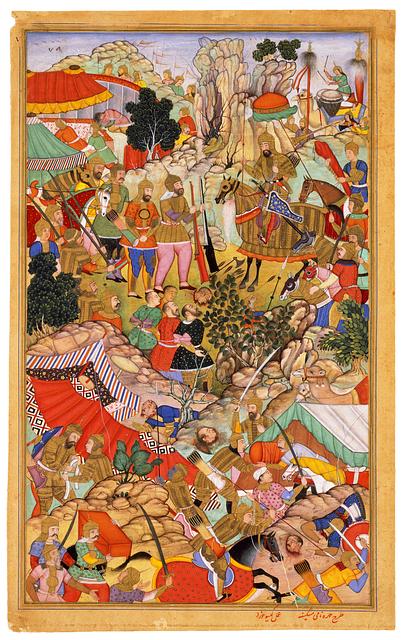
Miniature from a copy of Rashid al-Din’s Jami al-tawarikh. ‘Tayang Khan Presented with the Head of the Mongol Leader Ong Khan’
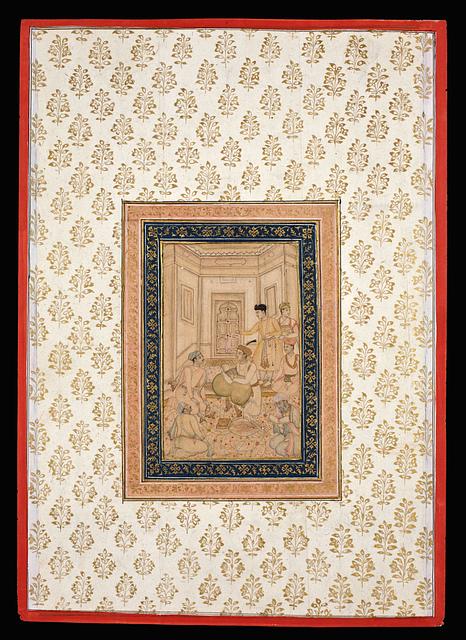
Miniature pasted on an album leaf. ‘A Prince Visiting his Library’. Attributed to La’l
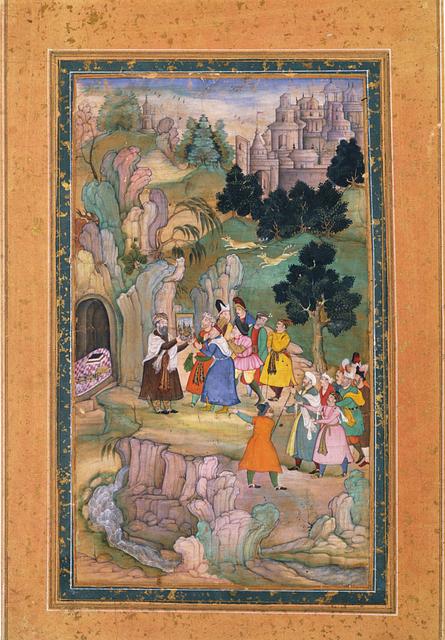
Miniature pasted on an album leaf. ‘Showing a Painting in Front of a Grotto’
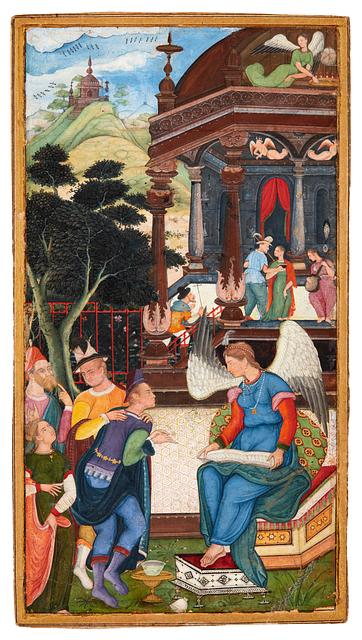
Miniature. ‘An Angel Conversing with a Group of Europeans’