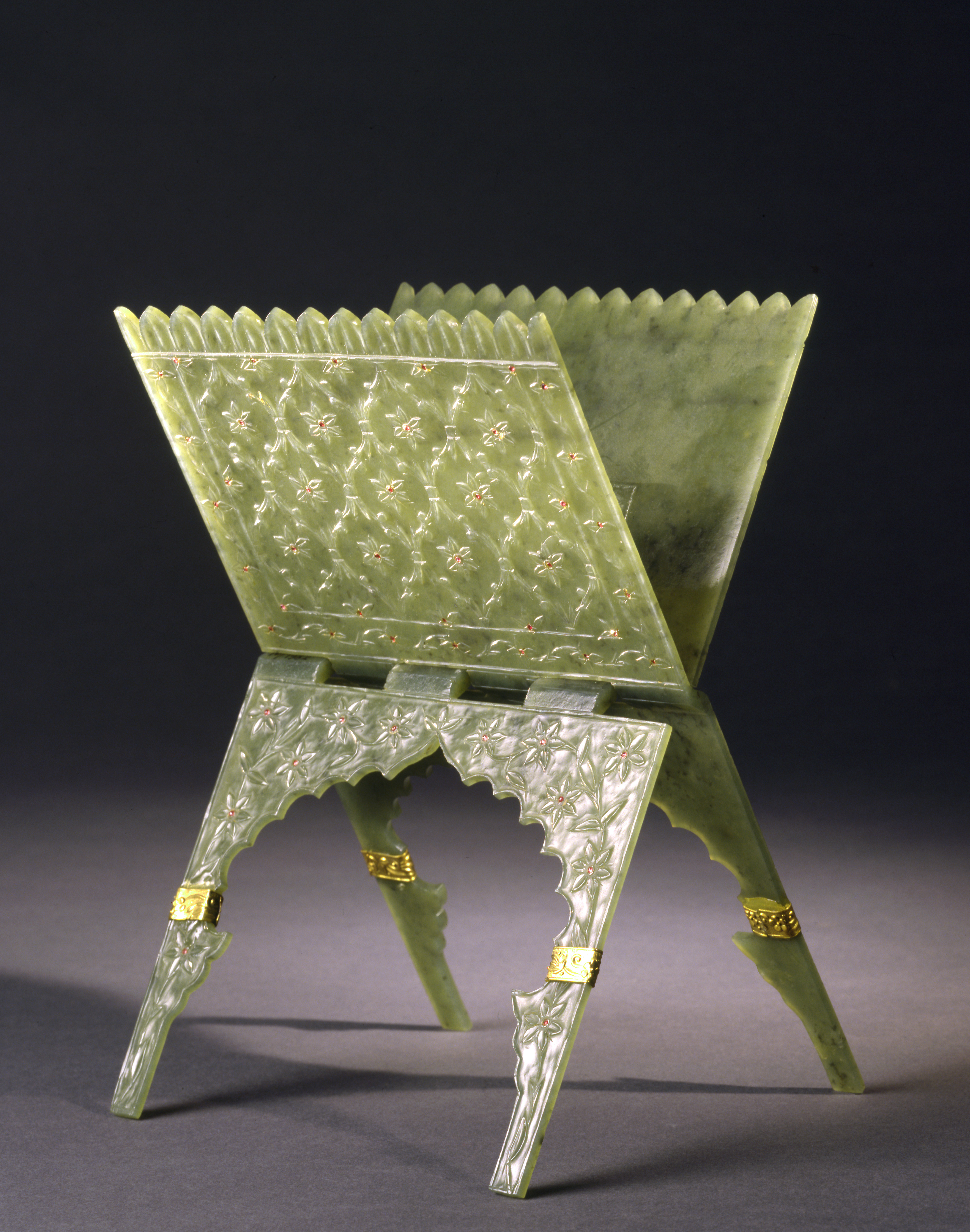
Koran stand, green jade, set with rubies
India; c. 1700
H: 23.5; W: 14 cm
Inventory number 10/1982
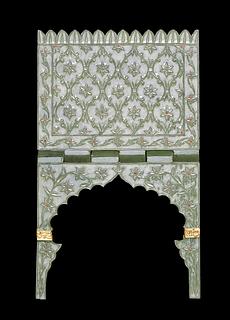
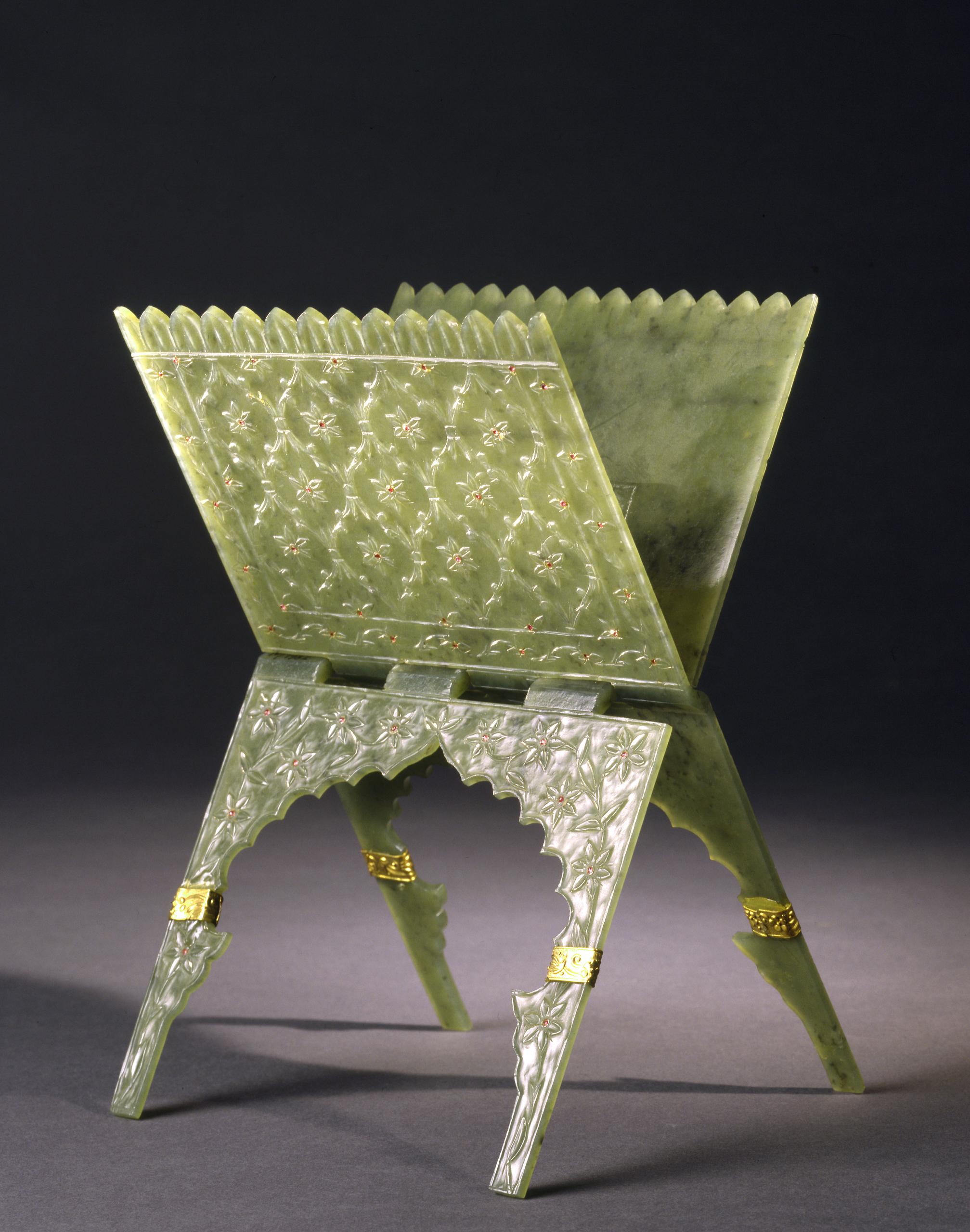
This little Koran stand was masterfully executed in precious materials. It was carved from a single piece of jade that was split into two sheets, but carved so that the two parts are linked in the axis along which the stand opens.
The outside of the stand is decorated with the vegetal ornamentation so typical of Mughal art, with flowers in a latticework at the top and delicate floral vines at the bottom that are set with rubies.
The legs form the kind of lobed arches that are familiar from the architecture of the Mughal period, but were also used in other decorative contexts. The four gold bands around the legs are of a later date. They hide the fact that two of the legs broke at some point.
The outside of the stand is decorated with the vegetal ornamentation so typical of Mughal art, with flowers in a latticework at the top and delicate floral vines at the bottom that are set with rubies.
The legs form the kind of lobed arches that are familiar from the architecture of the Mughal period, but were also used in other decorative contexts. The four gold bands around the legs are of a later date. They hide the fact that two of the legs broke at some point.
Published in
Published in
Kjeld von Folsach: Islamic art. The David Collection, Copenhagen 1990, cat.no. 267;
Kjeld von Folsach, Torben Lundbæk and Peder Mortensen (eds.): Sultan, Shah and Great Mughal: the history and culture of the Islamic world, The National Museum, Copenhagen 1996, cat.no. 116;
Jessica Hallett, Conceicao Amaral (eds.): Cultures of the Indian Ocean, Museu Nacional de Arte Antiga, Lissabon 1998, cat.no. 81, p. 214;
Kjeld von Folsach: Art from the World of Islam in The David Collection, Copenhagen 2001, cat.no. 380;
Yuka Kadoi: “Exchanges of shapes, exchanges of materials: arts of jade in Islamic Eurasia” in Orientations, 2013, 44:3, p. 51, fig. 7;
Zeina Elcheikh: Die Moschee: Architektur zwischen Geistlichem und Weltlichem, Neulingen 2020, ps. 82, Abb. 120;
Corinne Lefèvre, Jean-Baptiste Clais (eds.): Les arts moghols, Paris 2024, fig. 426, p. 409;
Kjeld von Folsach, Torben Lundbæk and Peder Mortensen (eds.): Sultan, Shah and Great Mughal: the history and culture of the Islamic world, The National Museum, Copenhagen 1996, cat.no. 116;
Jessica Hallett, Conceicao Amaral (eds.): Cultures of the Indian Ocean, Museu Nacional de Arte Antiga, Lissabon 1998, cat.no. 81, p. 214;
Kjeld von Folsach: Art from the World of Islam in The David Collection, Copenhagen 2001, cat.no. 380;
Yuka Kadoi: “Exchanges of shapes, exchanges of materials: arts of jade in Islamic Eurasia” in Orientations, 2013, 44:3, p. 51, fig. 7;
Zeina Elcheikh: Die Moschee: Architektur zwischen Geistlichem und Weltlichem, Neulingen 2020, ps. 82, Abb. 120;
Corinne Lefèvre, Jean-Baptiste Clais (eds.): Les arts moghols, Paris 2024, fig. 426, p. 409;
.-The-David-Collection_Copenhagen_Photo-Pernille-Klemp.jpg)