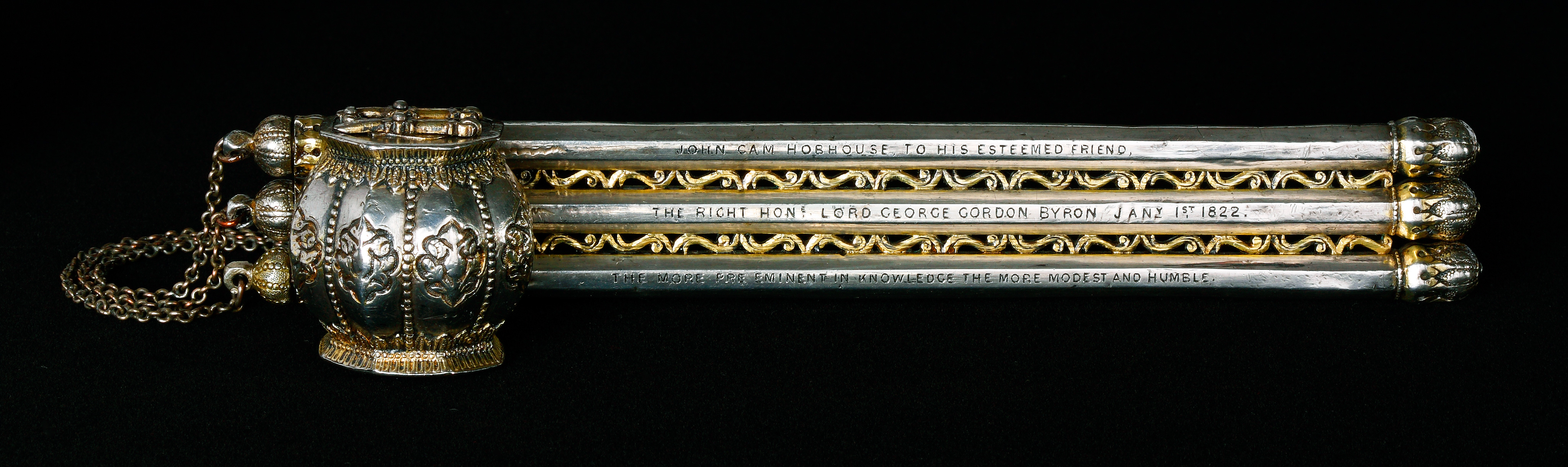
Scribe’s set, parcel-gilt silver, cast and engraved
Turkey; c. 1700
H: 4; L: 20.4 cm
Inventory number 10/1977
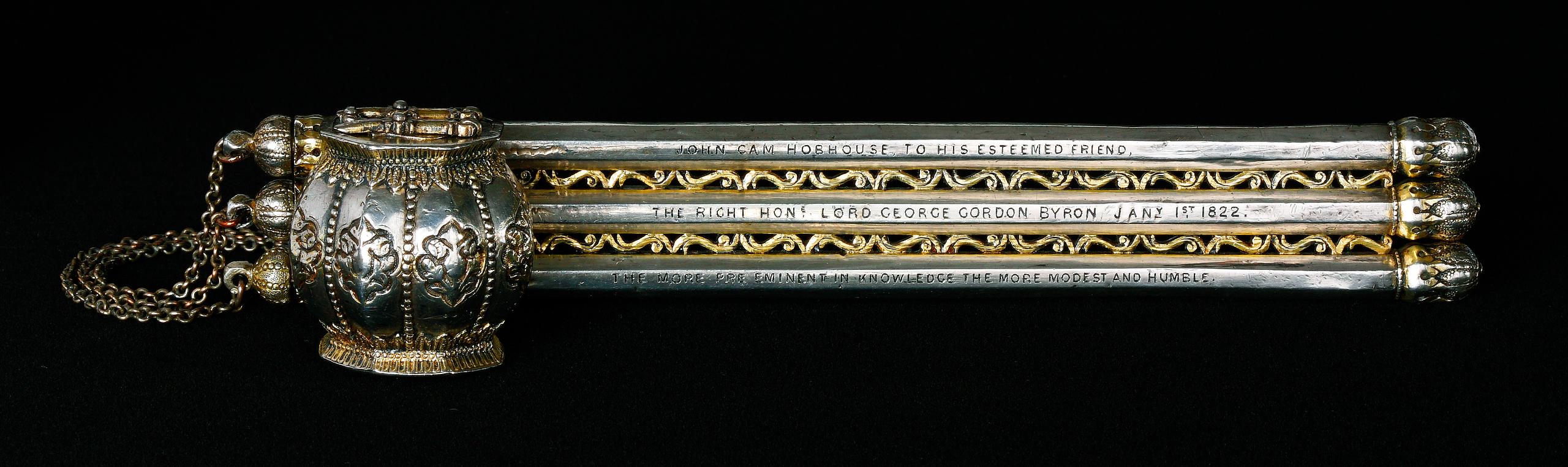
Scribe’s sets of this type are intended to be worn in the belt. They consist of an inkwell and a compartment for pens, which in this especially richly worked variant was given the form of three separate tubes.
The tughra stamp on the museum’s piece has been read as that of Mustafa II (1695-1703). Two almost identical sets bear the tughra of his successor, Ahmet III (1703-1730). A much simpler piece with three tubes of brass entered the Royal Danish Kunstkammer in 1690.
An inscription informs us that the English politician John Cam Hobhouse presented the scribe’s set in 1822 to his close friend Lord Byron (1788-1824), who took an active part in the Greek struggle for liberation from Ottoman rule.
The tughra stamp on the museum’s piece has been read as that of Mustafa II (1695-1703). Two almost identical sets bear the tughra of his successor, Ahmet III (1703-1730). A much simpler piece with three tubes of brass entered the Royal Danish Kunstkammer in 1690.
An inscription informs us that the English politician John Cam Hobhouse presented the scribe’s set in 1822 to his close friend Lord Byron (1788-1824), who took an active part in the Greek struggle for liberation from Ottoman rule.
Published in
Published in
Kjeld von Folsach: Islamic art. The David Collection, Copenhagen 1990, cat.no. 355;
Kjeld von Folsach: Art from the World of Islam in The David Collection, Copenhagen 2001, cat.no. 534;
Kjeld von Folsach: Art from the World of Islam in The David Collection, Copenhagen 2001, cat.no. 534;
.-The-David-Collection_Copenhagen_photo-Pernille-Klemp.jpg)
_-Photo-Pernille-Klemp.jpg)