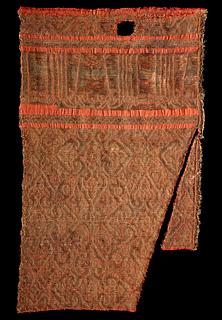
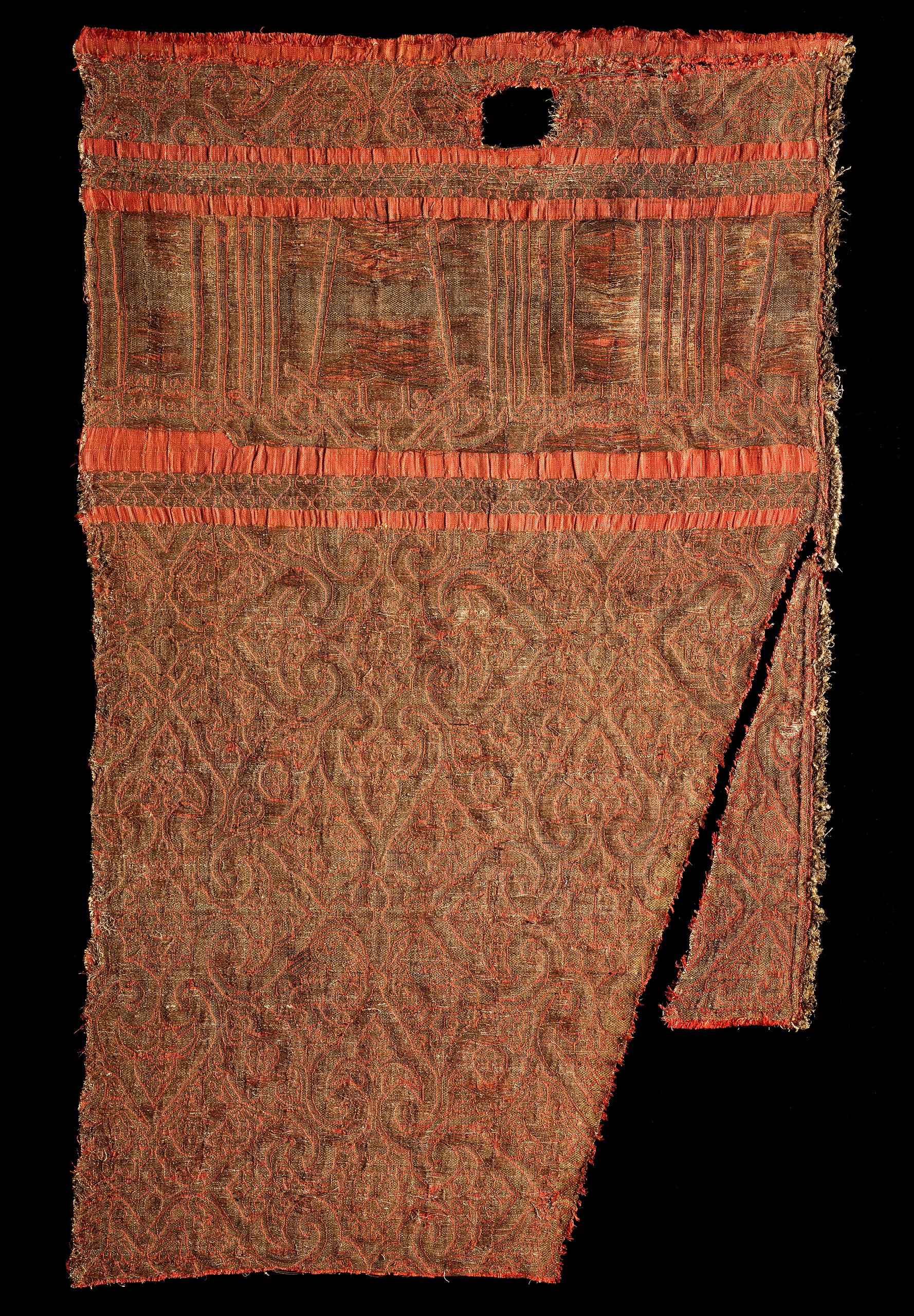
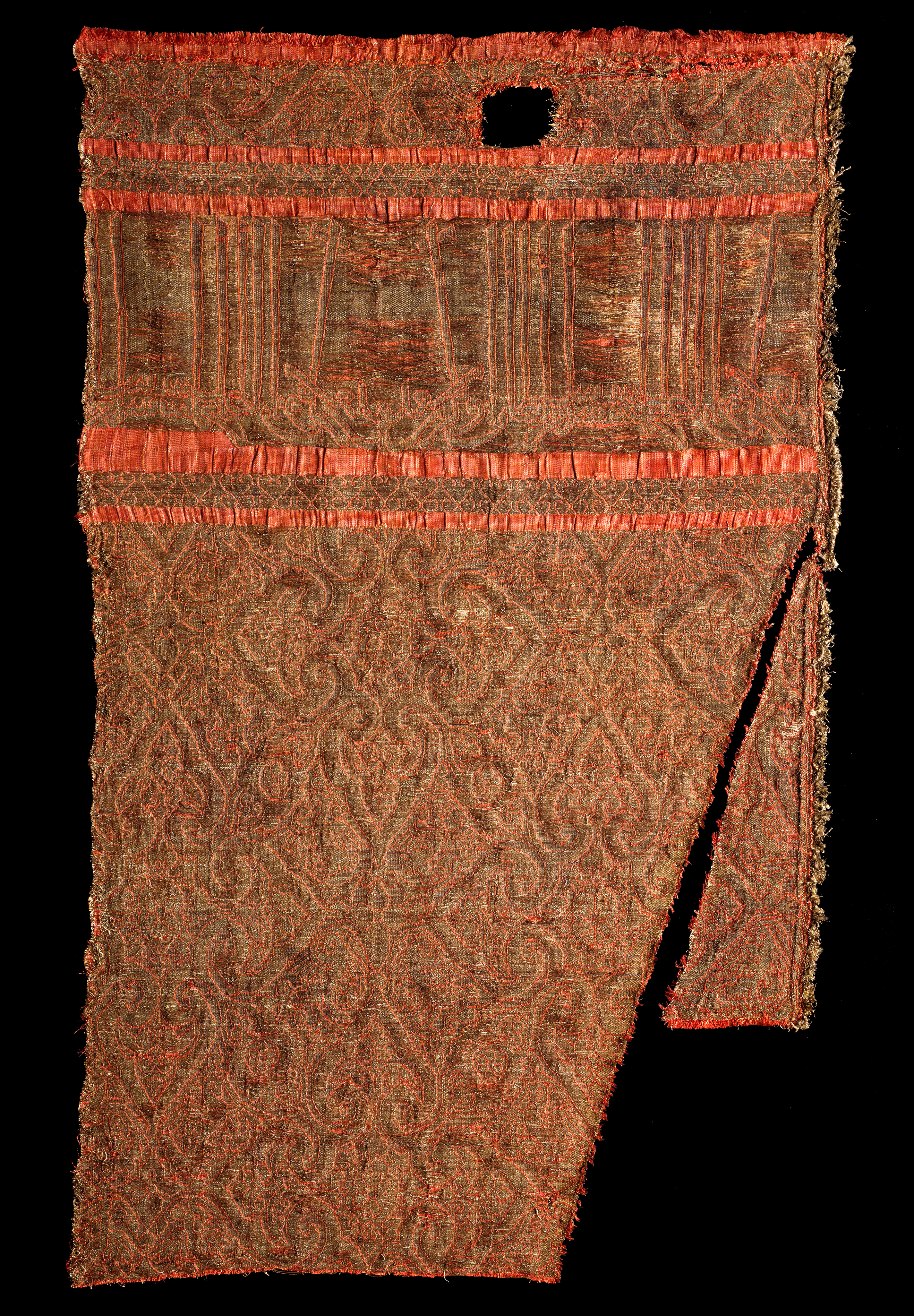
Fragment of a lampas-woven textile, silk and gilded lamella of animal substrate, both spun around a silk core and woven flat
Eastern Islamic area; mid-13th century
H: 66.5; W: 41 cm
Inventory number 20/1994
Pseudo-inscriptions are found on a number of textiles from the Mongol period (4/1993 and 14/1992). What is more unusual is to find an inscription that is legible: “Salghur Sultan Abu Bakr ibn Sad.” The Salghurid prince Abu Bakr ruled in Fars in western Iran from 1226 to 1260, first as a vassal of the Khwarazm Shahs and then of the Mongol khans – from 1256 under Hülegü.
The fragment undoubtedly belongs to the group of Mongol textiles and can hardly have been made in Fars. It has been suggested that it was made in the eastern part of the Islamic world on order from Hülegü, as a precious gift to his vassal.
The fragment undoubtedly belongs to the group of Mongol textiles and can hardly have been made in Fars. It has been suggested that it was made in the eastern part of the Islamic world on order from Hülegü, as a precious gift to his vassal.
Published in
Published in
James C. Y. Watt, Anne E. Wardwell: When silk was gold: Central Asian and Chinese textiles, Metropolitan Museum of Art, New York 1997, fig. 63, p. 135, analysed in note 37;
Kjeld von Folsach: Art from the World of Islam in The David Collection, Copenhagen 2001, cat. 639;
Kjeld von Folsach: “A set of silk panels from the Mongol period” in Sheila Blair and Jonathan Bloom (eds.): God is beautiful and loves beauty: the object in Islamic art and culture, New Haven 2013, p. 232, fig. 222c;
Louise W. Mackie: Symbols of power: luxury textiles from Islamic lands, 7th–21st century, Cleveland 2015, fig. 6.6;
Esra Akin-Kivanc: Muthanna / mirror writing in Islamic calligraphy : history, theory, and aesthetics, Bloomington 2020, pp. 146-147, fig. 5.15;
Corinne Mühlemann: Complex weaves: technique, text, and cultural history of striped silks, Affalterbach 2023, fig. 18, s. 54;
Joachim Meyer, Rasmus Bech Olsen and Peter Wandel: Beyond words: calligraphy from the World of Islam, The David Collection, Copenhagen 2024, cat. 88, pp. 244-245;
Kjeld von Folsach: Art from the World of Islam in The David Collection, Copenhagen 2001, cat. 639;
Kjeld von Folsach: “A set of silk panels from the Mongol period” in Sheila Blair and Jonathan Bloom (eds.): God is beautiful and loves beauty: the object in Islamic art and culture, New Haven 2013, p. 232, fig. 222c;
Louise W. Mackie: Symbols of power: luxury textiles from Islamic lands, 7th–21st century, Cleveland 2015, fig. 6.6;
Esra Akin-Kivanc: Muthanna / mirror writing in Islamic calligraphy : history, theory, and aesthetics, Bloomington 2020, pp. 146-147, fig. 5.15;
Corinne Mühlemann: Complex weaves: technique, text, and cultural history of striped silks, Affalterbach 2023, fig. 18, s. 54;
Joachim Meyer, Rasmus Bech Olsen and Peter Wandel: Beyond words: calligraphy from the World of Islam, The David Collection, Copenhagen 2024, cat. 88, pp. 244-245;
Textiles, Carpets and Leather
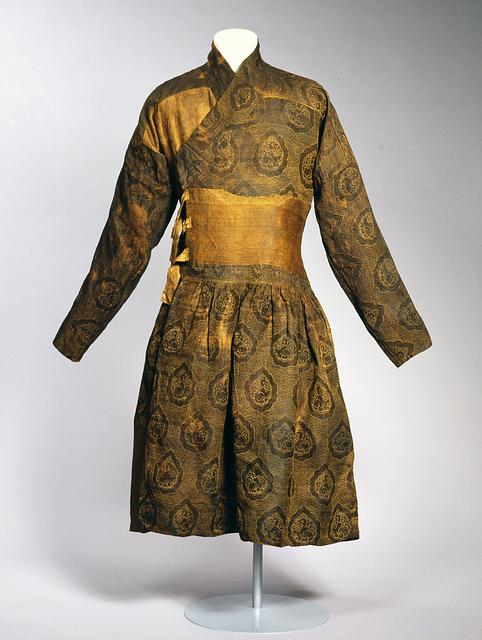
Caftan sewn from a lampas-woven textile, silk with gilded lamella of animal substrate
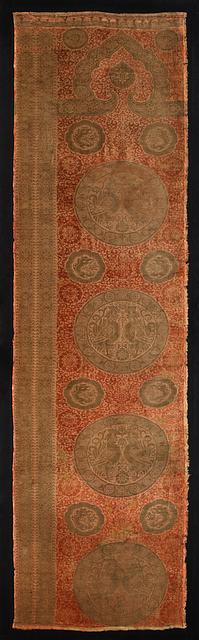
Left half of a lampas-woven textile, silk, gilded paper, and gilded animal substrate
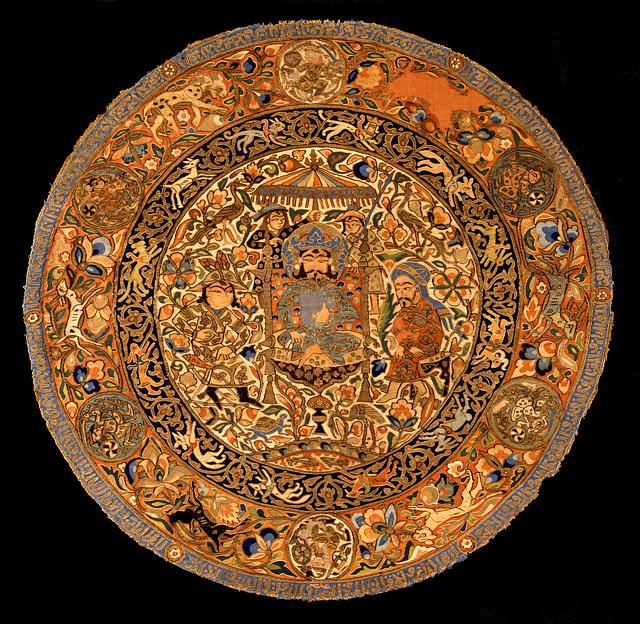
Medallion, tapestry, silk and gilded lamella of animal substrate spun around cotton
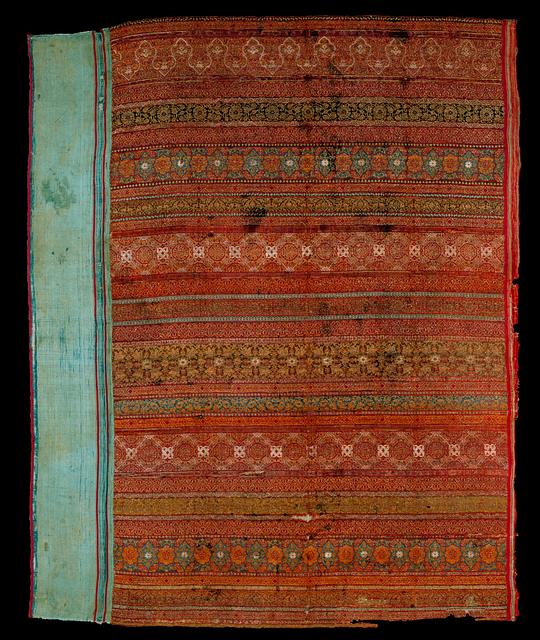
Fragment of a samitum-woven textile, silk and silver lamella spun around a silk core