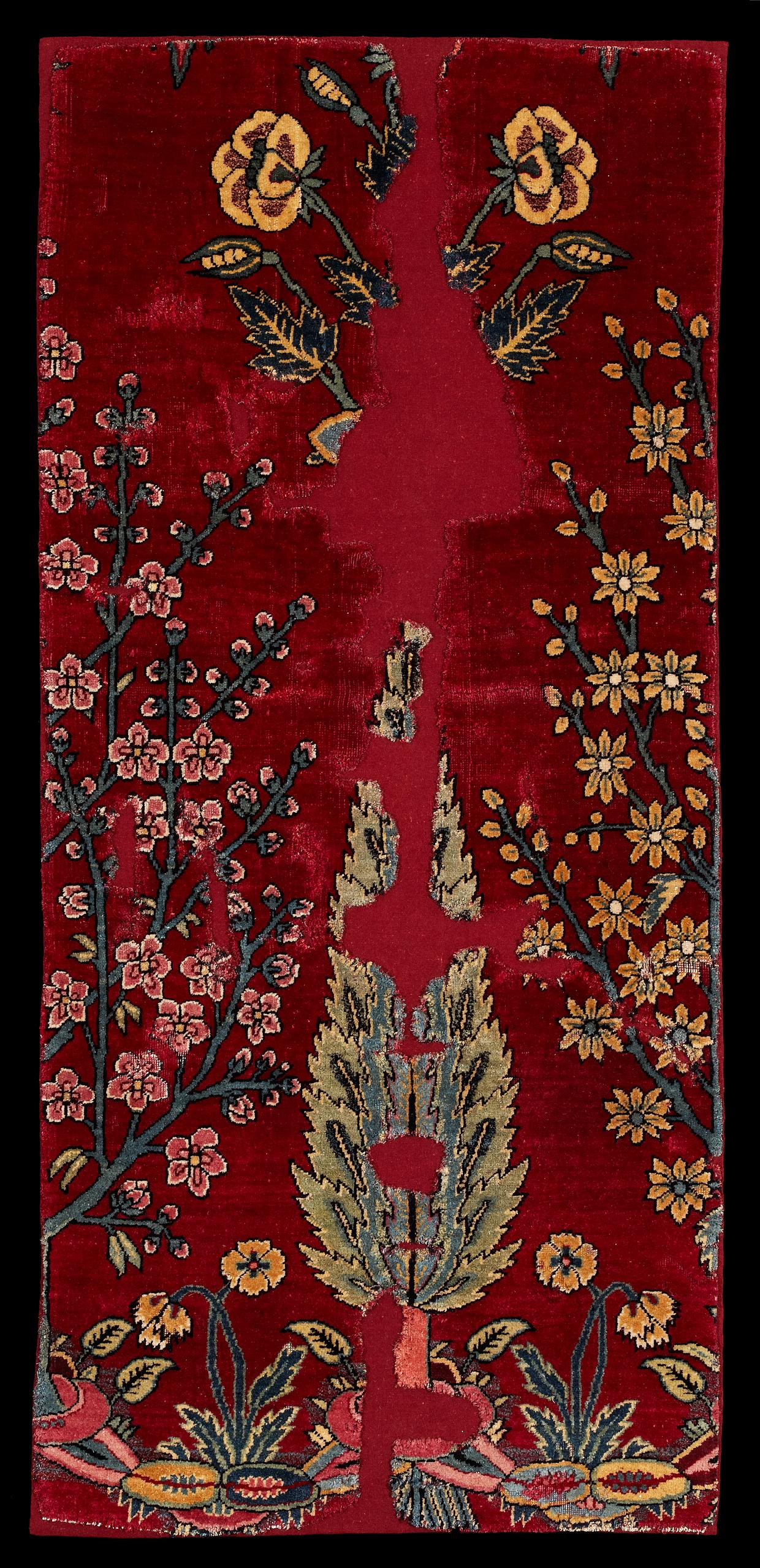
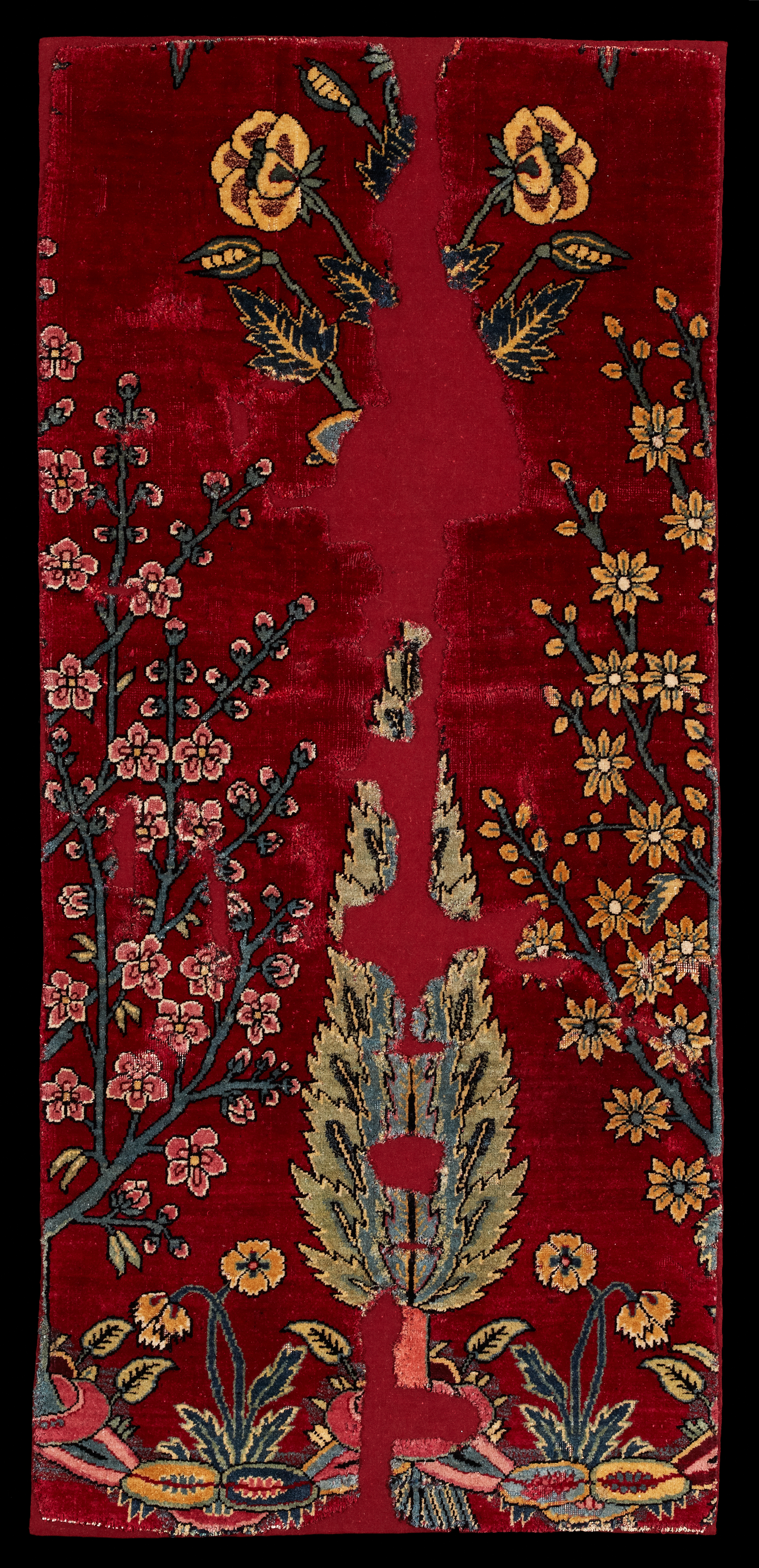
Fragment of a pile rug, silk and pashmina wool
Northern India; c. 1640-1660
H: 69; W: 32 cm
Inventory number 1/2008
This fragment with a cypress and flowering fruit trees comes from a famous rug from the Mughal period. It was in very poor condition at the end of the 19th century, and when it was restored, many fragments were combined into a visual whole that can be seen today in the Frick Collection in New York; others were left over.
The central motif on the original rug had 7-8 rows with four trees each, joined by chain-like rock formations wit flowers against a red ground. This fragment shows the rug’s great wealth of details and lyrical design. The tree is fairly rare as a motif, but can be viewed as an offshoot of the garden motif that forms the basis for many Islamic rugs.
The central motif on the original rug had 7-8 rows with four trees each, joined by chain-like rock formations wit flowers against a red ground. This fragment shows the rug’s great wealth of details and lyrical design. The tree is fairly rare as a motif, but can be viewed as an offshoot of the garden motif that forms the basis for many Islamic rugs.
Published in
Published in
Zeileis, Friedrich Georg: Sakrales und Säkulares von Gandhara bis Lhasa und entlang der Seidenstrasse: Katalog einer Privatsammlung von Kunst und Kunsthandwerk aus Indien, Ceylon, Nepal, Sikkim und Tibet nebst einem Anhang mit ebensolchem entlang der Seidenstrasse nach Westen, Gallspach 2004, pp. 90-95;
Kjeld von Folsach: Flora islamica: plantemotiver i islamisk kunst, Davids Samling, København 2013, cat.no. 43;
Kjeld von Folsach: Flora islamica: plantemotiver i islamisk kunst, Davids Samling, København 2013, cat.no. 43;