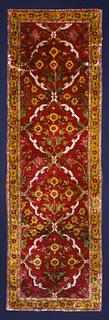
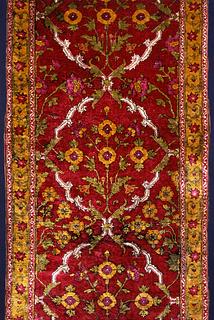
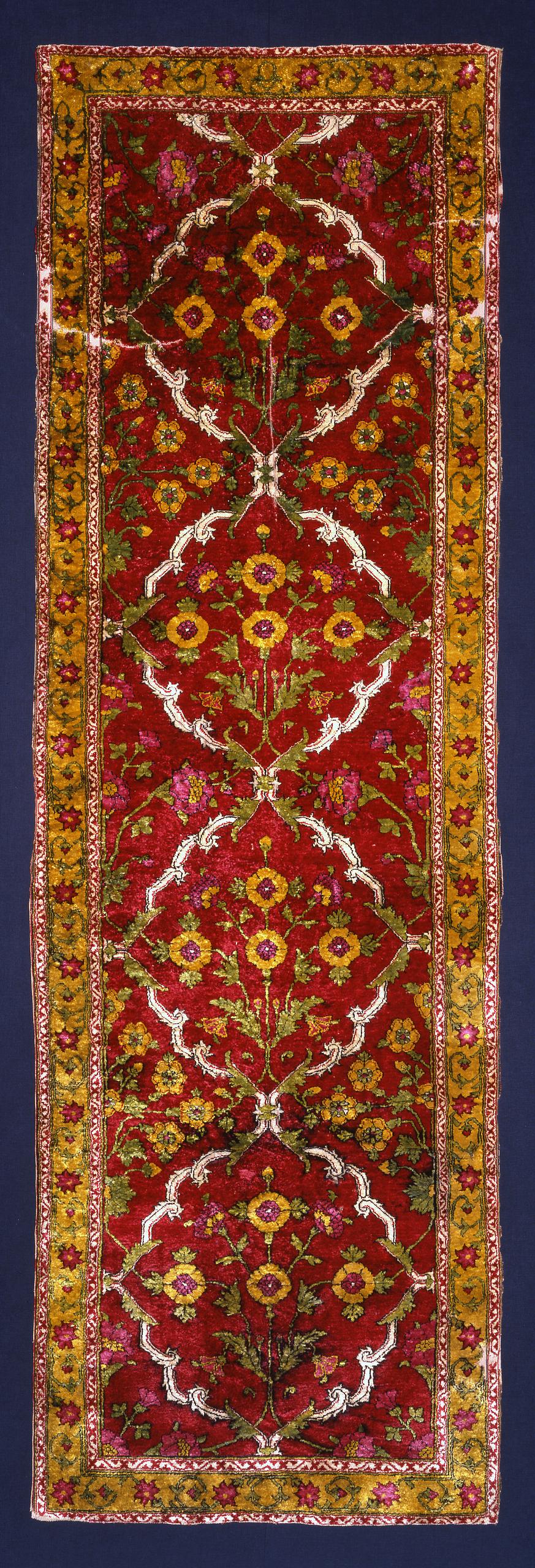
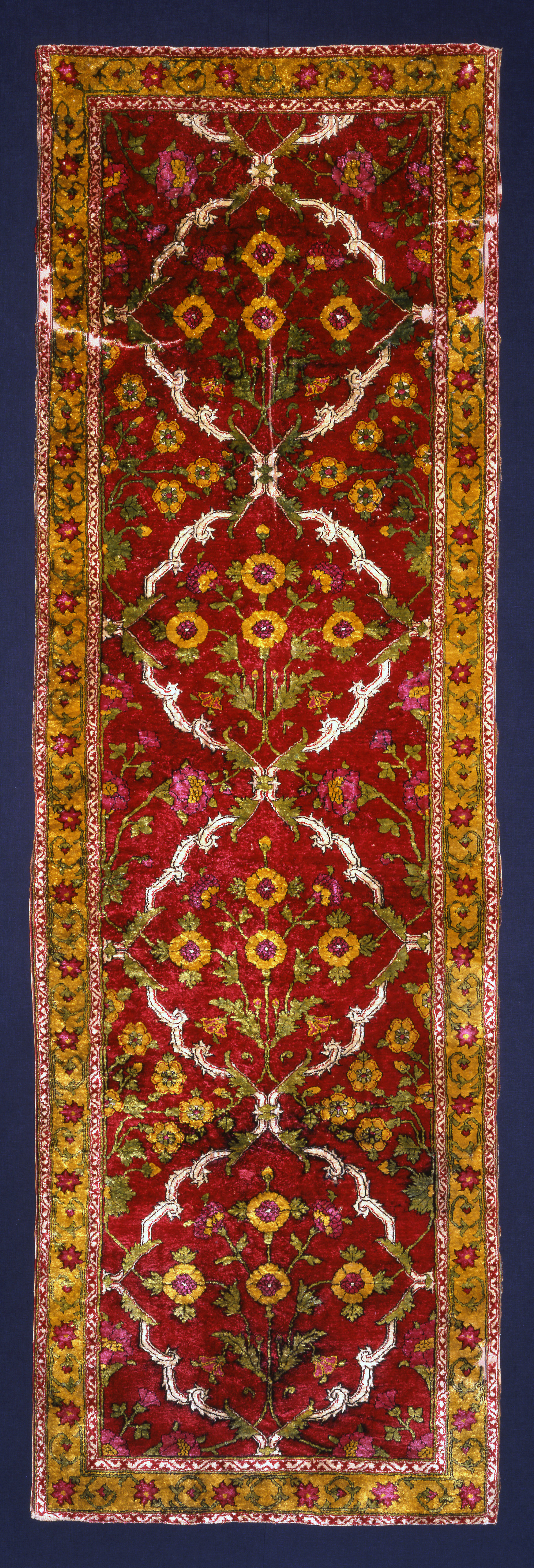
“Flower and lattice” carpet with silk pile and cotton foundation
India; 2nd half of 17th century
H: 251; W: 78 cm
Inventory number 5/2010
This silk carpet, which is unusually well preserved for its age, belongs to a small group that was previously ascribed to the Deccan. Today it is assumed that it was in fact woven in northern India, during the reign of the Great Mughal Aurangzeb (1658-1707).
While fine pashmina wool had previously been the preferred material for the Mughals’ carpets, this carpet’s shiny silk, glowing, jewel-like colors, and pattern with floral bouquets in a lattice mimic other Mughal works of art from this period: from silk velvets to jade objects inlaid with jewels and pieces of enameled gold.
The carpet was published by F. R. Martin in 1908 and was later found in both the Figdor and the Cassirer collection.
While fine pashmina wool had previously been the preferred material for the Mughals’ carpets, this carpet’s shiny silk, glowing, jewel-like colors, and pattern with floral bouquets in a lattice mimic other Mughal works of art from this period: from silk velvets to jade objects inlaid with jewels and pieces of enameled gold.
The carpet was published by F. R. Martin in 1908 and was later found in both the Figdor and the Cassirer collection.
Published in
Published in
Martin, F.R.: A history of oriental carpets before 1800, Vienna 1908, pl. xxvii;
Cassirer/Helbing, Sammlung Albert Figdor, Berlin 1930, vol. 1, lot 198, pl. xlvi;
Cassirer/Helbing, Sammlung Albert Figdor, Berlin 1930, vol. 1, lot 198, pl. xlvi;