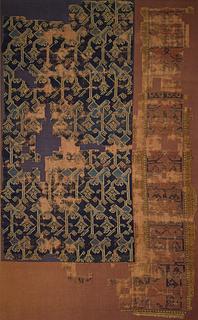
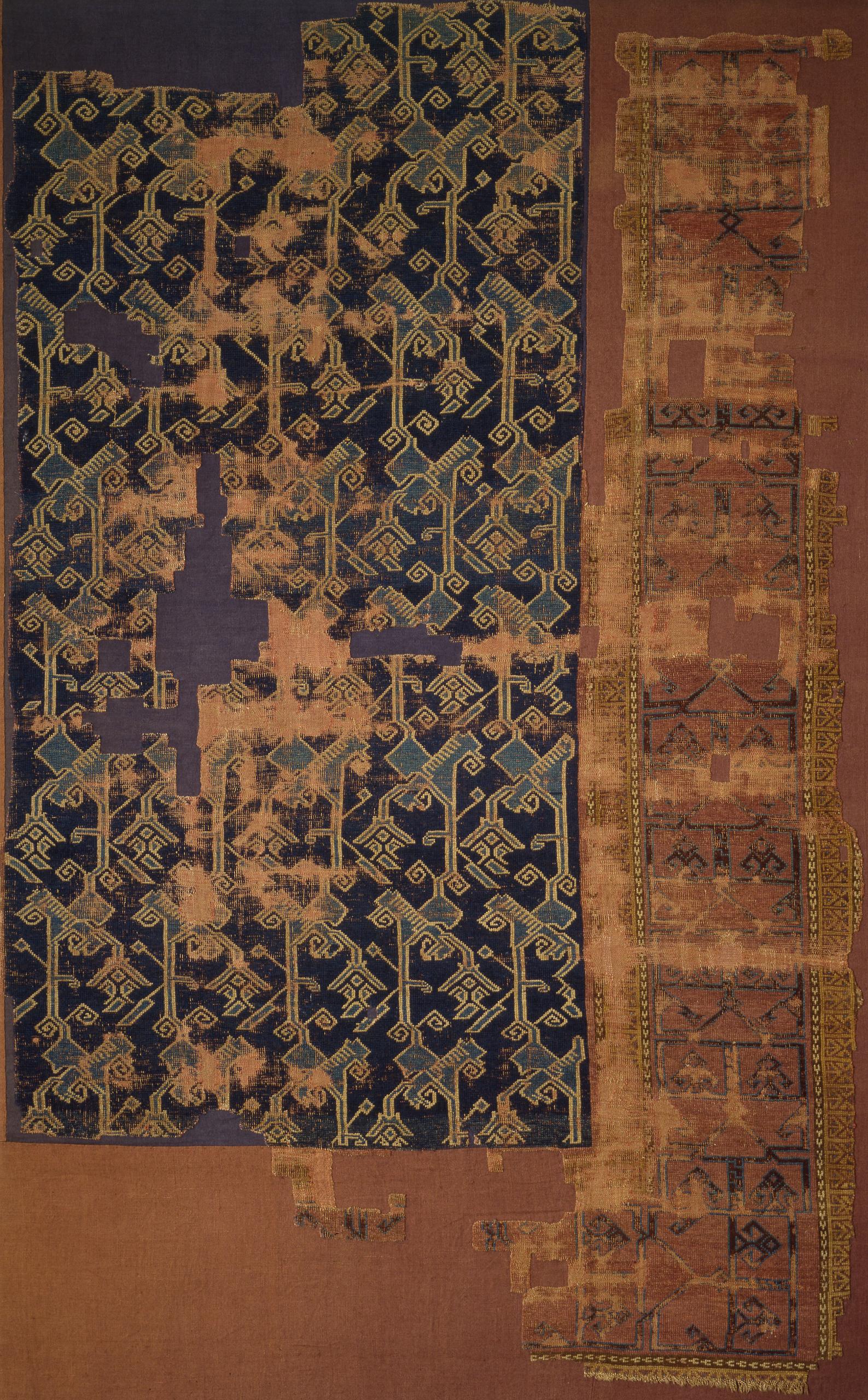
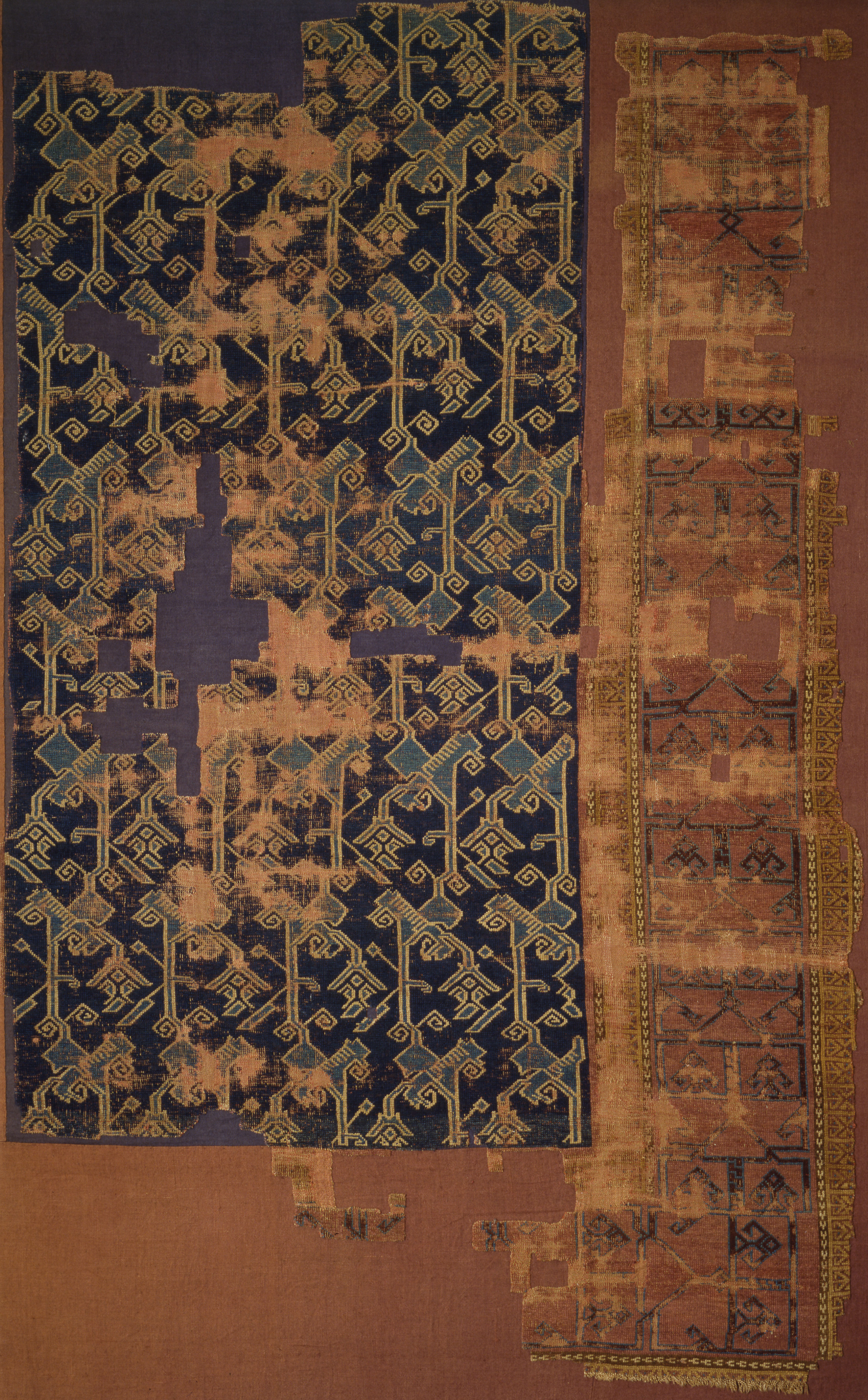
Fragment of a pile “Seljuk carpet,” wool
Anatolia; c. 1400
H: 302; W: 187 cm
Inventory number 3/1991
This fragment has traditionally been linked with a number of carpets found in Konya and dated to the 13th century. Nearly all of them have a Kufi-like border and simple, geometric main field. The fragment, which was found in Beysehir in 1929, has a related border, but its main field has stylized, flowering palmettes. Experts have consequently believed that this is the youngest in the group, something that has since been confirmed by carbon-14 dating.
The other half of the carpet was acquired by an English collection in 1971. The two fragments together measured c. 500 × 260 cm.
Anatolian carpets were praised in exalted terms by travelers such as Marco Polo and Ibn Battuta in the late 13th and 14th century.
The other half of the carpet was acquired by an English collection in 1971. The two fragments together measured c. 500 × 260 cm.
Anatolian carpets were praised in exalted terms by travelers such as Marco Polo and Ibn Battuta in the late 13th and 14th century.
Published in
Published in
Rudolf M. Riefstahl: “Primitive rugs of the "Konya" type in the mosque of Beyshehir” in Art Bulletin, 13:2, 1931, figs. 1, 2, 13 and 15;
Agnes Geijer: “Some thoughts on the problems of early Oriental carpets” in Ars Orientalis, 5, 1963, pp. 82-84, fig. 3 - about the whole piece, not specifically ours;
Friedrich Spuhler: Islamic carpets and textiles in the Keir Collection, London 1978, pp. 28 and 31-32 - about the whole piece, not specifically ours;
Serare Yetkin: Historical Turkish carpets, Istanbul 1981, p. 23;
Oktay Aslanapa: One thousand years of Turkish carpets, Istanbul 1988, pp. 26-28;
B. W. Robinson (ed.): Islamic art in the Keir Collection, B. W. Robinson [et al.], London 1988, p. 51, note 2;
Kjeld von Folsach, Torben Lundbæk and Peder Mortensen (eds.): Sultan, Shah and Great Mughal: the history and culture of the Islamic world, The National Museum, Copenhagen 1996, cat.no. 364;
Kjeld von Folsach: Art from the World of Islam in The David Collection, Copenhagen 2001, cat.no. 685;
Michael Franses: “An early Anatolian animal carpet and related examples” in Sheila Blair and Jonathan Bloom (eds.): God is beautiful and loves beauty: the object in Islamic art and culture, New Haven 2013, p. 252, fig. 235;
Michael Franses: Anatolian Tribal Rugs 1050-1750. The Orient Stars Collection [2], London 2021, pp. 51-53, fig. 32;
Jonathan M. Bloom: “From memory to drawing: The evolution of Islamic design”, in Sheila S. Blair, Jonathan M. Bloom, Sandra S. Williams (eds.): Iranian art from the Sasanians to the Islamic Republic: essays in honour of Linda Komaroff, Edinburgh 2024, pp. 29-49;
Agnes Geijer: “Some thoughts on the problems of early Oriental carpets” in Ars Orientalis, 5, 1963, pp. 82-84, fig. 3 - about the whole piece, not specifically ours;
Friedrich Spuhler: Islamic carpets and textiles in the Keir Collection, London 1978, pp. 28 and 31-32 - about the whole piece, not specifically ours;
Serare Yetkin: Historical Turkish carpets, Istanbul 1981, p. 23;
Oktay Aslanapa: One thousand years of Turkish carpets, Istanbul 1988, pp. 26-28;
B. W. Robinson (ed.): Islamic art in the Keir Collection, B. W. Robinson [et al.], London 1988, p. 51, note 2;
Kjeld von Folsach, Torben Lundbæk and Peder Mortensen (eds.): Sultan, Shah and Great Mughal: the history and culture of the Islamic world, The National Museum, Copenhagen 1996, cat.no. 364;
Kjeld von Folsach: Art from the World of Islam in The David Collection, Copenhagen 2001, cat.no. 685;
Michael Franses: “An early Anatolian animal carpet and related examples” in Sheila Blair and Jonathan Bloom (eds.): God is beautiful and loves beauty: the object in Islamic art and culture, New Haven 2013, p. 252, fig. 235;
Michael Franses: Anatolian Tribal Rugs 1050-1750. The Orient Stars Collection [2], London 2021, pp. 51-53, fig. 32;
Jonathan M. Bloom: “From memory to drawing: The evolution of Islamic design”, in Sheila S. Blair, Jonathan M. Bloom, Sandra S. Williams (eds.): Iranian art from the Sasanians to the Islamic Republic: essays in honour of Linda Komaroff, Edinburgh 2024, pp. 29-49;