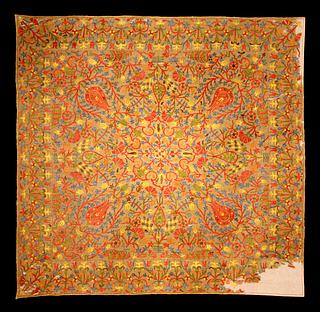
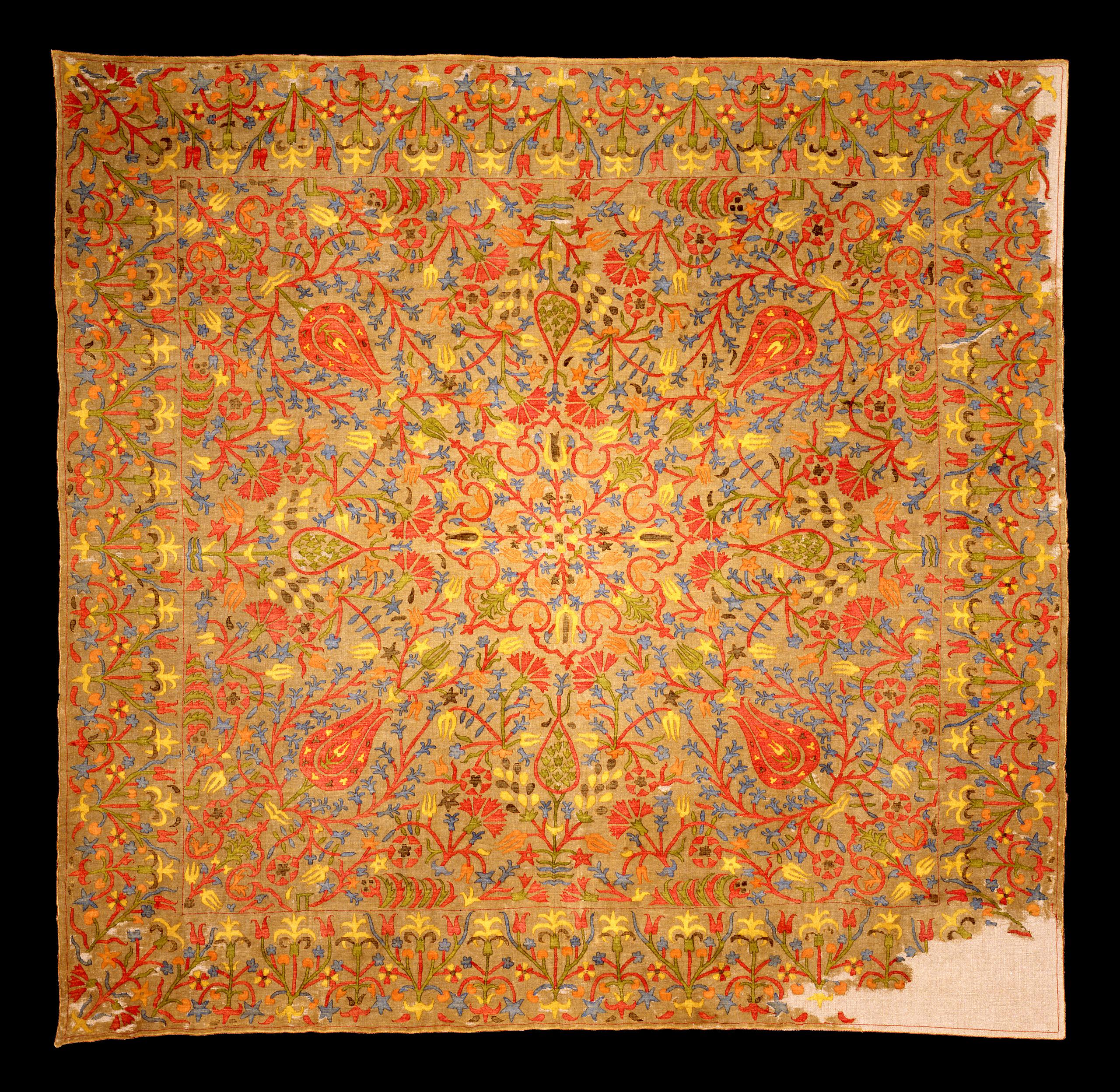
Turban cover, silk embroidery on linen
Turkey; 2nd half of 16th century
H: 119; W: 124 cm
Inventory number 17/1994
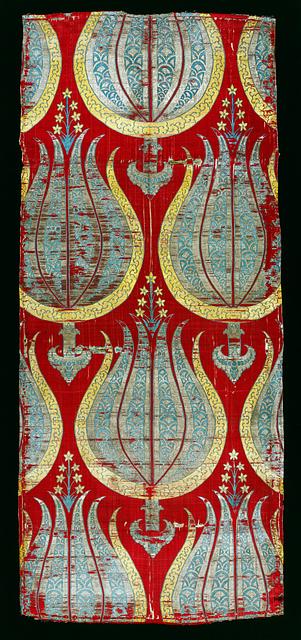
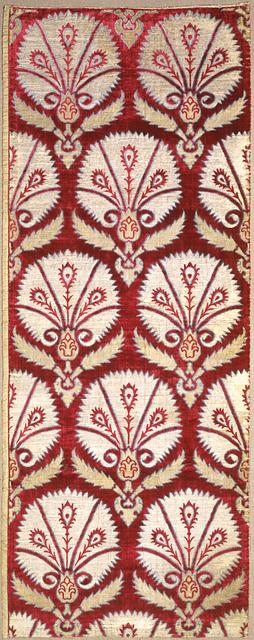
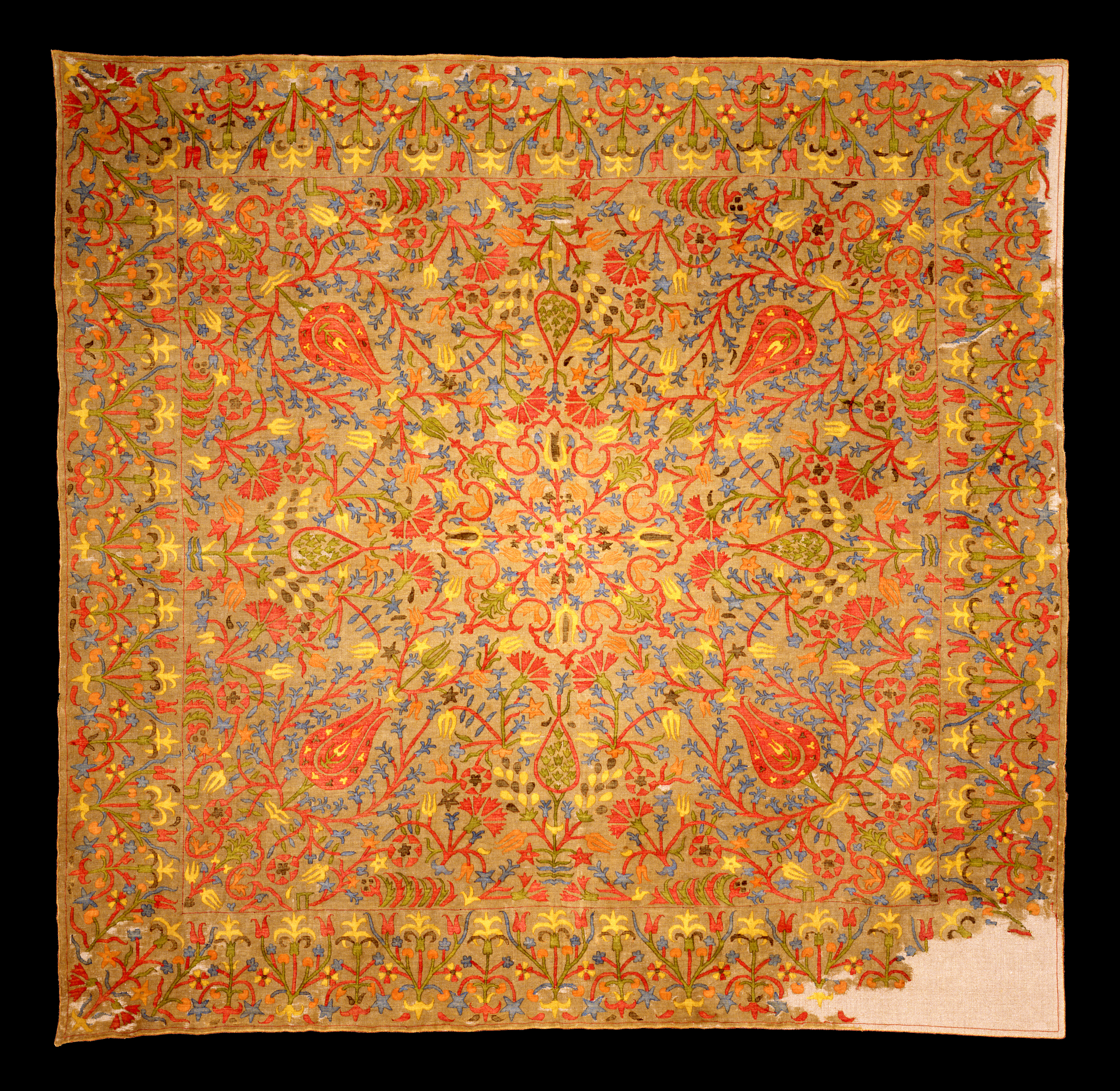
This incredibly fine embroidery was built up symmetrically over two axes. The motif is local Turkish flora, with tulips, carnations, hyacinths, and cypresses – a realm of motifs that also became modern for woven textiles and ceramics in the mid-16th century. Earlier, Chinese flora had dominated.
The quality of the embroidery is so high that it was presumably made in one of the court workshops in Istanbul. Traces of a drawn pattern can still be seen under the embroidery.
The square shape and rich decoration make it likely that this was a cover for a well-to-do Turk’s ceremonial turban – kavuk – which was so complicated that once it had been wound, it was sewn together.
The quality of the embroidery is so high that it was presumably made in one of the court workshops in Istanbul. Traces of a drawn pattern can still be seen under the embroidery.
The square shape and rich decoration make it likely that this was a cover for a well-to-do Turk’s ceremonial turban – kavuk – which was so complicated that once it had been wound, it was sewn together.
Published in
Published in
Kjeld von Folsach, Torben Lundbæk and Peder Mortensen (eds.): Sultan, Shah and Great Mughal: the history and culture of the Islamic world, The National Museum, Copenhagen 1996, cat.no. 398;
Kjeld von Folsach: Art from the World of Islam in The David Collection, Copenhagen 2001, cat.no. 660;
Sheila S. Blair and Jonathan M. Bloom (eds.): Cosmophilia. Islamic Art from the David Collection, Copenhagen, McMullen Museum of Art, Boston College, Boston 2006, cat.no. 80;
Kjeld von Folsach: Art from the World of Islam in The David Collection, Copenhagen 2001, cat.no. 660;
Sheila S. Blair and Jonathan M. Bloom (eds.): Cosmophilia. Islamic Art from the David Collection, Copenhagen, McMullen Museum of Art, Boston College, Boston 2006, cat.no. 80;