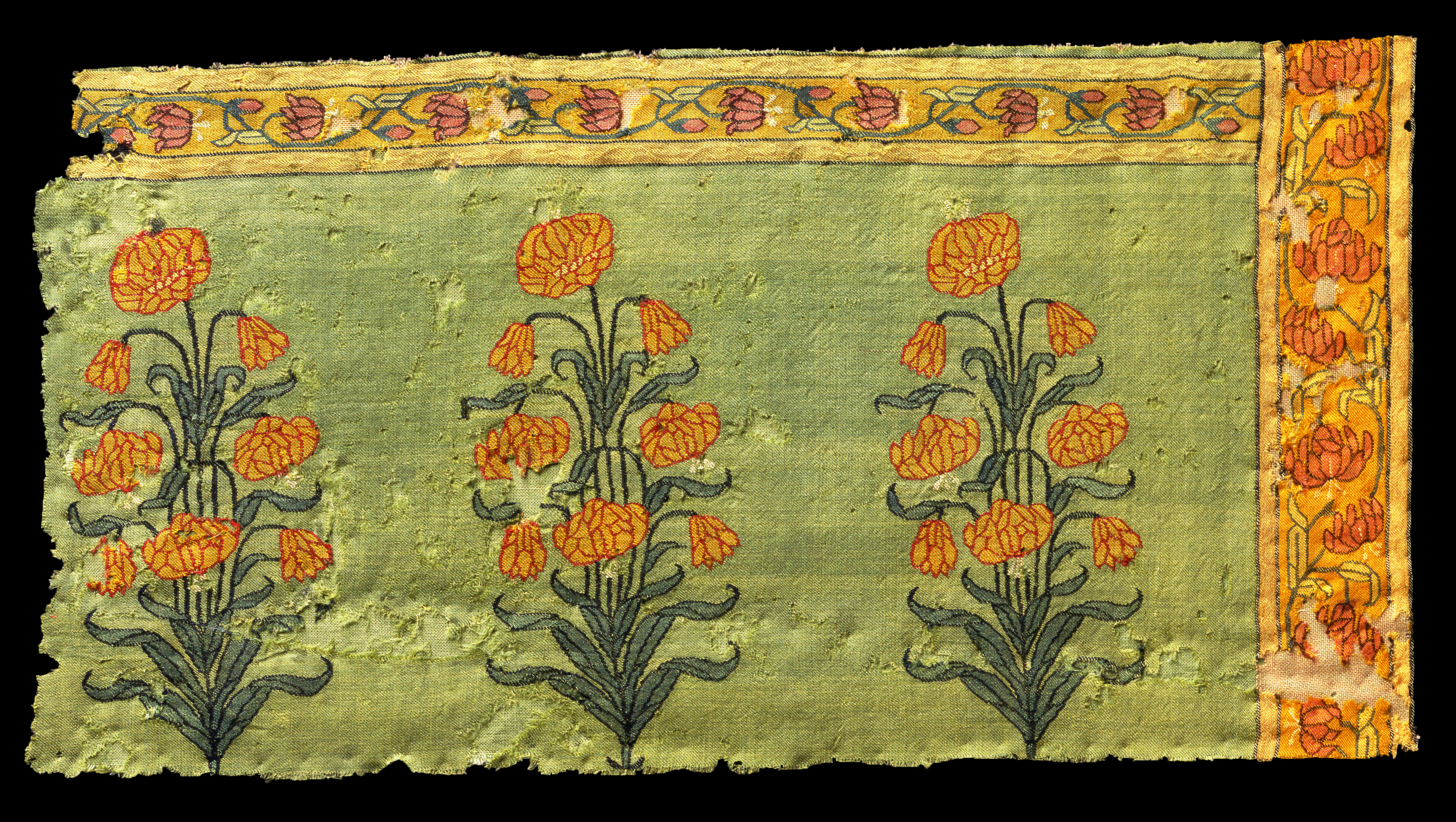
Fragment of a shawl, wool and silk
India, Kashmir; 2nd half of 17th century
H: 19.5; W: 37 cm
Inventory number 35/1992
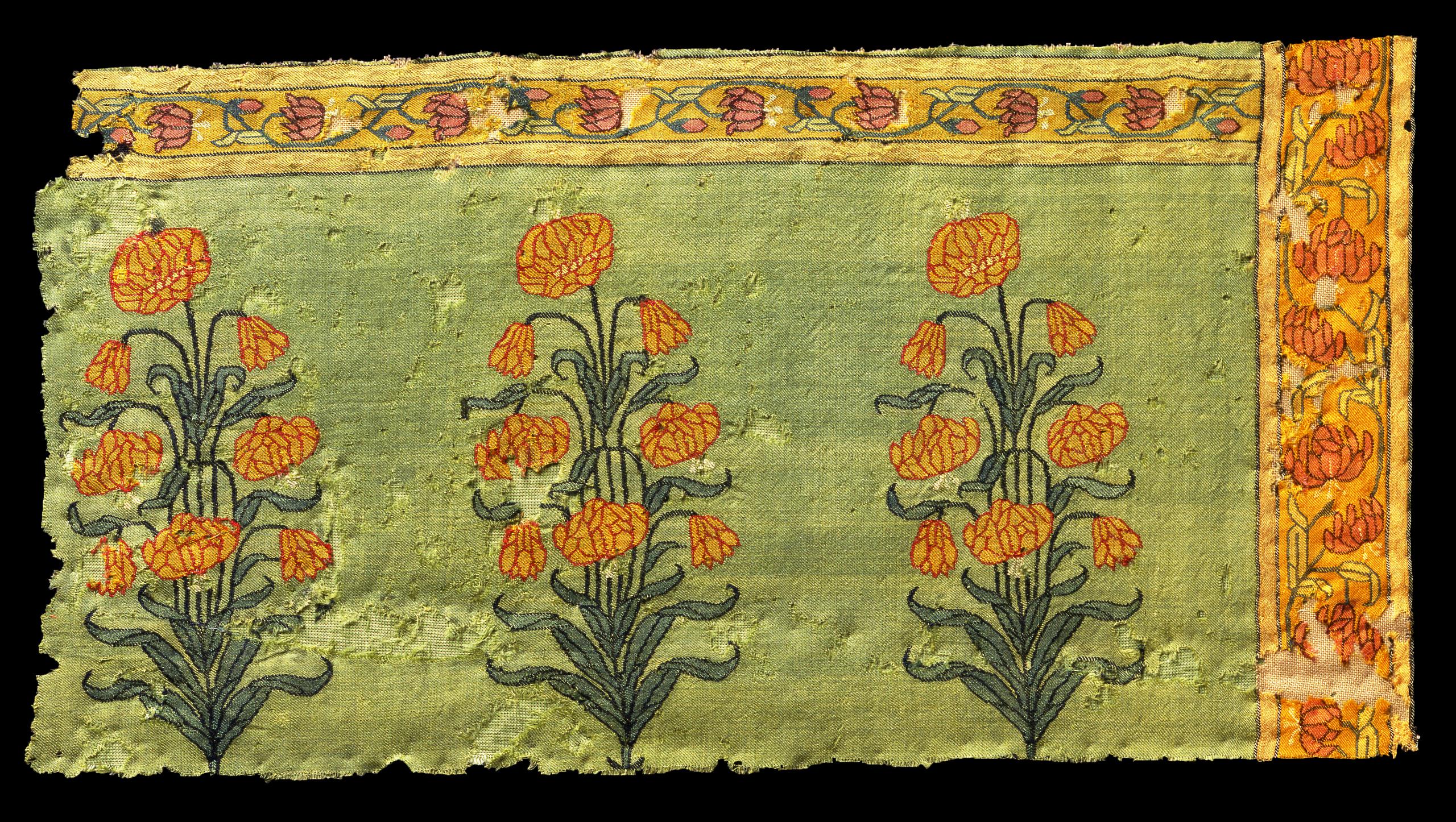
“Kashmir shawls” were probably made in northern India from the 15th century, and Akbar valued them highly and encouraged their manufacture. The earliest preserved shawls only date to the second half of the 17th century, however.
This fragment is from the end of a long, narrow shawl whose large center section was solid green. Each flowering bush grows in the earth and is rendered quite naturalistically, with leaves, stems, and uniform flowers in various degrees of bloom.
Later, toward 1700, the motif was stylized, and flowers were frequently placed in vases. In the 18th century, the bouquets were stylized further into an asymmetrical, drop-shaped ornament – the buta.
This fragment is from the end of a long, narrow shawl whose large center section was solid green. Each flowering bush grows in the earth and is rendered quite naturalistically, with leaves, stems, and uniform flowers in various degrees of bloom.
Later, toward 1700, the motif was stylized, and flowers were frequently placed in vases. In the 18th century, the bouquets were stylized further into an asymmetrical, drop-shaped ornament – the buta.
Published in
Published in
Kjeld von Folsach and Anne-Marie Keblow Bernsted: Woven Treasures: Textiles from the World of Islam, David Collection, Copenhagen 1993, cat.no. 51;
Kjeld von Folsach, Torben Lundbæk and Peder Mortensen (eds.): Sultan, Shah and Great Mughal: the history and culture of the Islamic world, The National Museum, Copenhagen 1996, cat.no. 335;
Kjeld von Folsach: Art from the World of Islam in The David Collection, Copenhagen 2001, cat.no. 683;
Sheila S. Blair and Jonathan M. Bloom (eds.): Cosmophilia. Islamic Art from the David Collection, Copenhagen, McMullen Museum of Art, Boston College, Boston 2006, cat.no. 101;
Kjeld von Folsach: Flora islamica: plantemotiver i islamisk kunst, Davids Samling, København 2013, cat.no. 64;
Amanda Phillips: Seachange: Ottoman textiles between the Mediterranean and the Indian Ocean, Oakland 2021, p. 204 og p. 205, fig. 6.4;
Kjeld von Folsach, Torben Lundbæk and Peder Mortensen (eds.): Sultan, Shah and Great Mughal: the history and culture of the Islamic world, The National Museum, Copenhagen 1996, cat.no. 335;
Kjeld von Folsach: Art from the World of Islam in The David Collection, Copenhagen 2001, cat.no. 683;
Sheila S. Blair and Jonathan M. Bloom (eds.): Cosmophilia. Islamic Art from the David Collection, Copenhagen, McMullen Museum of Art, Boston College, Boston 2006, cat.no. 101;
Kjeld von Folsach: Flora islamica: plantemotiver i islamisk kunst, Davids Samling, København 2013, cat.no. 64;
Amanda Phillips: Seachange: Ottoman textiles between the Mediterranean and the Indian Ocean, Oakland 2021, p. 204 og p. 205, fig. 6.4;