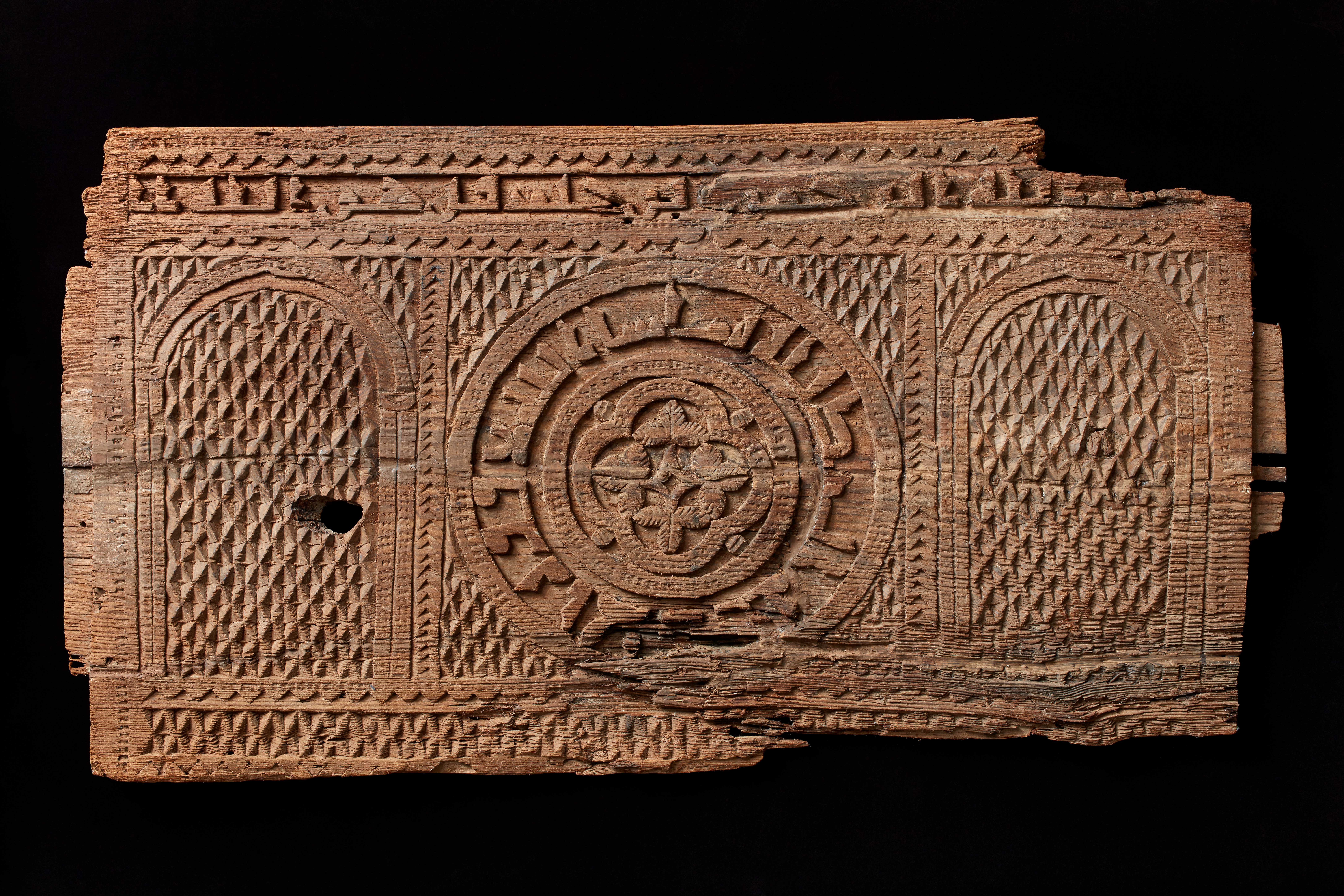
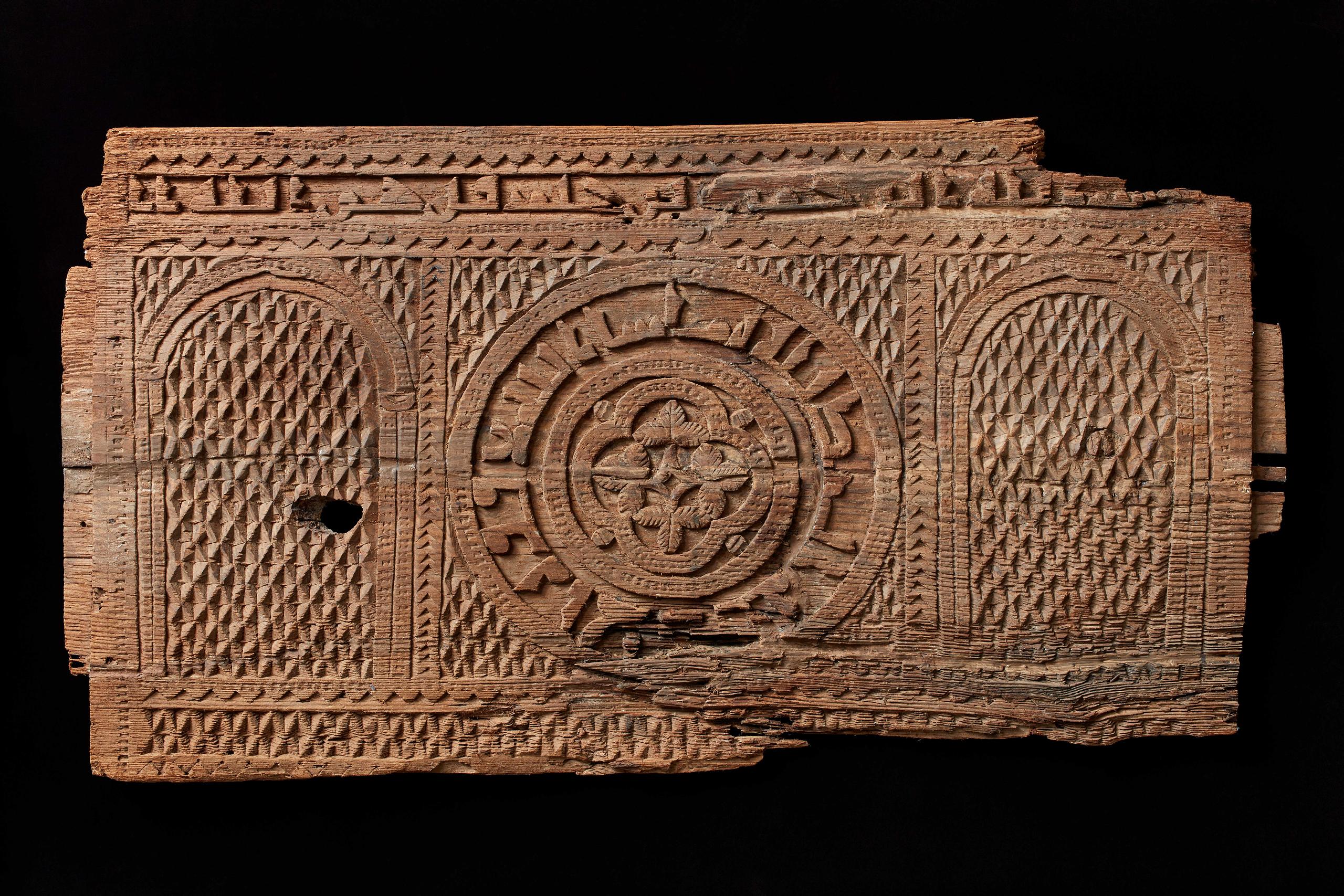
Carved wooden panel with Kufi inscriptions
Egypt; 9th century
H: 46.5; W: 87.5; D: 3 cm
Inventory number 6/2019
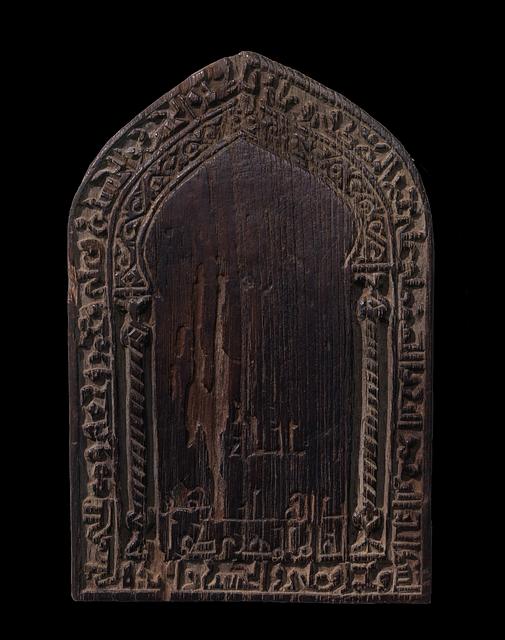
Along the right and left edges of the panel are partly preserved tongues which show that it has previously been joined to other panels. It may have comprised the front of a storage chest whose purpose we do not know today. The panel is decorated with carved reliefs featuring geometrical patterns, architecture-inspired arches, plant ornamentation, and Arabic inscriptions in Kufi.
The opening passage contains a quotation from the Koran’s sura 112: In the name of God, Most Gracious, Most Merciful. Say: He is God.1 The inscription around the central medallion contains three eulogies addressing God’s omnipotence: what God decides, there is no power save [in God], sovereignty belongs to God. The inscriptions were written in fairly simple Kufi that resembles the inscription on a contemporary panel from the Ibn Tulun mosque in Cairo (1/2002). One can, however, view the split ends of several letters in the upper inscription as an early heralding of later centuries’ artistic floral Kufi that can be seen, for example, fully developed on a clay bowl from 10th-century Iran (22/1974).
Although the inscriptions are clearly Islamic, the rest of the decoration harks back to the Christian art of late Antiquity. Trefoils like the ones that fill the panel’s central medallion are also found, for example, on Coptic decorative art from the pre-Islamic and early Islamic periods.
Other museums have several related panels of a corresponding size that are decorated with variations on the same patterns and inscriptions.2 They might all have been made in the same workshop.
The opening passage contains a quotation from the Koran’s sura 112: In the name of God, Most Gracious, Most Merciful. Say: He is God.1 The inscription around the central medallion contains three eulogies addressing God’s omnipotence: what God decides, there is no power save [in God], sovereignty belongs to God. The inscriptions were written in fairly simple Kufi that resembles the inscription on a contemporary panel from the Ibn Tulun mosque in Cairo (1/2002). One can, however, view the split ends of several letters in the upper inscription as an early heralding of later centuries’ artistic floral Kufi that can be seen, for example, fully developed on a clay bowl from 10th-century Iran (22/1974).
Although the inscriptions are clearly Islamic, the rest of the decoration harks back to the Christian art of late Antiquity. Trefoils like the ones that fill the panel’s central medallion are also found, for example, on Coptic decorative art from the pre-Islamic and early Islamic periods.
Other museums have several related panels of a corresponding size that are decorated with variations on the same patterns and inscriptions.2 They might all have been made in the same workshop.
Published in
Published in
Unpublished;
Footnotes
Footnotes
1.
The Holy Qur’an, translation and commentary by Abdullah Yusuf Ali, New York 2012, p. 1806.
2.
See e.g. Museum für Islamische Kunst, Berlin: I. 4471, I. 4472, I. 4503; Musée du Louvre, Paris: HI 1 (Elise Anglade: Musée du Louvre: Catalogue des boiseries de la section islamique, Paris 1988, pp. 24-26 + fig. 10); Museum of Islamic Art, Cairo: 6852, 6853, 6854 (Jean David-Weil: Les bois à épigraphes jusqu’a l’époque mamlouke, Cairo 1931, pp. 64-65 + plates I & II); Al-Sabah Collection, Kuwait City: LNS 4 W ab (Marilyn Jenkins (ed.): Islamic art in the Kuwait National Museum: the al-Sabah Collection, London 1983, p. 46).
The Tulunids and the Fatimids