Vilhelm Hammershøi (1864–1916)
From a Farm, Refsnæs, 1900
Oil on canvas
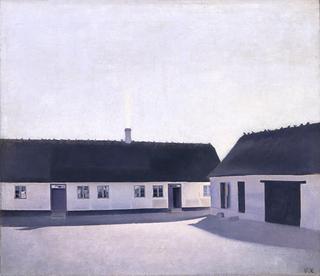
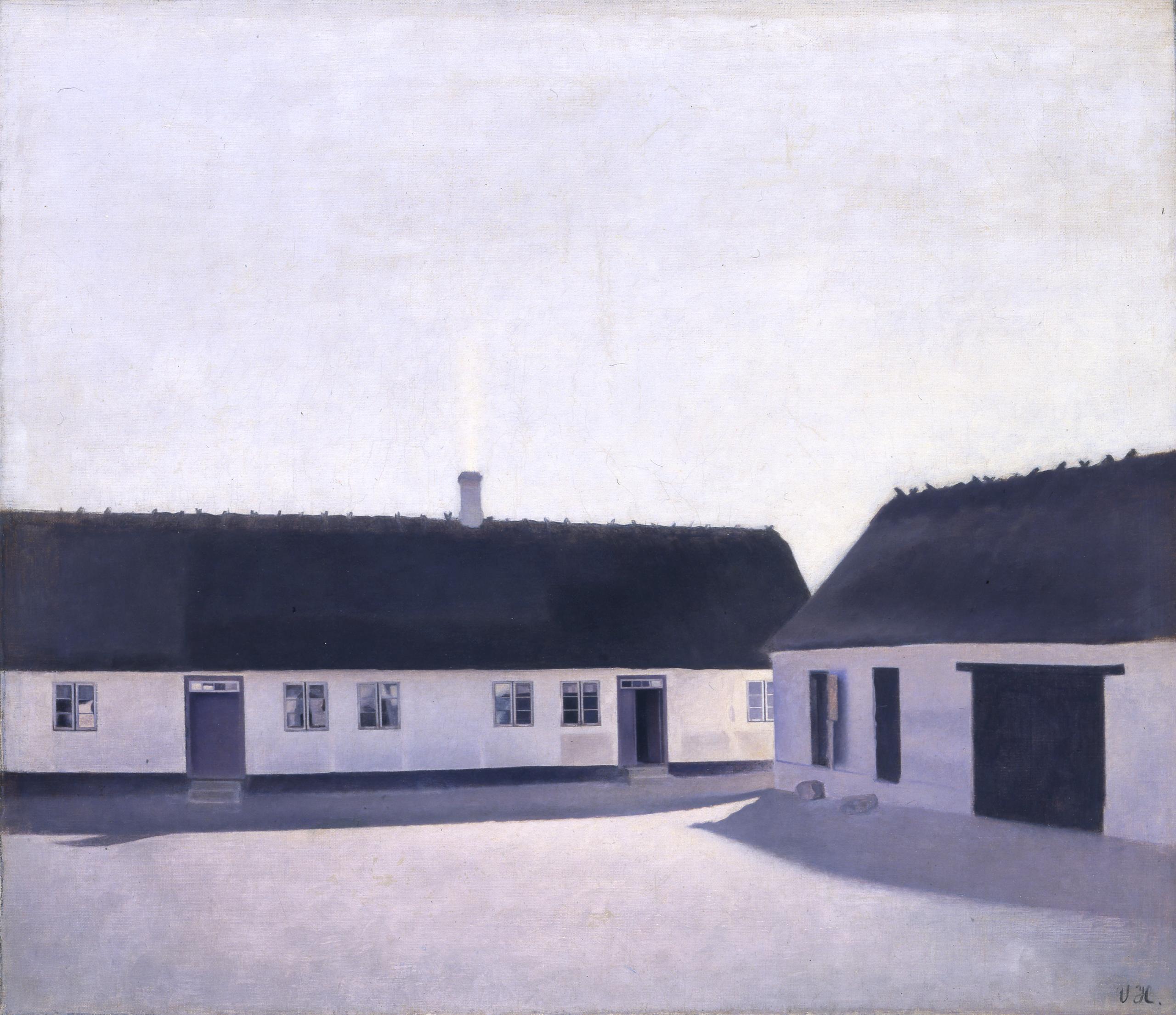
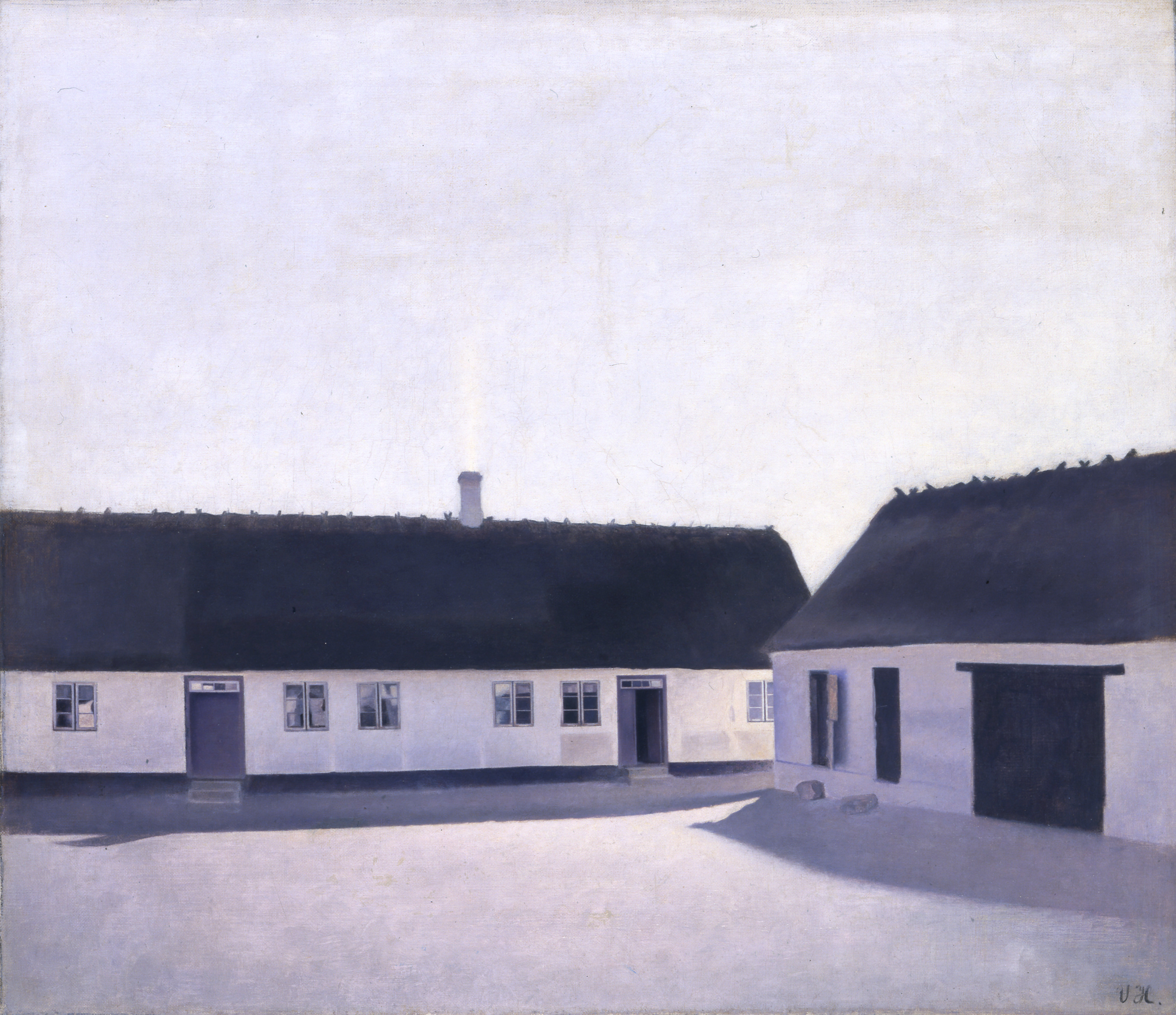
From a Farm, Refsnæs was painted during Ida and Vilhelm Hammershøi’s summer sojourn at Refsnæs in West Zealand in 1900. Hammershøi has depicted the whitewashed farmhouse ‘Kildevang’ near Kongstrup, northwest of Kalundborg where the couple stayed for a few weeks.
Hammershøi has worked with light and colour as well as with lines and surfaces in a manner reminiscent of his approach to interior scenes. He has staged his chosen subject with great care and deliberation, in fact to such an extent that the Danish farm – a place generally associated with teeming life, full of peasants, servants and animals – has become an disturbing empty, unreal, almost lifeless place. The farm is also depicted in an extremely pared-back form: compositionally, the dark, elongated fields of the thatched roofs contrast sharply with the whitewashed walls, the bright sky and open courtyard, emphasising the transverse format of the picture. The farmhouse is painted with meticulous care, especially the windows and the open and closed doors. Notably, Hammershøi has omitted to paint in the cobblestones covering the courtyard surface. Presumably they would disrupt the clear form.
A nearly invisible, white plume of smoke rises vertically from the chimney, dissolving against the almost colourless sky in which Hammershøi’s many small brushstrokes, saturated with light, create a strong sense of presence. The smoke indicates that there is no wind. At the same time, it emphasises that, contrary to all appearances, there are in fact people at the farm even if there is not a single person to be seen.
Like so many other scenes depicted by Hammershøi, this painting is deliberately devoid of life and narrative, thereby making room for registrations of various light phenomena: the light in the sky, the way it plays on and between the whitewashed farm buildings, and the glints and reflections bouncing off the windows. These light phenomena evoke a metaphysical mood, leaving the work inscrutably enigmatic.
Published in
Published in
Sophus Michaëlis and Alfred Bramsen: Vilhelm Hammershøi. Kunstneren og hans Værk, Copenhagen 1918, p. 97, cat. 203;
Alfred Bramsen: Udvalg af Vilh. Hammershøis arbejder, Copenhagen 1930, p. 8, cat. 11;
C.L. David: C.L. Davids Samling, Copenhagen 1960, p. 28;
Hanne Finsen and Inge Vibeke Raaschou-Nielsen (ed.): Vilhelm Hammershøi. En retrospektiv udstilling, Ordrupgaard, Charlottenlund 1981, p. 120, cat. 69;
Leena Ahtola-Moorhouse, Carl Thomas Edam and Birgitta Schreiber (ed.): Dreams of a Summer Night. Scandinavian Painting at the Turn of the Century, Hayward Gallery, London 1986, p. 127, cat. 31;
Rolf Andree and Maria Kreutzer (ed.): Im Lichte des Nordens. Skandinavische Malerei um die Jahrhundertwende, Kunstmuseum Düsseldorf, Düsseldorf 1986, p. 126, cat. 31;
Hanne Honnens de Lichtenberg: Symbolismen i dansk kunst, Nivaagaards Malerisamling, Nivå 1993, pp. 54-55, cat. 41;
Poul Vad: “Vilhelm Hammershøi,” in Kjeld von Folsach and Nana Lund (ed.): Dansk kunst i Davids Samling. Fra Philipsen til Saxbo, Copenhagen 1995, pp. 96-97, cat. 33;
Anne-Birgitte Fonsmark et al.: Vilhelm Hammershøi, 1864-1916. Danish Painter of Solitude and Light, Ordrupgaard, Musée d’Orsay, Solomon R. Guggenheim Museum, New York 1998, p. 76, cat. 21;
Kirk Varnedoe: Northern Light. Realism and Symbolism in Scandinavian Painting, 1980-1910, Brooklyn Museum, New York 1982, pp. 122-123, cat. 28;
Poul Vad: Vilhelm Hammershøi and Danish Art at the Turn of the Century, New Haven 1992, fig. 181, pp. 203, 256;
Felix Krämer, Ulrich Luckhardt and Barbara Ludwig: Vilhelm Hammershøi, Hamburger Kunsthalle, Hamburg 2003, pp. 22, 53, 151, cat. 24;
Poul Vad: Hammershøi. Værk og liv, 5th ed., Copenhagen 2003, pp. 292, 321;
Bente Scavenius: Grib tiden. Kunsten 1890-1910, Kunstforeningen Gl. Strand, Copenhagen 2004, pp. 17, 75, cat. 71;
Tone Sinding Steinsvik, Ida Lorentzen and Bente Scavenius: Den forunderlige stillheten. Ida Lorentzen (f.1951), Vilhelm Hammershøi (1864-1916), Stiftelsen Modums Blaafarveværk, Modum 2005, pp. 87, 102, cat. 45;
Henrik Wivel: Hammershøi in The David Collection, Copenhagen 2017, pp. 68-69;
Annette Rosenvold Hvidt and Gertrud Oelsner: Vilhelm Hammershøi. På sporet af det åbne billede, Copenhagen 2018, pp. 164-165;
Astrid Becker: “Ausstellungen dänischer Künstler von 1898 bis 1901 in den Studienorten Emil Noldes,” in Kathrin Baumstark (ed.): Nolde und der Norden, Bucerius Kunst Forum, Hamburg 2021, fig. 42, p. 211;
Henrik Wivel: Vilhelm Hammershøi. maleri som poesi, Copenhagen 2026, fig. 94, pp. 217-222;
Interior with a View of an Exterior Gallery, 1903
Oil on canvas
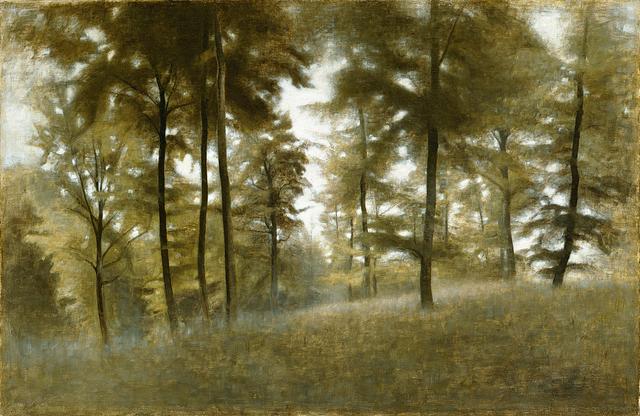
Young Beech Forest, Frederiksværk, 1904
Oil on canvas
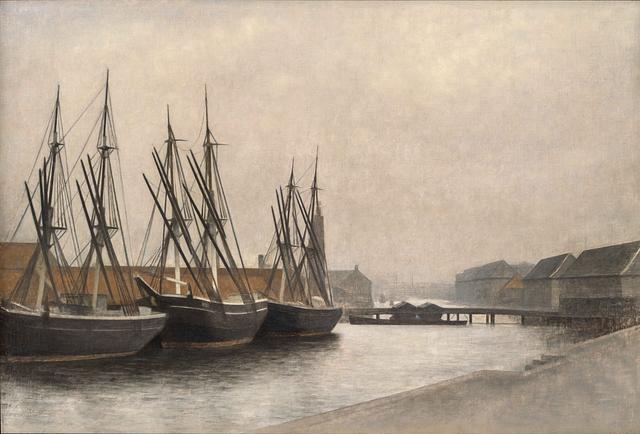
Three Ships, Christianshavn Canal, 1905
Oil on canvas
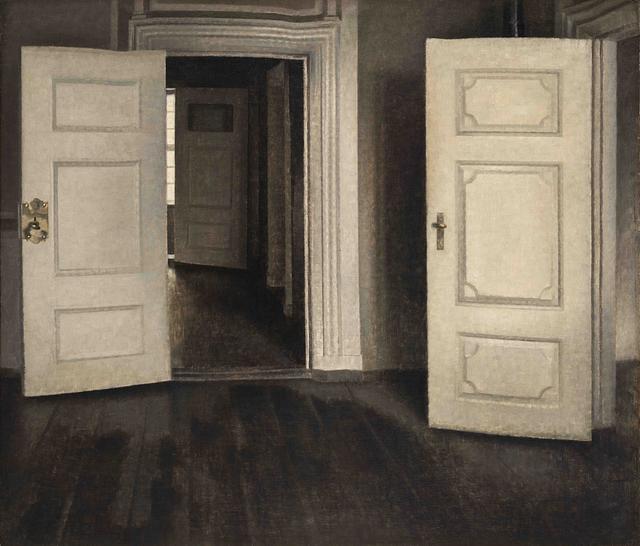
Open Doors, 1905
Oil on canvas