Vilhelm Hammershøi (1864–1916)
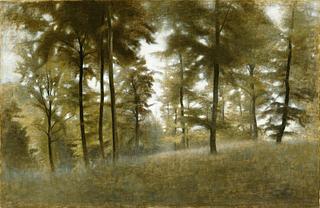
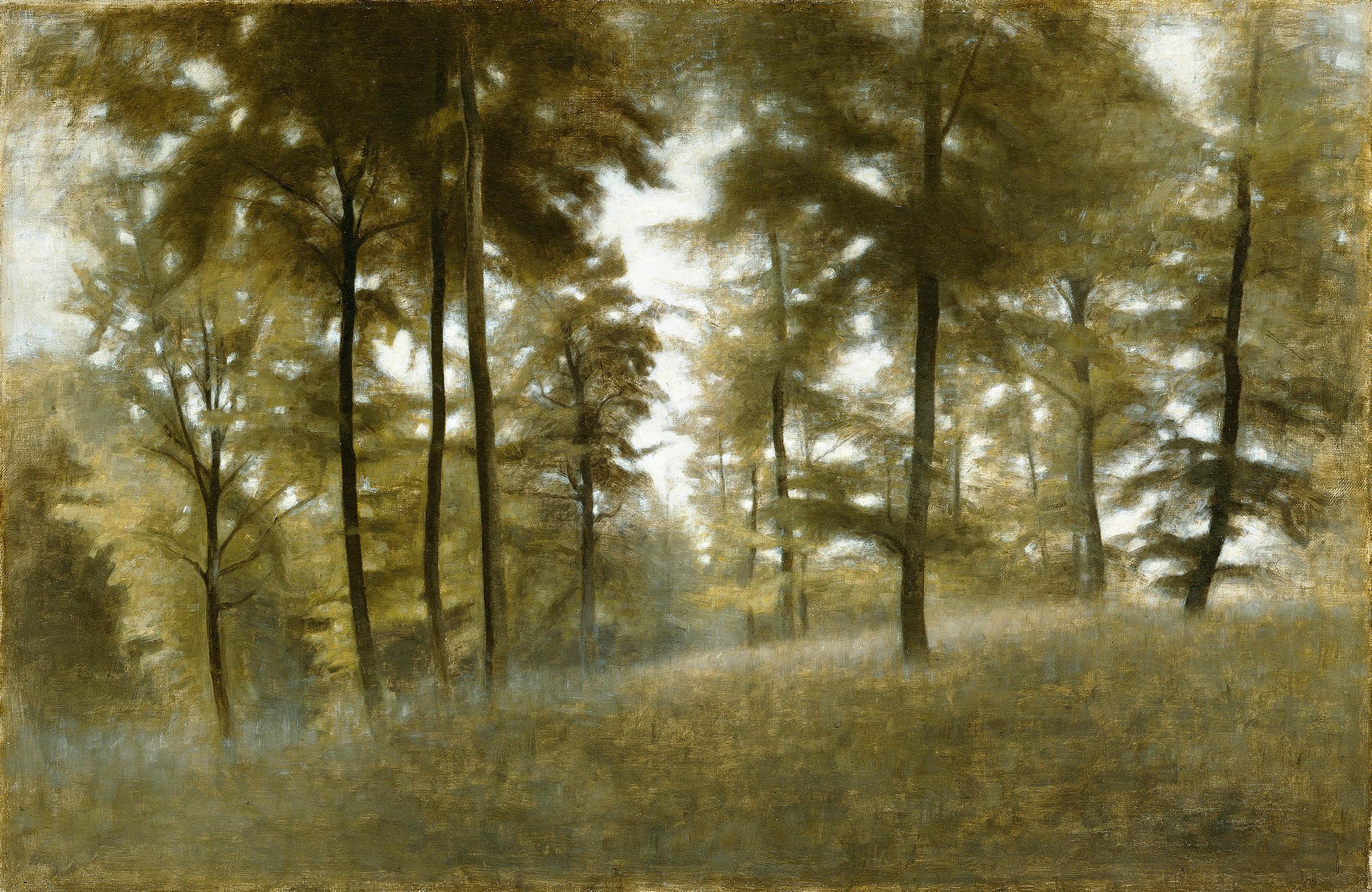
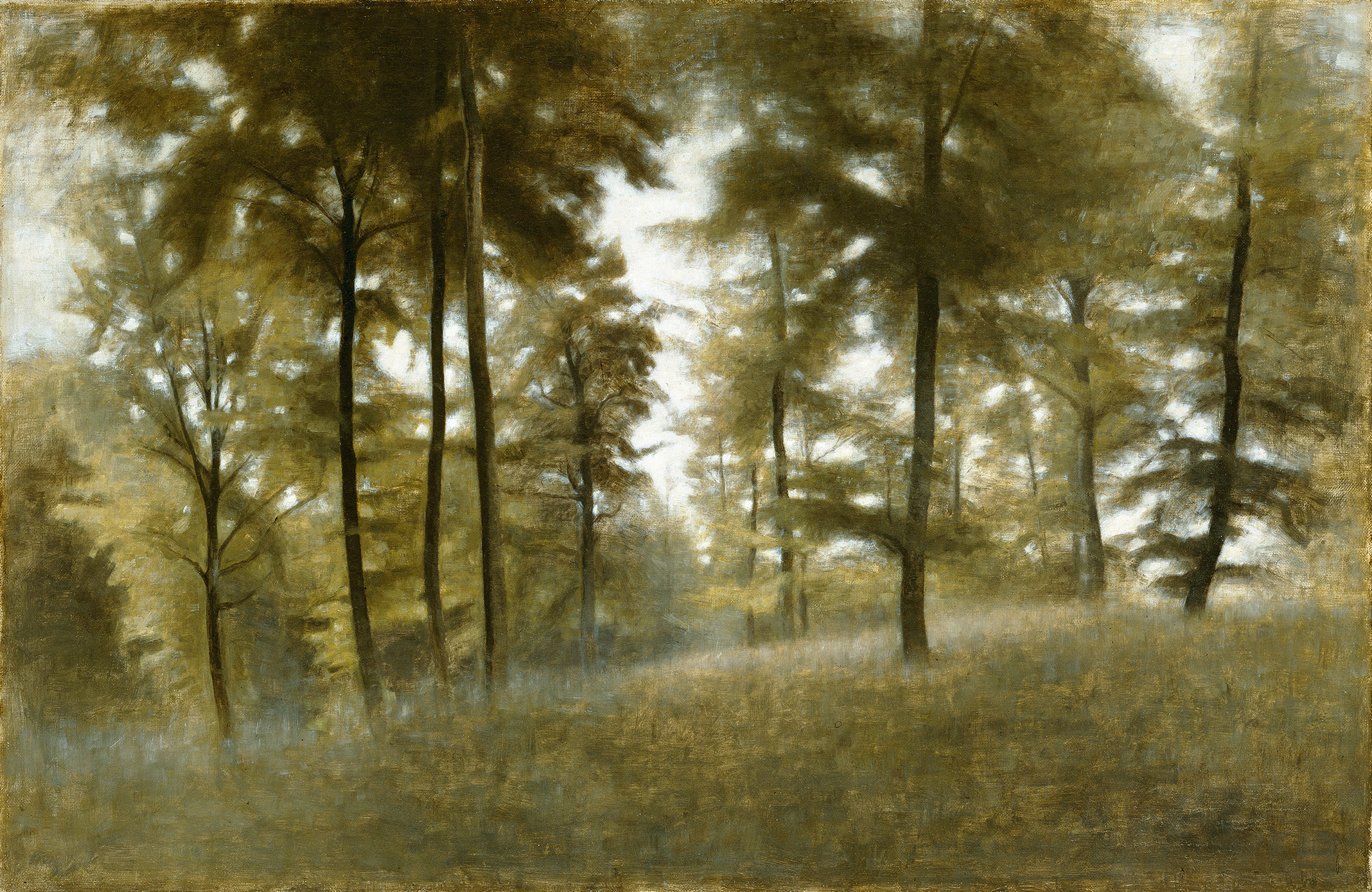
Young Beech Forest, Frederiksværk, 1904
Oil on canvas
Unlike his open landscapes (7/2016), painted while taking up a position at a more conventional distance from his chosen subject, Hammershøi has here elected to depict a section of the forest in which the most important elements are the slender tree trunks and their fuzzy foliage. The forest floor in the foreground of the picture is blurred and hazy, creating the feeling that one cannot enter the space shown here at all. The beech forest seems alien to us, and even though the subject is firmly inscribed in the Danish Golden Age tradition, it does not testify to National Romantic sensibilities of any kind.
With Young Beech Forest, Frederiksværk, Hammershøi does not follow his usual transversal compositional principle in which his subject matter runs parallel to the picture plane. Instead, he has worked with slightly sloping and dynamic lines: the slender tree trunks and the lush forest floor slope downwards to the left in a diagonal, depicting an – for Hammershøi – unusual point of view. The beech forest is represented without details, without any road and without traces of humans or animals. Everything has been omitted in favour of rendering the light falling in between the trees from behind, the backlight adding a misty, almost dreamlike mood to the scene.
Published in
Published in
Fortegnelse over arbejder af Vilhelm Hammershøi, booklet 2, Kunstforeningen, Copenhagen 1916, p. 6, cat. 44;
Sophus Michaëlis and Alfred Bramsen: Vilhelm Hammershøi. Kunstneren og hans Værk, København 1918, p. 103, cat. 262;
Alfred Bramsen: Udvalg af Vilh. Hammershøis arbejder, Copenhagen 1930, p. 9, cat. 21;
Erik Zahle: ”Billedkunst,” in C.L. Davids Samling. Vol. 1, Nogle Studier, Copenhagen 1948, p. 207;
Knud Voss and Verner Aspenström: Vilhelm Hammershøi, Prins Eugens Waldemarsudde, Stockholm 1976, cat. 21;
Hanne Finsen and Inge Vibeke Raaschou-Nielsen: Vilhelm Hammershøi. En retrospektiv udstilling, Ordrupgaard, Charlottenlund 1981, p. 123, cat. 99;
Poul Vad: Vilhelm Hammershøi and Danish Art at the Turn of the Century, New Haven 1992, fig. 224, pp. 262, 256;
Poul Vad: ”Vilhelm Hammershøi,” in Kjeld von Folsach and Nana Lund (ed.): Dansk kunst i Davids Samling. Fra Philipsen til Saxbo, Copenhagen 1995, pp. 98-99, cat. 34;
Anne-Birgitte Fonsmark et al.: Vilhelm Hammershøi, 1864-1916. Danish Painter of Solitude and Light, Ordrupgaard, Musée d’Orsay og Solomon R. Guggenheim Museum, New York 1998, pp. 96-97, cat. 35;
Lena Boëthius and Görel Cavalli-Björkman (ed.): Vilhelm Hammershøi, Göteborg Konstmuseum and Stockholm Nationalmuseum, Göteborg 1999, p. 34;
Felix Krämer, Ulrich Luckhardt and Barbara Ludwig: Vilhelm Hammershøi, Hamburger Kunsthalle, Hamburg 2003, pp. 22, 64, 154, cat. 34;
Poul Vad: Hammershøi. Værk og liv, 5. ed., Copenhagen 2003, pp. 290, 401;
Tone Sinding Steinsvik, Ida Lorentzen and Bente Scavenius: Den forunderlige stillheten. Ida Lorentzen (f.1951), Vilhelm Hammershøi (1864-1916), Stiftelsen Modums Blaafarveværk, Modum 2005, p. 82, cat. 53;
Henrik Wivel: Hammershøi in The David Collection, Copenhagen 2017, pp. 72-73;
Annette Rosenvold Hvidt and Gertrud Oelsner: Vilhelm Hammershøi. På sporet af det åbne billede, Copenhagen 2018, pp. 212-213;
Henrik Wivel: Vilhelm Hammershøi. Maleri som poesi, Copenhagen 2026, fig. 110, pp. 257-259;
Suzanne Ferrières-Pestureau: Vilhelm Hammershøi. Les couleurs de l'absence, Paris 2026, fig. 6;
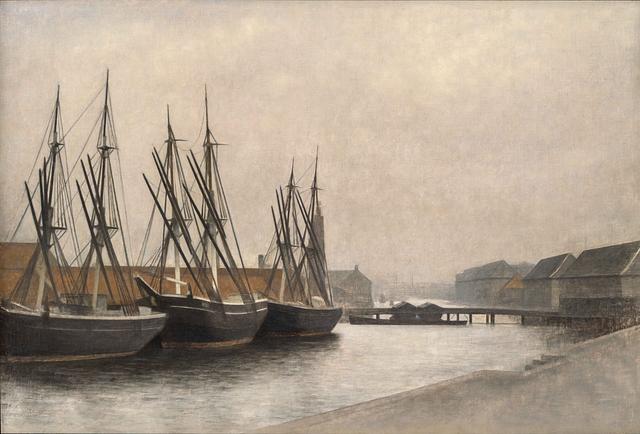
Three Ships, Christianshavn Canal, 1905
Oil on canvas
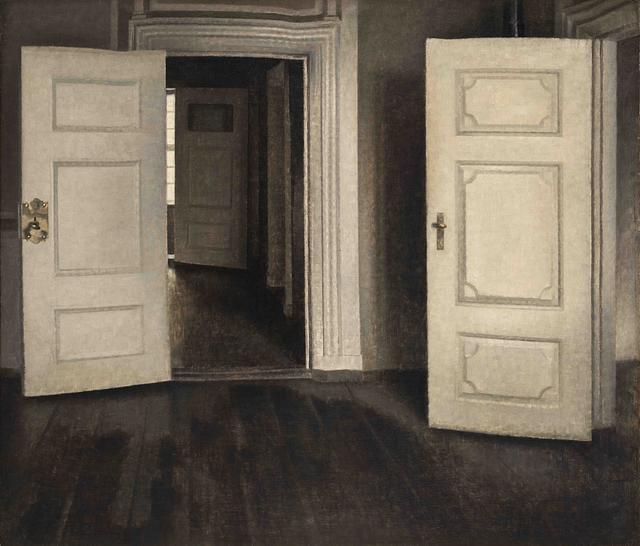
Open Doors, 1905
Oil on canvas
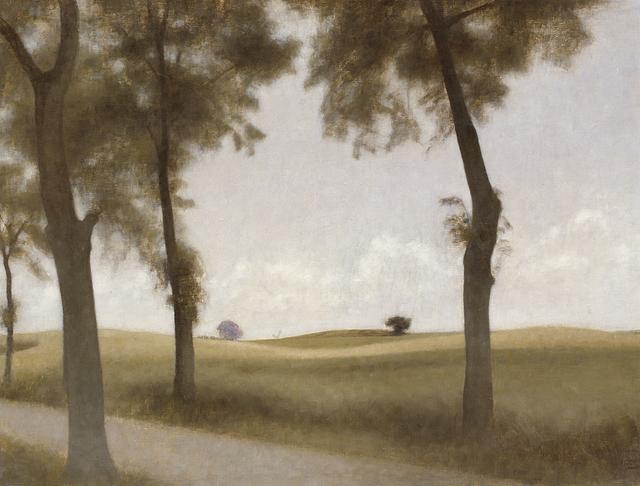
The Rowan Avenue at Snekkersten, 1906
Oil on canvas
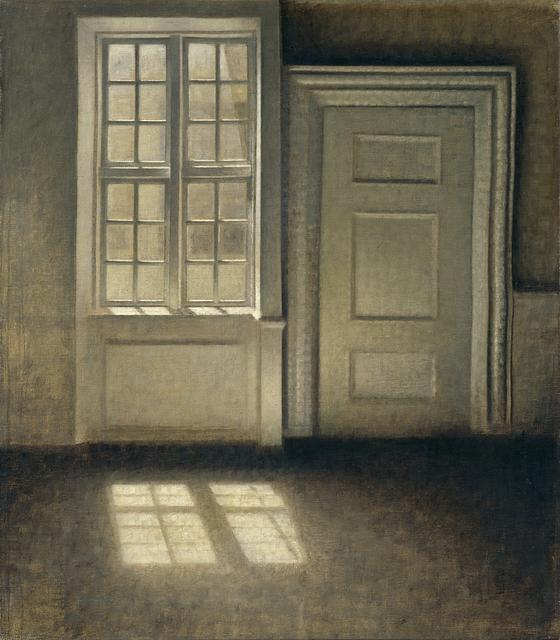
Sitting Room. Study in Sunlight, 1906
Oil on canvas