Tureen with underdish of faience
Schleswig Manufactory, 1758–1780
H: 27; L of dish: 46 cm
Inventory number NF 80
The David Collection owns a small but fine collection of faience from the duchies, where various ceramic enterprises were established in the decades from the mid-1750s onwards.
The first of these manufactories was set up in Schleswig in 1755 and is particularly associated with the Rambusch family, who oversaw faience production there for two generations, spanning the years from 1758 to 1800.1 The manufactory was highly successful, both in terms of sales and artistic achievement. The designs and decorations had a close affinity with Danish and Norwegian models, and the production mainly consisted of tureens, bowls, dishes, plates, jugs, candlesticks, etc., which were primarily sold to Denmark. Around the mid-1780s, the manufactory began to decline, changing ownership several times until it ceased production in 1814.
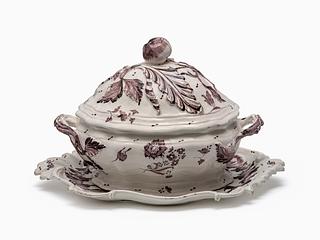
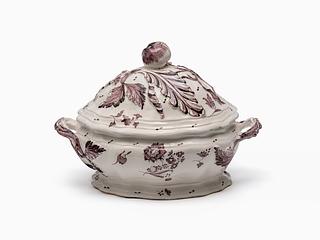
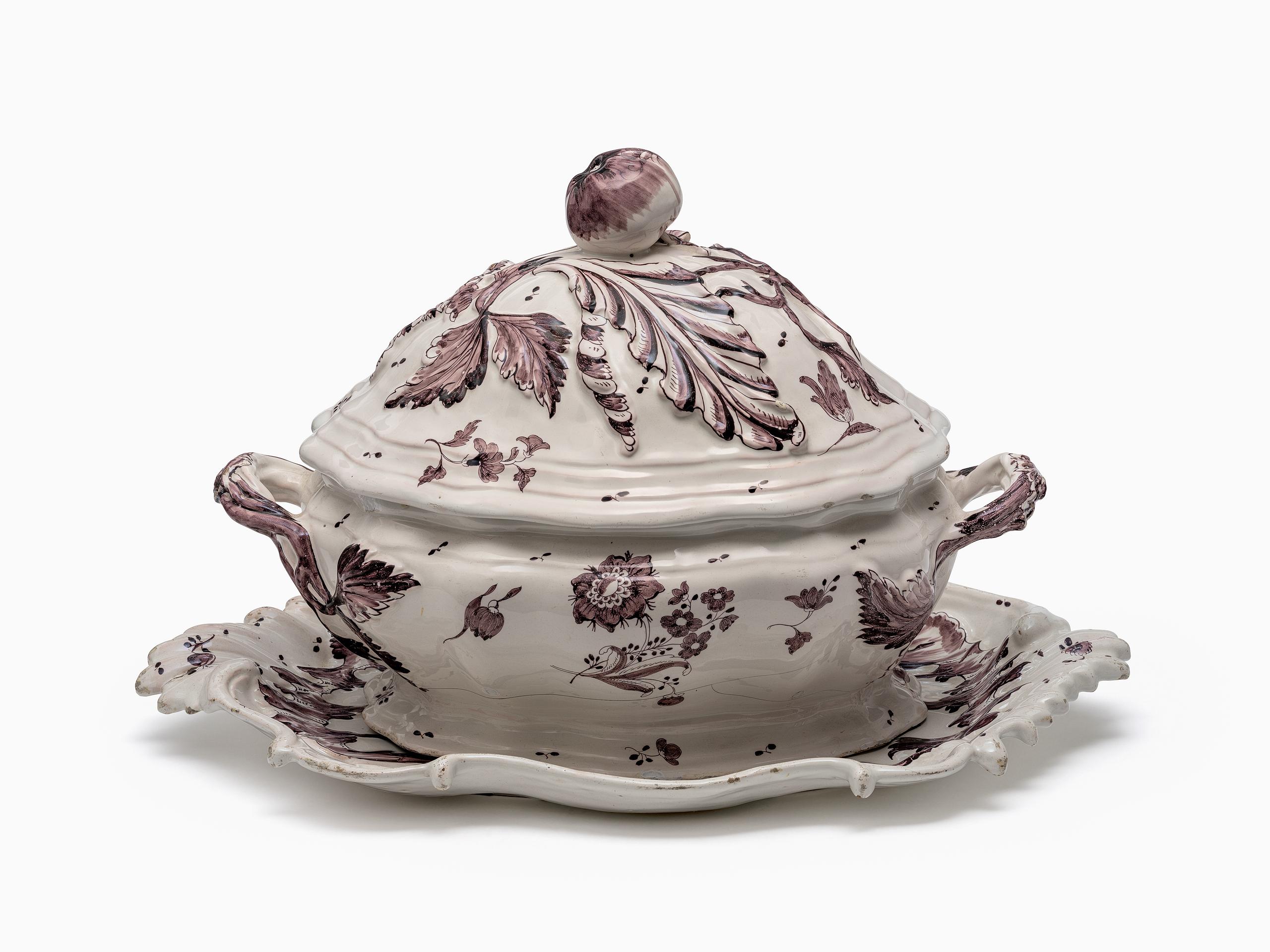
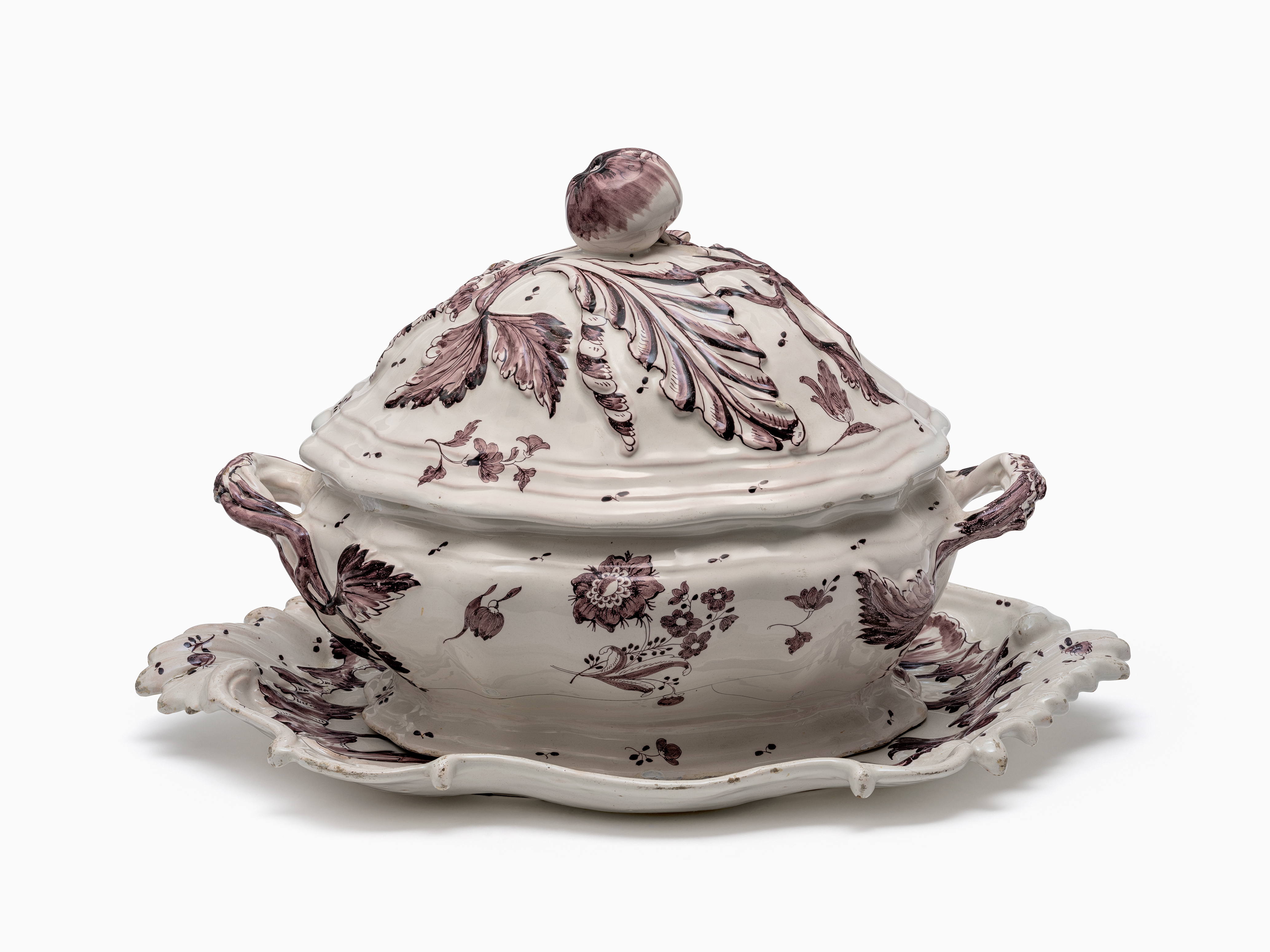
The oval tureen in The David Collection belongs to a dinner service known as ‘the ordinary service’.2 It is distinguished by its somewhat heavy Rococo form with curved edges and decorations featuring sculpted elements in manganese violet: the two handles of the tureen are shaped like branches with leaves, and on the lid, whose leaf ornamentation is partially sculpted and picked out in thick contours, is a finial shaped like an apple. The body and lid are both decorated with small painted leaves and scattered flowers, these too in manganese.
Overall, monochrome decorations in manganese are typical of the Schleswig Manufactory’s wares. Manganese was used instead of the highly popular blue because the Store Kongensgade Faience Manufactory held a monopoly on the production of faience with blue decorations until 1769 (NF 46).
The first of these manufactories was set up in Schleswig in 1755 and is particularly associated with the Rambusch family, who oversaw faience production there for two generations, spanning the years from 1758 to 1800.1 The manufactory was highly successful, both in terms of sales and artistic achievement. The designs and decorations had a close affinity with Danish and Norwegian models, and the production mainly consisted of tureens, bowls, dishes, plates, jugs, candlesticks, etc., which were primarily sold to Denmark. Around the mid-1780s, the manufactory began to decline, changing ownership several times until it ceased production in 1814.
The oval tureen in The David Collection belongs to a dinner service known as ‘the ordinary service’.2 It is distinguished by its somewhat heavy Rococo form with curved edges and decorations featuring sculpted elements in manganese violet: the two handles of the tureen are shaped like branches with leaves, and on the lid, whose leaf ornamentation is partially sculpted and picked out in thick contours, is a finial shaped like an apple. The body and lid are both decorated with small painted leaves and scattered flowers, these too in manganese.
Overall, monochrome decorations in manganese are typical of the Schleswig Manufactory’s wares. Manganese was used instead of the highly popular blue because the Store Kongensgade Faience Manufactory held a monopoly on the production of faience with blue decorations until 1769 (NF 46).
Published in
Published in
Dansk kunst og kunsthåndværk, Davids Samling, København 1972, p. 43;
Verner Jul Andersen: Dansk kunst og kunsthåndværk, Davids Samling, København 1983, cat. 136, p. 57;
Verner Jul Andersen: Dansk kunst og kunsthåndværk, Davids Samling, København 1983, cat. 136, p. 57;
Footnotes
Footnotes
1.
Gunilla Eriksson, catalogue 1 in the series ‘Fajanserna kring Östersjön’, Lund 1997, p. 48 and cat. 55, p. 103.
2.
Johann Rambusch (1702–1773) was director of the Schleswig Manufactory from 1758 to 1773. Following this, his son, Friedrich Vollrath Rambusch, took over management from 1773 to 1800. The first period would be the manufactory’s finest from an artistic point of view, and its products were in particularly high demand on the Nordic market. For more information, see Kai Uldall: Gammel dansk fajence. Fra fabriker i kongeriget og hertugdømmerne. Copenhagen 1961, p. 139.