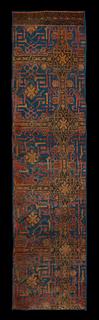
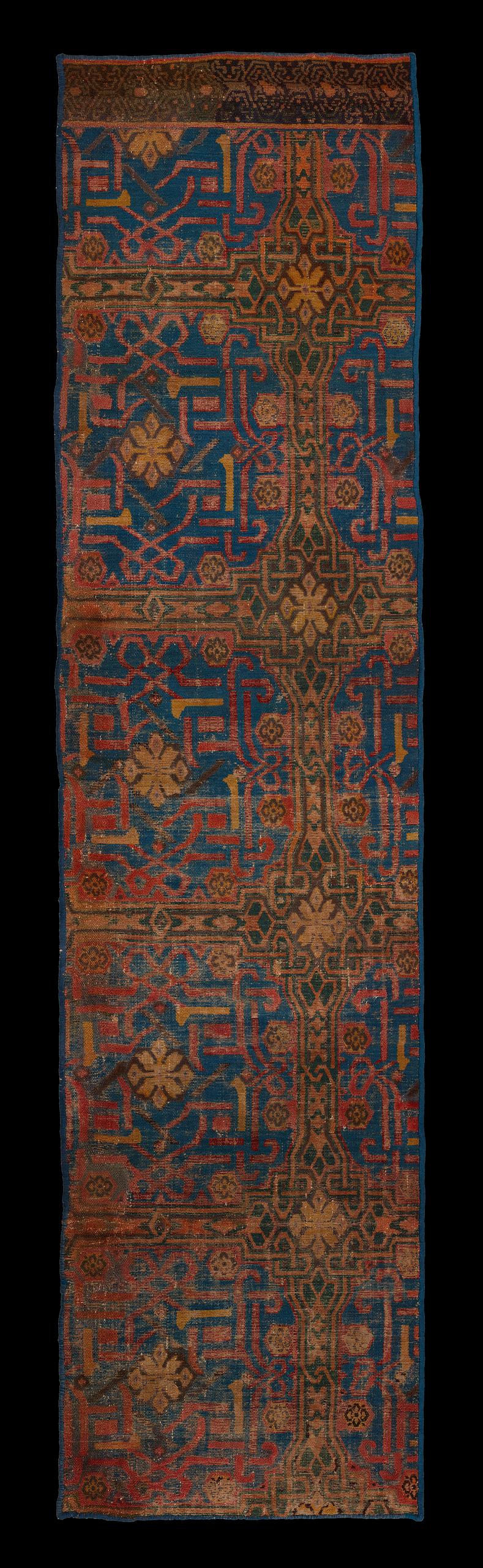
Fragment of a carpet, wool with Spanish knots in blue, green, yellow, orange, red, and brown on a white ground weave
Spain, Alcaraz?; 2nd half of 15th century
H: 250; W: 63 cm
Inventory number 17/2018
Virtually no carpets from the Spanish region have been preserved that can be dated to before the 15th century. The oldest still show signs of Islamic ornamentation as it was known from Nasrid Granada and from North Africa. The early carpets are often called mudejar since, like much of the ceramics from the 15th century, they were made by Muslim artists, but in Christian regions of southern Spain.
The best-known place of manufacture is Alcaraz, between Malaga and Valencia, but there were also workshops in other nearby cities such as Liétor and Hellin. In the 16th century, ornamentation was influenced more by European Renaissance art – and acanthus leaves became a favorite element.
The museum’s fragment is dominated by octagons kept in place by a frame. The octagons are filled with a complex interlacing pattern with a stylized flower or star in the middle that is also found in the frame. At the bottom are remnants of a border. The carpet was originally much larger and it has been proposed that the decoration reflected the coffered ceilings of the period.1
The Spanish knot differs from the Turkish (ghiordes) and the Persian (senneh) knots by being tied over only one warp thread, while the others use two.
The best-known place of manufacture is Alcaraz, between Malaga and Valencia, but there were also workshops in other nearby cities such as Liétor and Hellin. In the 16th century, ornamentation was influenced more by European Renaissance art – and acanthus leaves became a favorite element.
The museum’s fragment is dominated by octagons kept in place by a frame. The octagons are filled with a complex interlacing pattern with a stylized flower or star in the middle that is also found in the frame. At the bottom are remnants of a border. The carpet was originally much larger and it has been proposed that the decoration reflected the coffered ceilings of the period.1
The Spanish knot differs from the Turkish (ghiordes) and the Persian (senneh) knots by being tied over only one warp thread, while the others use two.
Published in
Published in
Ian Bennett (ed.): Complete illustrated rugs and carpets of the world, New York 1977 (before it was devided into several parts);
Lefevre & Partners, London, 18/6-1982, lot 24;
Christopher Alexander: A foreshadowing of 21st century art: the color and geometry of very early Turkish carpets, New York 1993, pp. 114-115;
Hali, 74, 1994, p. 89, fig. 7;
Edoardo Concaro, Alberto Levi (eds.): Sovrani tappeti: il tappeto orientale dal XV al XIX secolo: duecento capolavori di arte tessile, Palazzo Reale, Milano 1999, p. 193, cat.no. 166;
Rosamund Garrett, Matthew Reeves: Late Medieval and Renaissance textiles, Sam Fogg, London 2018, cat.no. 20;
John Mills: “Mirror image” in Hali, 195, 2018, pp. 96-97;
Lefevre & Partners, London, 18/6-1982, lot 24;
Christopher Alexander: A foreshadowing of 21st century art: the color and geometry of very early Turkish carpets, New York 1993, pp. 114-115;
Hali, 74, 1994, p. 89, fig. 7;
Edoardo Concaro, Alberto Levi (eds.): Sovrani tappeti: il tappeto orientale dal XV al XIX secolo: duecento capolavori di arte tessile, Palazzo Reale, Milano 1999, p. 193, cat.no. 166;
Rosamund Garrett, Matthew Reeves: Late Medieval and Renaissance textiles, Sam Fogg, London 2018, cat.no. 20;
John Mills: “Mirror image” in Hali, 195, 2018, pp. 96-97;
Footnotes
Footnotes
1.
John Mills: “Mirror Image,” Hali, 195, 2018, pp. 96-99.

Al-Andalus, Muslim Spain
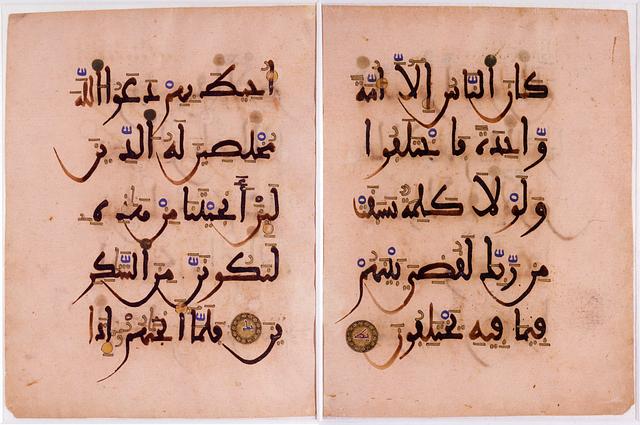
Two leaves from a Koran written in Maghribi
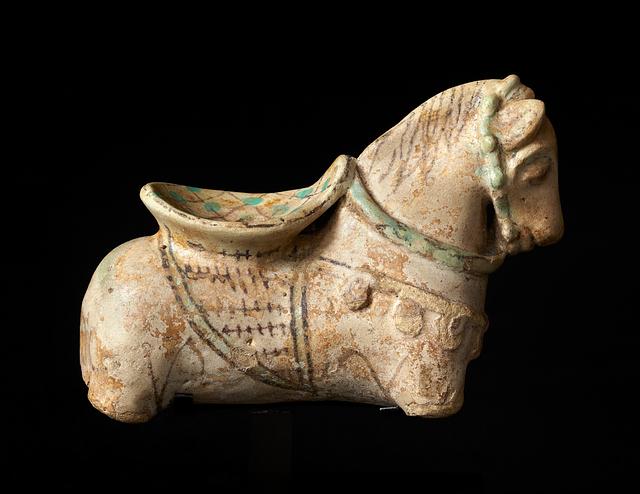
Fragmented figure of a horse, earthenware covered with a whitish slip and painted in green and manganese under a slightly toned, poorly preserved glaze
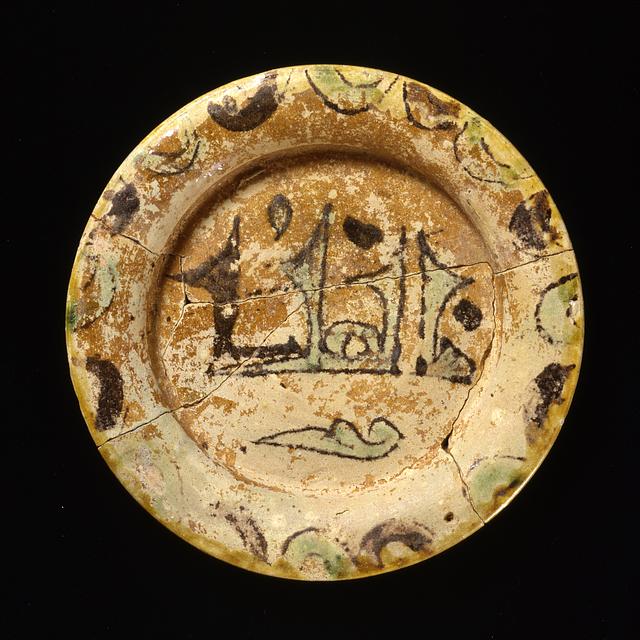
Earthenware dish, decorated with green and manganese
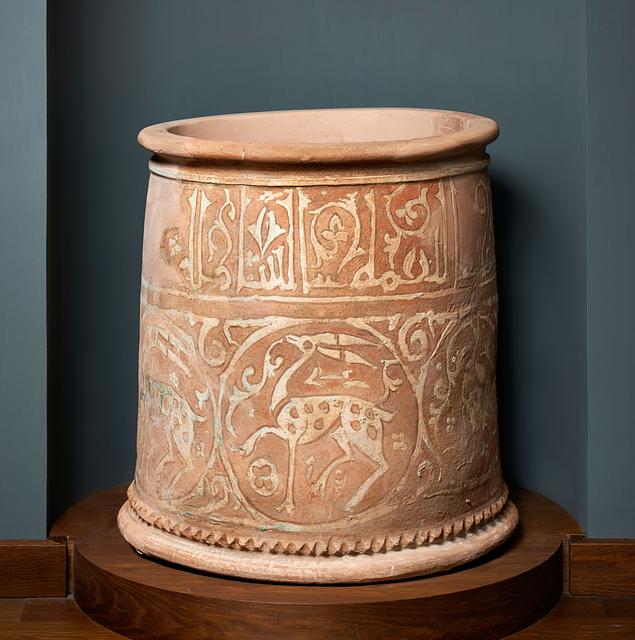
Wellhead, earthenware painted in green and a manganese-colored glaze