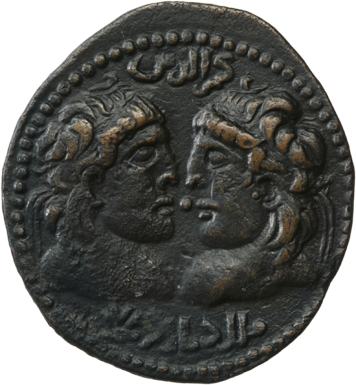
The Artuqid Rulers of Hisn Kayfa and Amid, 495-629 H/1101-1231 AD
Legend & Design
Legend & Design
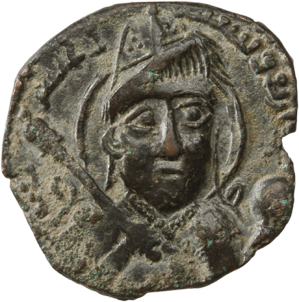
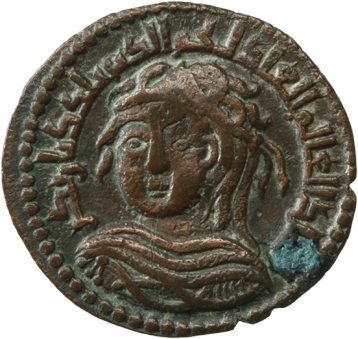
Obverse
Within beaded circle
half figure with almond-shaped eyes, facing slightly right, with looped cords over the shoulders and a fringed head-dress with pointed crest, holding a sceptre in his right hand and a globe in the left.
In segments around
in cursive Kufic from 3:00 to 8:00 (sana) arba‘ wa tis‘in wa khamsmi’a
“year four and ninety and five hundred”
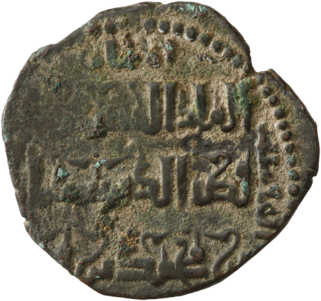
Reverse
Within beaded circle
in cursive Kufic al-malik al-(mas‘ud)/ qutb al-din sukman / ibn muhammad ibn (qara)
(6:00: arslan), 12:00: al-imam, (9:00: al-nasir amir,) 3:00: al-mu’minin
“the Fortunate King, Pole Star of the Faith, Sukman ibn Muhammad ibn Qara Arslan, the Imam al-Nasir, Commander of the Faithful”
Historical Note
Historical Note
Qutb al-Din Sukman II succeeded his father, Nur al-Din Muhammad, in 581 H (1185 AD), and reigned in Hisn Kayfa and Amid for sixteen years. Unlike the coinage he issued ten years earlier, this dirham, struck in 594 H, no longer bears any reference to his Ayyubid overlord Saladin.
He had died five years earlier, and Sukman appears to have freed his kingdom from subservience to the Ayyubids for the time being. The new regal title he chose for himself, al-malik al-mas’ud, the Fortunate King, may have been a reference to his new freedom.
On the reverse Sukman takes his ancestry back only two generations, giving the names of his father Muhammad and his grandfather Qara Arslan. The Turkish-type facial features of the figure on the obverse suggest that it is a Turkish depiction of Jupiter as the king of the planets.
The headdress has been thought to be a helmet or a crown, but it actually bears a strong resemblance to the sharbush or fur hat that was worn by the military hierarchy of the Saljuqs and Zangids before the Mongol invasion.
Sukman may have chosen this coin design as another way of marking his independence from the Ayyubids. The orb and scepter held by the figure are princely attributes that are frequently seen in Islamic and Byzantine art, and they are very ancient symbols of power that go back to Greek and Roman times.