
Page from part 24 of a Chinese Koran
written in Sini
China; 1053 H = 1643
Each leaf: 24 × 15,3 cm
Inventory number 53/1999
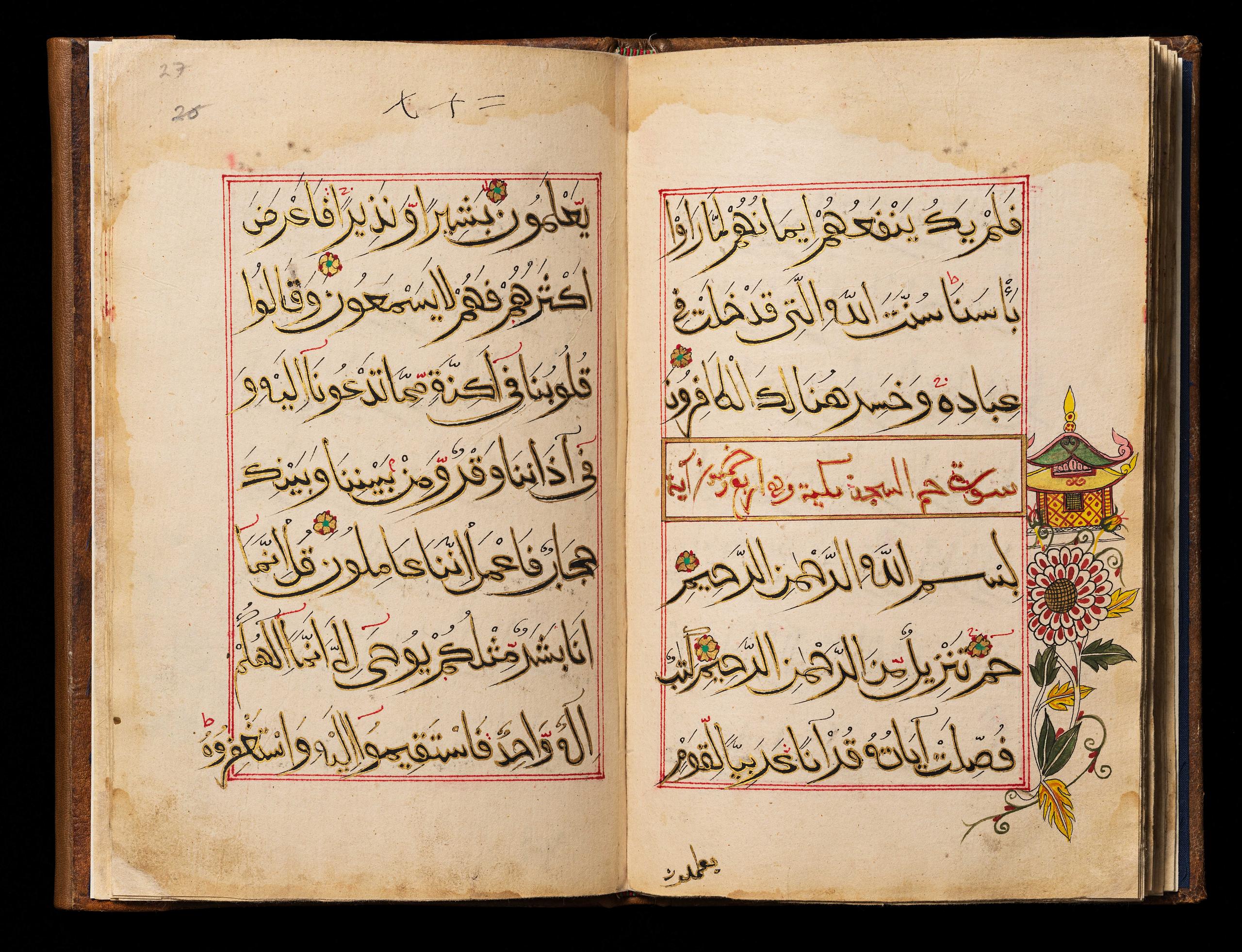
This Koran manuscript was written in a Chinese variant of the Rayani script that is often termed Sini. The margin of the entire part contains a number of highly decorative markers that designate five and ten verses, all of them in the shape of flowers, with little pagodas here and there. The two Sura headings were given their own frame and written in red.
The colophon in the manuscript’s double leaf tells us that this Koran was written in Khan Balgh (Beijing) in 1053 H = 1643 by Ama Allah Nur al-Ilm bint (daughter of) Rashid al-Din. Female calligraphers are rare in the Islamic world. Two little red stamps with Chinese characters, judged to be from the 19th century, denote a later owner.
The colophon in the manuscript’s double leaf tells us that this Koran was written in Khan Balgh (Beijing) in 1053 H = 1643 by Ama Allah Nur al-Ilm bint (daughter of) Rashid al-Din. Female calligraphers are rare in the Islamic world. Two little red stamps with Chinese characters, judged to be from the 19th century, denote a later owner.
Published in
Published in
Kjeld von Folsach: Art from the World of Islam in The David Collection, Copenhagen 2001, cat.no. 15;
Stig T. Rasmussen: Klassisk arabisk litteratur i oversættelse til dansk: en litteraturhistorisk vejvisende antologi, København 2018, pp. 246-247;
Joachim Meyer, Rasmus Bech Olsen and Peter Wandel: Beyond words: calligraphy from the World of Islam, The David Collection, Copenhagen 2024, cat. 26, p. 157;
Rasmus Bech Olsen: “Beyond words: calligraphy from the World of Islam”, Orientations, 55:4, 2024, fig. 11, p. 41;
Stig T. Rasmussen: Klassisk arabisk litteratur i oversættelse til dansk: en litteraturhistorisk vejvisende antologi, København 2018, pp. 246-247;
Joachim Meyer, Rasmus Bech Olsen and Peter Wandel: Beyond words: calligraphy from the World of Islam, The David Collection, Copenhagen 2024, cat. 26, p. 157;
Rasmus Bech Olsen: “Beyond words: calligraphy from the World of Islam”, Orientations, 55:4, 2024, fig. 11, p. 41;