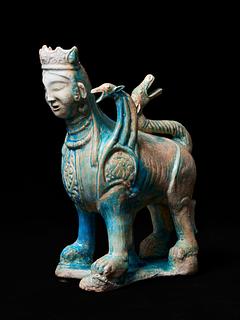
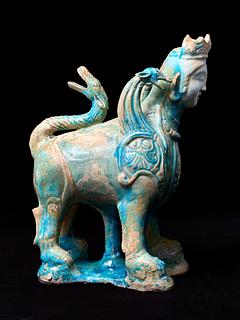
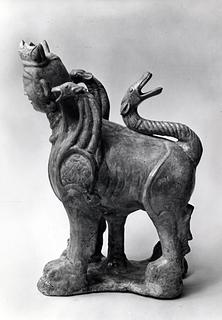
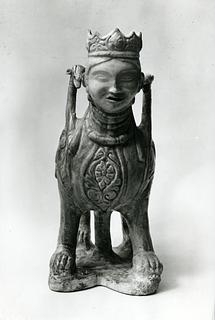
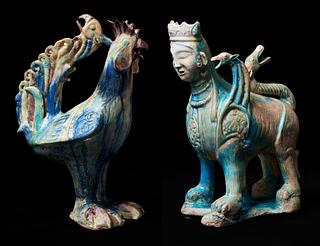
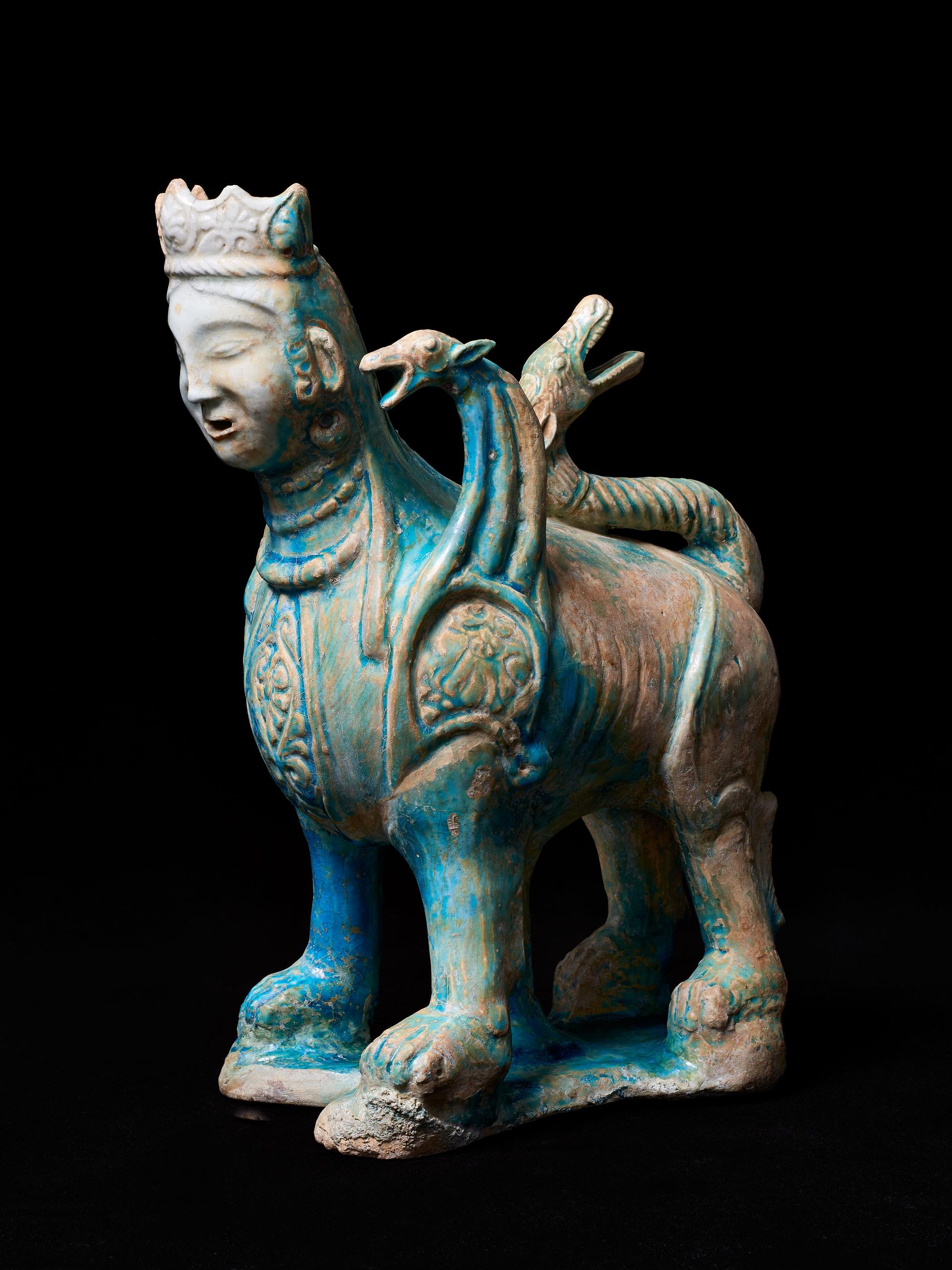
Sphinx, cast, modeled, and carved fritware painted in an opaque white and a turquoise glaze
Syria, Raqqa; 2nd half of 12th century
H: 37 cm
Inventory number Isl 56
This sphinx was found in Rafiqa, Raqqa’s twin city, in 1924 together with the cock (Isl 57) and the figure of a horseman in Syria’s National Museum. As ceramic sculptures, they are unique not only in Syria, but also in the rest of the Islamic world.
They are fountain figures, and all have pipes to carry water up to the figures’ heads. The North African historian al-Maqqari wrote that the Spanish Umayyad caliph Abd al-Rahman III had a fountain made with 12 figures: a lion with a gazelle, a crocodile, a serpent, an eagle, an elephant, a dove, a falcon, a peacock, a hen, a cock, a hawk, and a vulture.
They are fountain figures, and all have pipes to carry water up to the figures’ heads. The North African historian al-Maqqari wrote that the Spanish Umayyad caliph Abd al-Rahman III had a fountain made with 12 figures: a lion with a gazelle, a crocodile, a serpent, an eagle, an elephant, a dove, a falcon, a peacock, a hen, a cock, a hawk, and a vulture.
Published in
Published in
Eva Baer: Sphinxes and Harpies in Medieval Islamic Art. An Iconographical Study, Jerusalem 1965, fig. 19, pp. 12, 15 and 22;
Ernst J. Grube: “Islamic Sculpture. Ceramic Figurines,” Oriental Art, New Series, 12:3, 1966, fig. 6, p. 168;
Vilhelm Slomann: Bicorporates. Studies in Revivals and Migrations of Art Motifs, Copenhagen 1967, vol. 1, p. 47 and vol. 2, fig. 177-178;
André Leth: C.L. Davids Samling. Vol. 4, Jubilæumsskrift 1945-70, Copenhagen 1970, no. 2, p. 270-271;
André Leth: The David Collection. Islamic Art, Copenhagen 1975, s. 33;
Oliver Watson: “A Syrian bull. A Rare Islamic figurine,” Apollo, 113:227, 1981, fig. 3;
Art from the World of Islam. 8th-18th Century, Louisiana Museum of Modern Art, Humlebæk 1987, cat. 82;
Kjeld von Folsach: Islamic Art. Davids Samling, Copenhagen 1990, cat.129;
Kjeld von Folsach: Fabelvæsner fra Islams Verden, Davids Samling, Copenhagen 1991, cat. 3;
Joachim Gierlichs: Mittelalterliche Tierreliefs in Anatolien und Nordmesopotamien. Untersuchungen zur figürlichen Baudekoration der Seldschuken, Artuqiden und ihrer Nachfolger bis ins 15. Jahrhundert, Tübingen 1996, p. 49 and note 403;
Kjeld von Folsach, Torben Lundbæk and Peder Mortensen (ed.): Sultan, Shah and Great Mughal. The History and Culture of the Islamic World, National Museum, Copenhagen 1996, cat. 204;
Markus Hattstein and Peter Delius (ed.): Islam: Art and Architecture, Berlin 2000, p. 196;
Kjeld von Folsach: Art from the World of Islam in the David Collection, Copenhagen 2001, cat.187;
Eric Delpont (ed.): L'Orient de Saladin. L’art des Ayyoubides, exposition présentée à l'Institut du monde arabe, Institut du monde arabe, Paris 2001, cat. 52, p. 56-57;
Almut v. Gladiss (ed.): Die Dschazira. Kulturlandschaft zwischen Euphrat und Tigris, Museum für Islamische Kunst, Berlin 2006, cat. 6, p. 44-46;
Abbas Daneshvari: “From Mashu to Qâf. The Iconography of a Minai Bowl,” in Patricia L. Baker and Barbara Brends (ed.): Sifting Sands. Reading Signs, Studies in Honour of Professor Géza Fehérvári, London 2006, fig. 7;
Abbas Daneshvari: Of Serpents and Dragons in Islamic Art. An Iconographical Study, Costa Mesa 2011, p. 172, pl. 110;
Kjeld von Folsach: “Paradise on Earth. Water and the Islamic Garden,” in John Kuhlmann Madsen, Nils Overgaard Andersen and Ingolf Thuesen (ed.): Water of Life. Essays from a Symposium Held on the Occasion of Peder Mortensen's 80th Birthday, Copenhagen 2016, p. 191, fig. 5;
Sheila R. Canby et al.: Court and Cosmos. The Great Age of the Seljuqs, Metropolitan Museum of Art, New York 2016, fig. 98, p. 243;
Antony Eastmond: Tamta's World. The Life and Encounters of a Medieval Noblewoman from the Middle East to Mongolia, Cambridge 2017, p. 256, fig. 87;
Finbarr B. Flood and Beate Fricke: Tales Things Tell. Material Histories of Early Globalisms, Princeton 2024, fig. 157, pp. 167-168;
Yusuf Cetin: Türk Sanatında Ejder Ikonografisi, Ankara 2025, fig. 172, s. 212;
Ernst J. Grube: “Islamic Sculpture. Ceramic Figurines,” Oriental Art, New Series, 12:3, 1966, fig. 6, p. 168;
Vilhelm Slomann: Bicorporates. Studies in Revivals and Migrations of Art Motifs, Copenhagen 1967, vol. 1, p. 47 and vol. 2, fig. 177-178;
André Leth: C.L. Davids Samling. Vol. 4, Jubilæumsskrift 1945-70, Copenhagen 1970, no. 2, p. 270-271;
André Leth: The David Collection. Islamic Art, Copenhagen 1975, s. 33;
Oliver Watson: “A Syrian bull. A Rare Islamic figurine,” Apollo, 113:227, 1981, fig. 3;
Art from the World of Islam. 8th-18th Century, Louisiana Museum of Modern Art, Humlebæk 1987, cat. 82;
Kjeld von Folsach: Islamic Art. Davids Samling, Copenhagen 1990, cat.129;
Kjeld von Folsach: Fabelvæsner fra Islams Verden, Davids Samling, Copenhagen 1991, cat. 3;
Joachim Gierlichs: Mittelalterliche Tierreliefs in Anatolien und Nordmesopotamien. Untersuchungen zur figürlichen Baudekoration der Seldschuken, Artuqiden und ihrer Nachfolger bis ins 15. Jahrhundert, Tübingen 1996, p. 49 and note 403;
Kjeld von Folsach, Torben Lundbæk and Peder Mortensen (ed.): Sultan, Shah and Great Mughal. The History and Culture of the Islamic World, National Museum, Copenhagen 1996, cat. 204;
Markus Hattstein and Peter Delius (ed.): Islam: Art and Architecture, Berlin 2000, p. 196;
Kjeld von Folsach: Art from the World of Islam in the David Collection, Copenhagen 2001, cat.187;
Eric Delpont (ed.): L'Orient de Saladin. L’art des Ayyoubides, exposition présentée à l'Institut du monde arabe, Institut du monde arabe, Paris 2001, cat. 52, p. 56-57;
Almut v. Gladiss (ed.): Die Dschazira. Kulturlandschaft zwischen Euphrat und Tigris, Museum für Islamische Kunst, Berlin 2006, cat. 6, p. 44-46;
Abbas Daneshvari: “From Mashu to Qâf. The Iconography of a Minai Bowl,” in Patricia L. Baker and Barbara Brends (ed.): Sifting Sands. Reading Signs, Studies in Honour of Professor Géza Fehérvári, London 2006, fig. 7;
Abbas Daneshvari: Of Serpents and Dragons in Islamic Art. An Iconographical Study, Costa Mesa 2011, p. 172, pl. 110;
Kjeld von Folsach: “Paradise on Earth. Water and the Islamic Garden,” in John Kuhlmann Madsen, Nils Overgaard Andersen and Ingolf Thuesen (ed.): Water of Life. Essays from a Symposium Held on the Occasion of Peder Mortensen's 80th Birthday, Copenhagen 2016, p. 191, fig. 5;
Sheila R. Canby et al.: Court and Cosmos. The Great Age of the Seljuqs, Metropolitan Museum of Art, New York 2016, fig. 98, p. 243;
Antony Eastmond: Tamta's World. The Life and Encounters of a Medieval Noblewoman from the Middle East to Mongolia, Cambridge 2017, p. 256, fig. 87;
Finbarr B. Flood and Beate Fricke: Tales Things Tell. Material Histories of Early Globalisms, Princeton 2024, fig. 157, pp. 167-168;
Yusuf Cetin: Türk Sanatında Ejder Ikonografisi, Ankara 2025, fig. 172, s. 212;
Ceramics