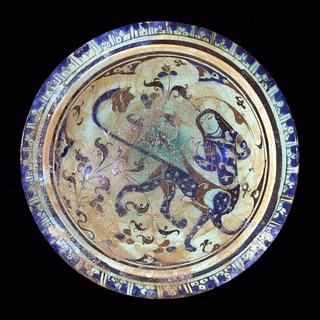
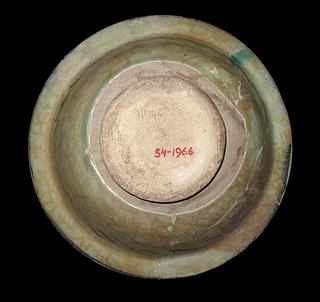
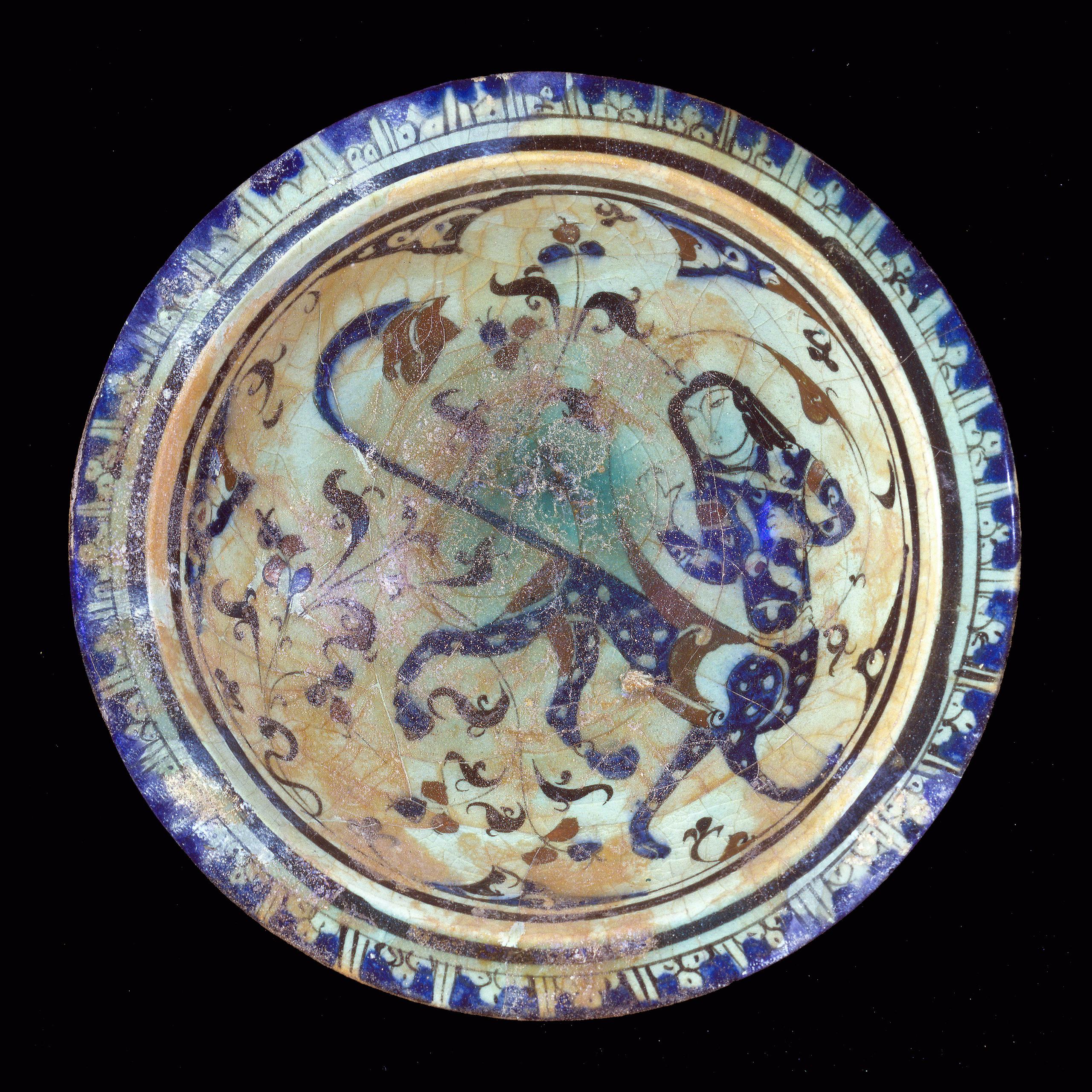
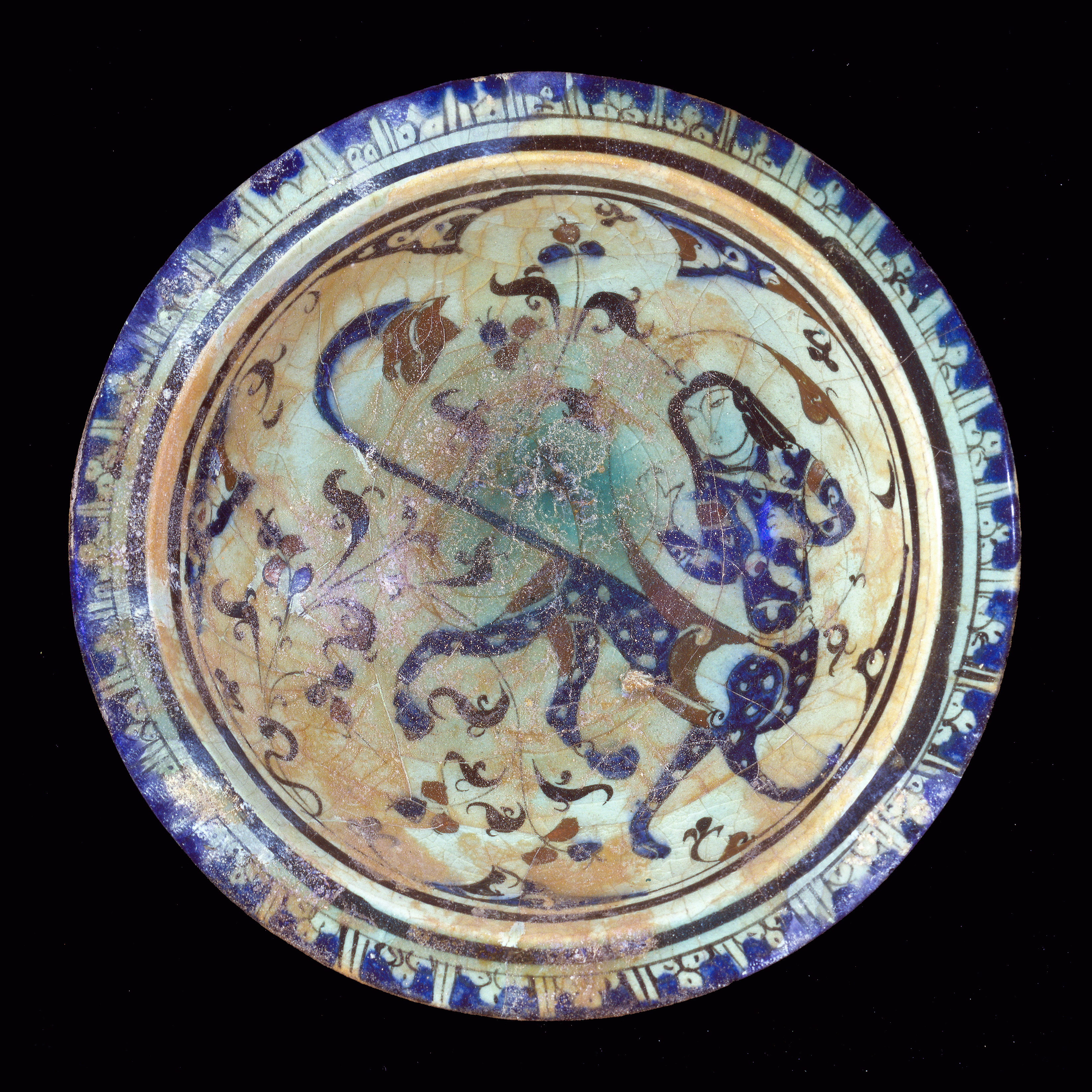
Fritware dish, painted in blue, black, and reddish brown under a transparent glaze
Syria, Raqqa; beginning of 13th century
H: 8; Diam: 29.5 cm
Inventory number 54/1966
At around the same time as Persian potters from Kashan, their Syrian colleagues also began to decorate their wares with the underglaze technique. Although they rarely possessed the same technical perfection as the Persians, much of the Syrians’ pottery did display amazing compositional freedom and self-assurance. This is reflected in the way that the body of the centaur on the dish is balanced elegantly by its own tail, which ends in a menacing animal head.
Centaurs are not common in Islamic art, but there were many references to Classical culture specifically in the province of Jazira – northern Iraq and Syria and southeastern Anatolia.
Centaurs are not common in Islamic art, but there were many references to Classical culture specifically in the province of Jazira – northern Iraq and Syria and southeastern Anatolia.
Published in
Published in
Gönül Öney: “Dragon figures in Anatolian Seljuk art,” Belleten, 33: 130, 1969, fig. 37, pp. 210-211;
C.L. Davids Samling. Vol. 4, Jubilæumsskrift 1945-70, Copenhagen 1970, fig. 13, p. 282;
Adalbert Klein et al.: Islamische Keramik, Hetjens-Museum, Düsseldorf 1973, cat. 205;
The Arts of Islam. Hayward Gallery, 8 April - 4 July 1976, London 1976, cat. 306;
Art from the World of Islam. 8th-18th Century, Louisiana Museum of Modern Art, Humlebæk 1987, cat. 85;
C.L. Davids Samling. Vol. 4, Jubilæumsskrift 1945-70, Copenhagen 1970, fig. 13, p. 282;
Adalbert Klein et al.: Islamische Keramik, Hetjens-Museum, Düsseldorf 1973, cat. 205;
The Arts of Islam. Hayward Gallery, 8 April - 4 July 1976, London 1976, cat. 306;
Art from the World of Islam. 8th-18th Century, Louisiana Museum of Modern Art, Humlebæk 1987, cat. 85;
Kjeld von Folsach: Islamic Art. The David Collection, Copenhagen 1990, cat. 134;
Kjeld von Folsach: Fabelvæsner fra Islams Verden, Davids Samling, Copenhagen 1991, cat. 14;
Kjeld von Folsach: Fabelvæsner fra Islams Verden, Davids Samling, Copenhagen 1991, cat. 14;
Kjeld von Folsach, Torben Lundbæk and Peder Mortensen (ed.): Sultan, Shah and Great Mughal. The History and Culture of the Islamic World, National Museum, Copenhagen 1996, cat. 125;
Markus Hattstein og Peter Delius, (ed.): Islam. Art and Architecture, Berlin 2000, p. 197 (shown reversed);
Kjeld von Folsach: Art from the World of Islam in the David Collection, Copenhagen 2001, cat. 192;
Eric Delpont (ed.): L'Orient de Saladin. L'art des Ayyoubides, Institut du monde arabe, Paris 2001, cat. 56;
Anne-Marie Keblow Bernsted: Early Islamic Pottery. Materials and Techniques. London 2003, fig. 56, p. 39 and fig. 59-60, p. 40;
Almut v. Gladiss (ed.): Die Dschazira. Kulturlandschaft zwischen Euphrat und Tigris, Museum für Islamische Kunst, Berlin 2006, pp. 55-56, cat. 14;
Sabiha Al Khemir: Beauty and Belief. Crossing Bridges with the Arts of Islamic Culture, Brigham Young University Museum of Art, Provo 2012, p. 220;
Yusuf Cetin: Türk Sanatında Ejder Ikonografisi, Ankara 2025, fig. 242, p. 284;
Markus Hattstein og Peter Delius, (ed.): Islam. Art and Architecture, Berlin 2000, p. 197 (shown reversed);
Kjeld von Folsach: Art from the World of Islam in the David Collection, Copenhagen 2001, cat. 192;
Eric Delpont (ed.): L'Orient de Saladin. L'art des Ayyoubides, Institut du monde arabe, Paris 2001, cat. 56;
Anne-Marie Keblow Bernsted: Early Islamic Pottery. Materials and Techniques. London 2003, fig. 56, p. 39 and fig. 59-60, p. 40;
Almut v. Gladiss (ed.): Die Dschazira. Kulturlandschaft zwischen Euphrat und Tigris, Museum für Islamische Kunst, Berlin 2006, pp. 55-56, cat. 14;
Sabiha Al Khemir: Beauty and Belief. Crossing Bridges with the Arts of Islamic Culture, Brigham Young University Museum of Art, Provo 2012, p. 220;
Yusuf Cetin: Türk Sanatında Ejder Ikonografisi, Ankara 2025, fig. 242, p. 284;
Ceramics
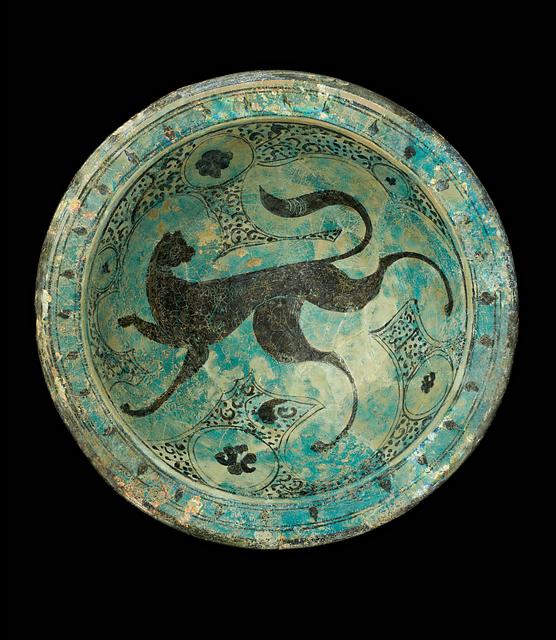
Fritware dish, painted in black under a transparent, turquoise glaze
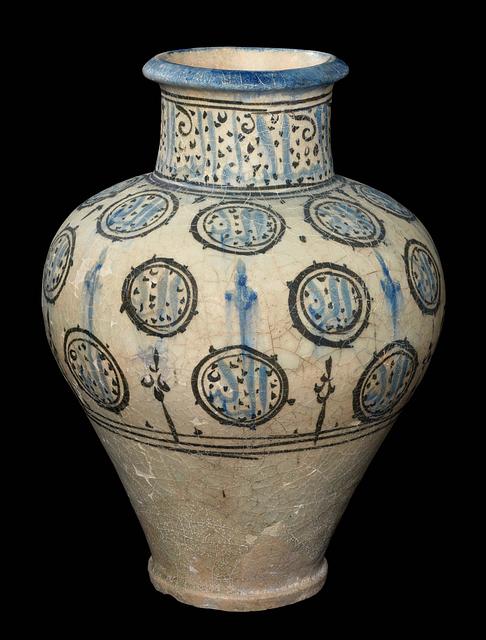
Fritware jar painted in black and blue under a transparent glaze
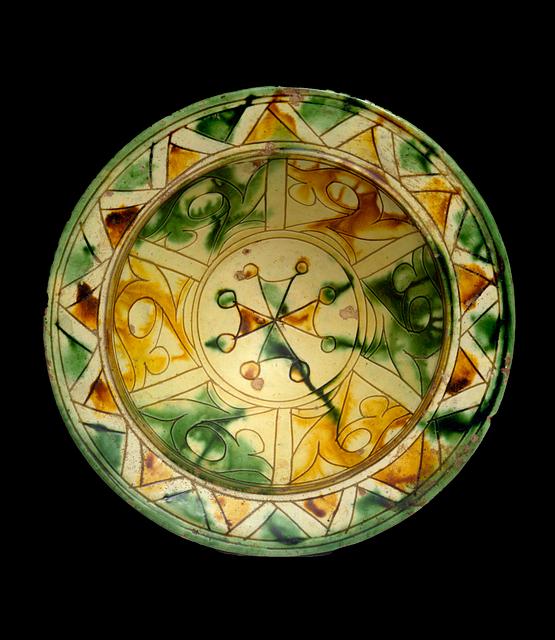
Earthenware bowl, covered with a white slip, incised, and painted in yellowish brown and green in a transparent glaze. Sgraffito type
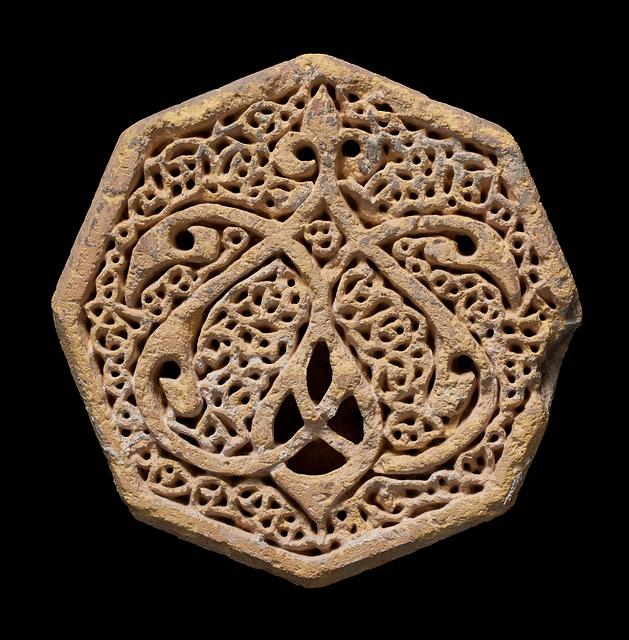
Earthenware tile, carved and unglazed