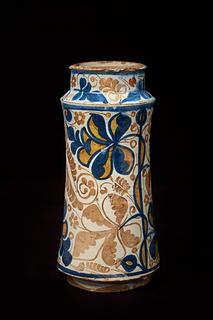
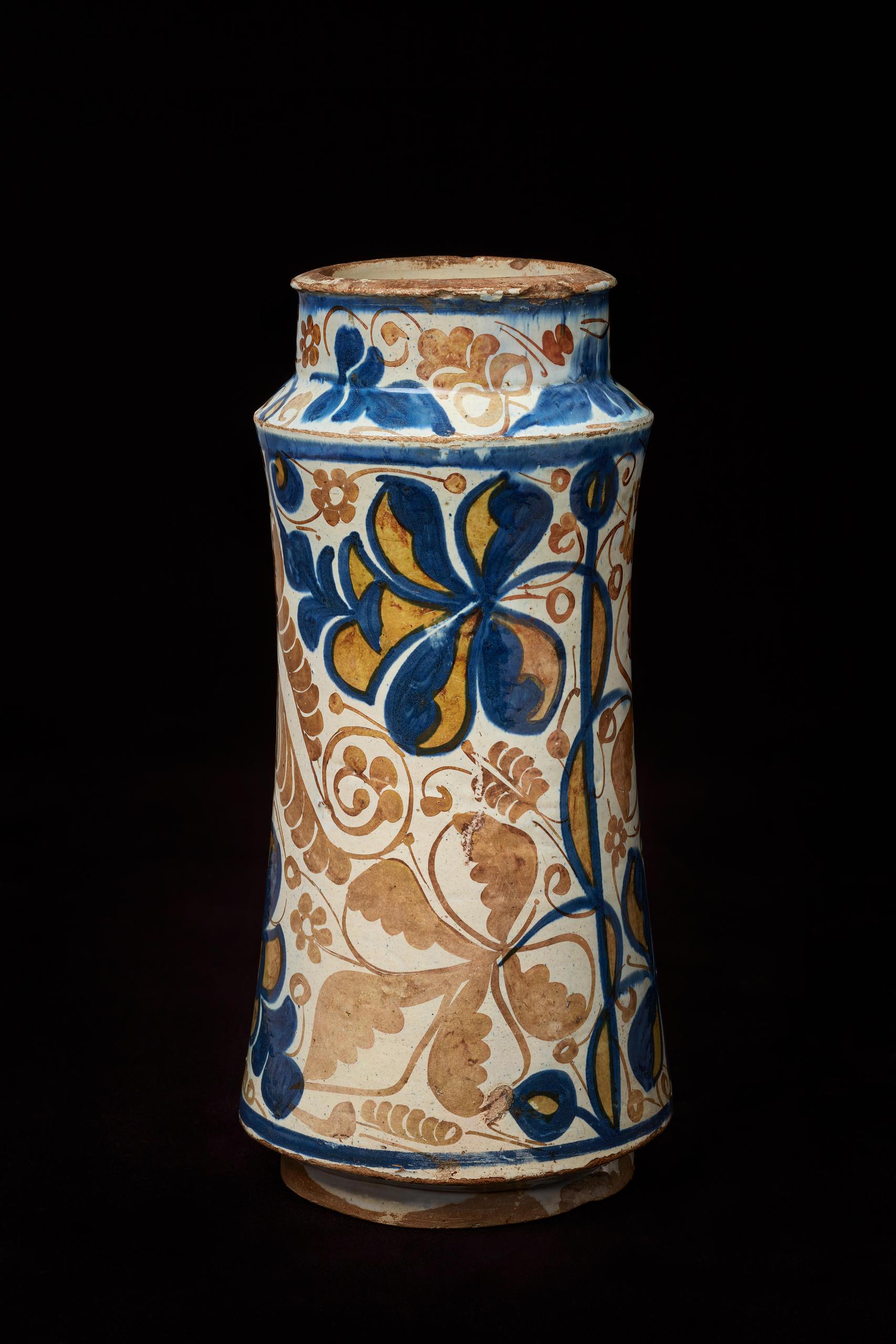
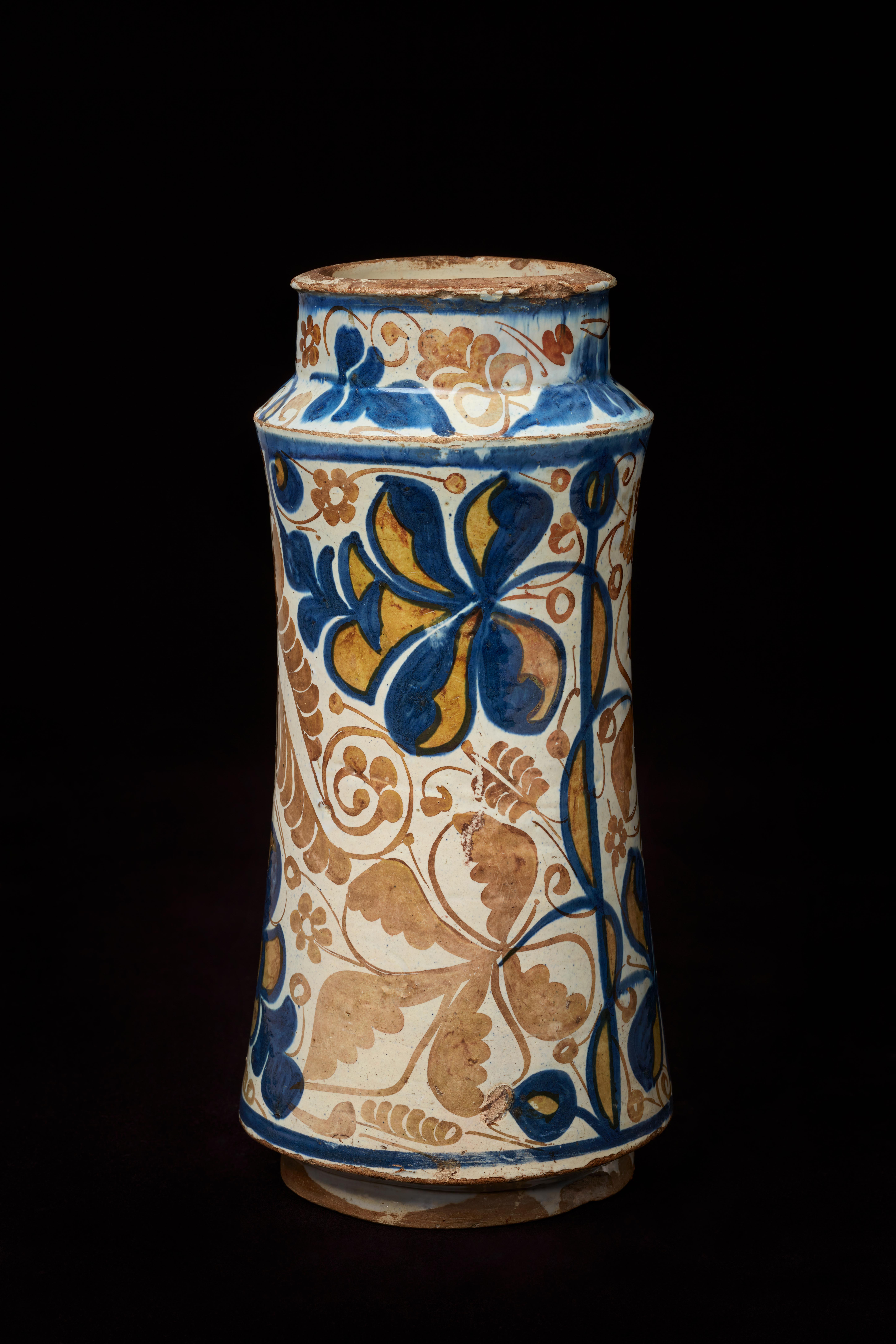
Earthenware albarello, painted in blue in, and with two tones of lustre over, an opaque, white glaze
Manises, Spain; 1st half of 15th century
H: 29.5 cm
Inventory number 14/1990
Both faience and the lustre technique reached Muslim Spain from Iraq by way of Egypt. In the middle of the 13th century, high-quality lustreware was made in Malaga, from which it spread with Muslim craftsmen to Christian Spain. This “Spanish-Moorish” pottery was exported e.g. to Italy, where it was called majolica or faience, after the island Mallorca and the town of Faenza.
A jar with concave sides is called an albarello, probably from the Spanish-Arabic word al-barrada – a jug. The type was most often used in pharmacies, since the shape made it easy to grasp the jars even when they stood in lines.
A jar with concave sides is called an albarello, probably from the Spanish-Arabic word al-barrada – a jug. The type was most often used in pharmacies, since the shape made it easy to grasp the jars even when they stood in lines.
Published in
Published in
Hotel des Ventes de Lyon, 12/6-1990, lot 3;
Kjeld von Folsach, Torben Lundbæk and Peder Mortensen (eds.): Sultan, Shah and Great Mughal: the history and culture of the Islamic world, The National Museum, Copenhagen 1996, cat.no. 200;
Kjeld von Folsach: Art from the World of Islam in The David Collection, Copenhagen 2001, cat.no. 112;
Sheila S. Blair and Jonathan M. Bloom (eds.): Cosmophilia. Islamic Art from the David Collection, Copenhagen, McMullen Museum of Art, Boston College, Boston 2006, cat.no. 90;
Kjeld von Folsach, Torben Lundbæk and Peder Mortensen (eds.): Sultan, Shah and Great Mughal: the history and culture of the Islamic world, The National Museum, Copenhagen 1996, cat.no. 200;
Kjeld von Folsach: Art from the World of Islam in The David Collection, Copenhagen 2001, cat.no. 112;
Sheila S. Blair and Jonathan M. Bloom (eds.): Cosmophilia. Islamic Art from the David Collection, Copenhagen, McMullen Museum of Art, Boston College, Boston 2006, cat.no. 90;
Ceramics
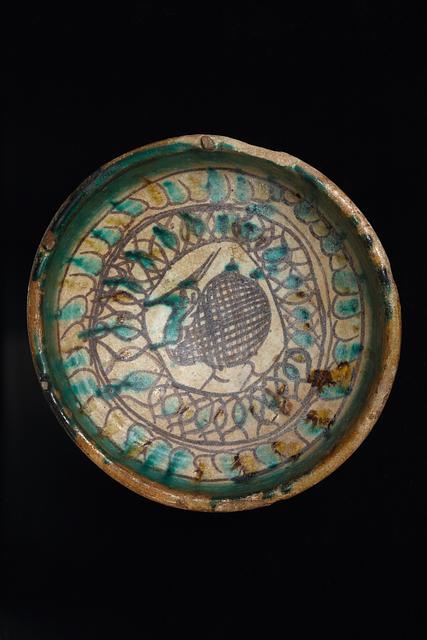
Earthenware bowl, covered with a white slip and painted in manganese, yellow, and green under and in a transparent glaze
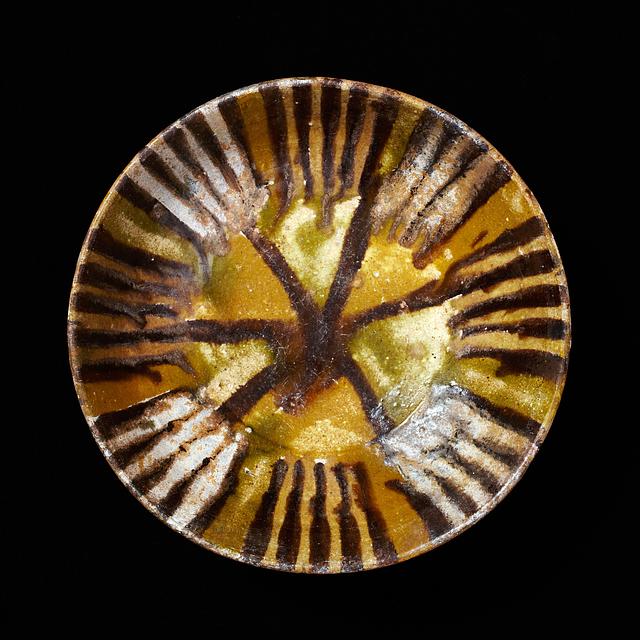
Earthenware bowl, covered with a thin, white slip and painted in yellow, green, and manganese under a transparent glaze. Fayyum type
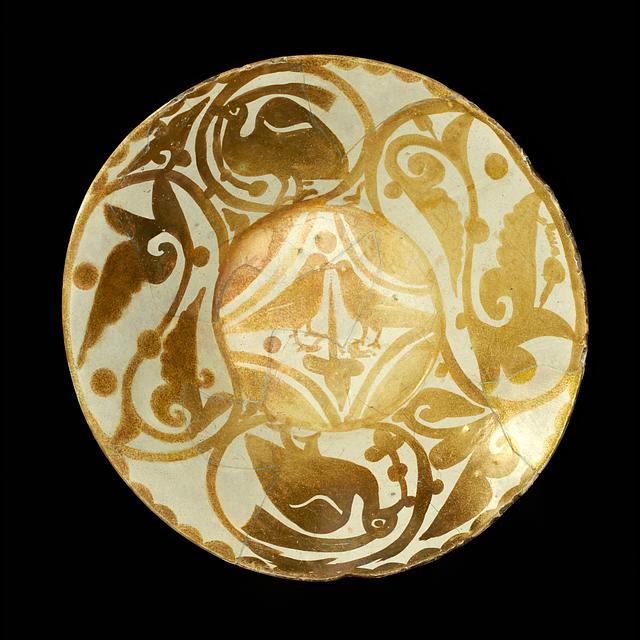
Fragmentary earthenware bowl, painted in lustre over an opaque, white glaze
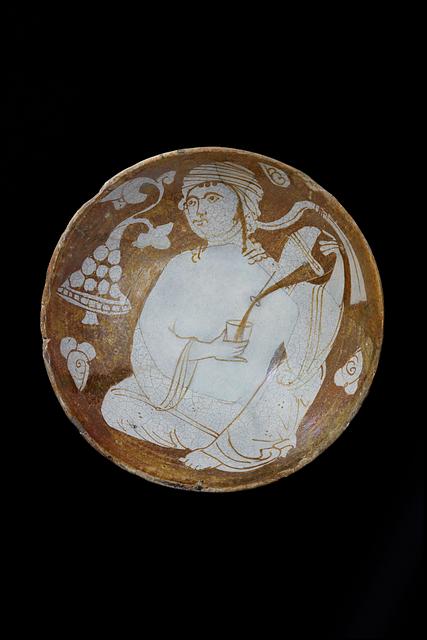
Earthenware bowl, painted in lustre over a white glaze