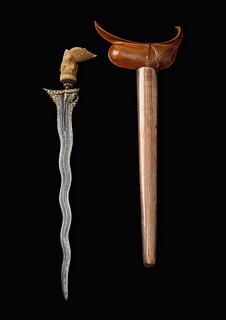
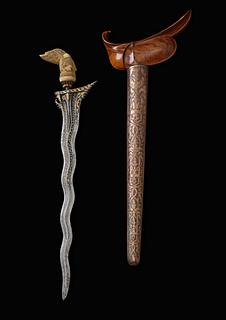
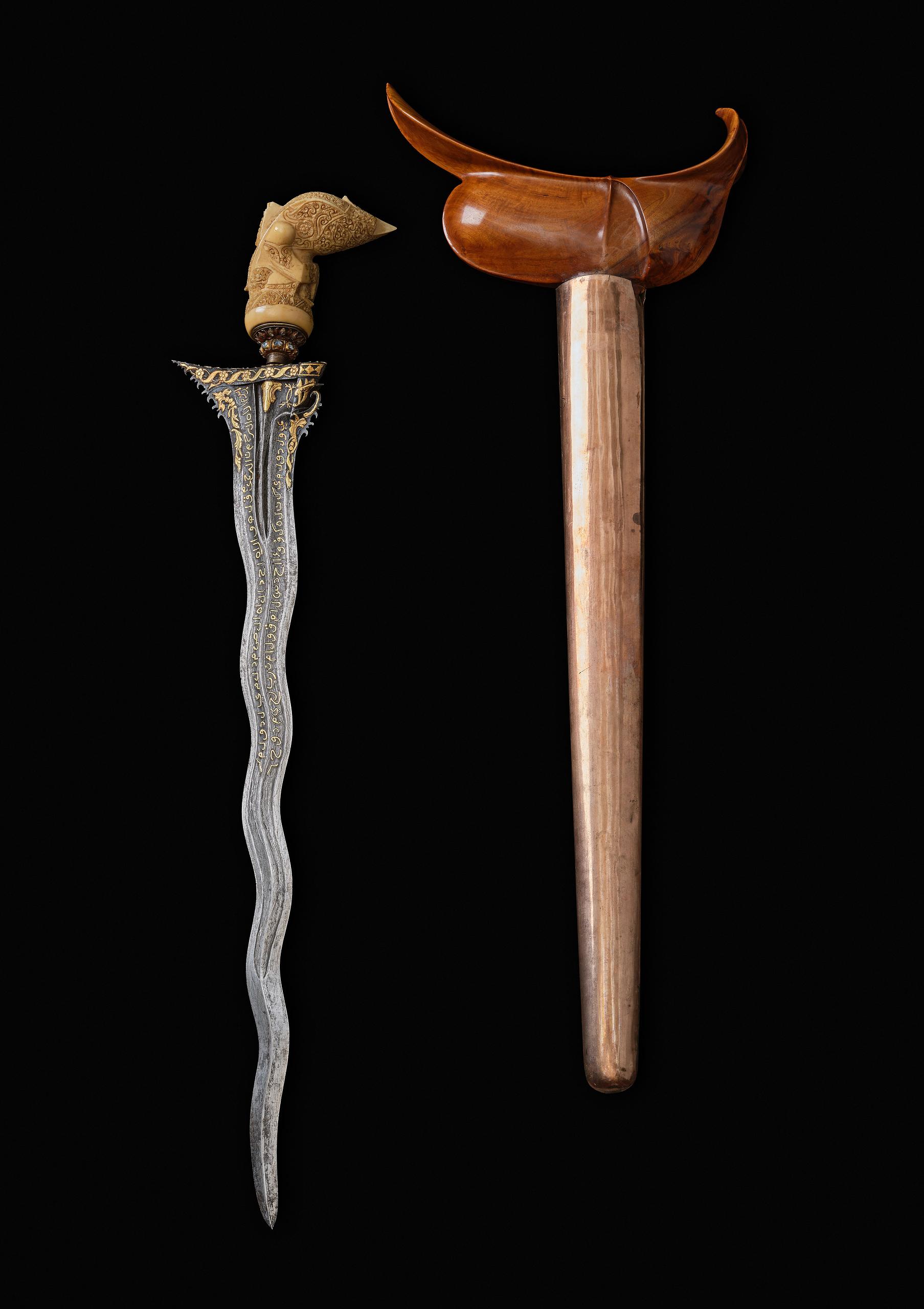
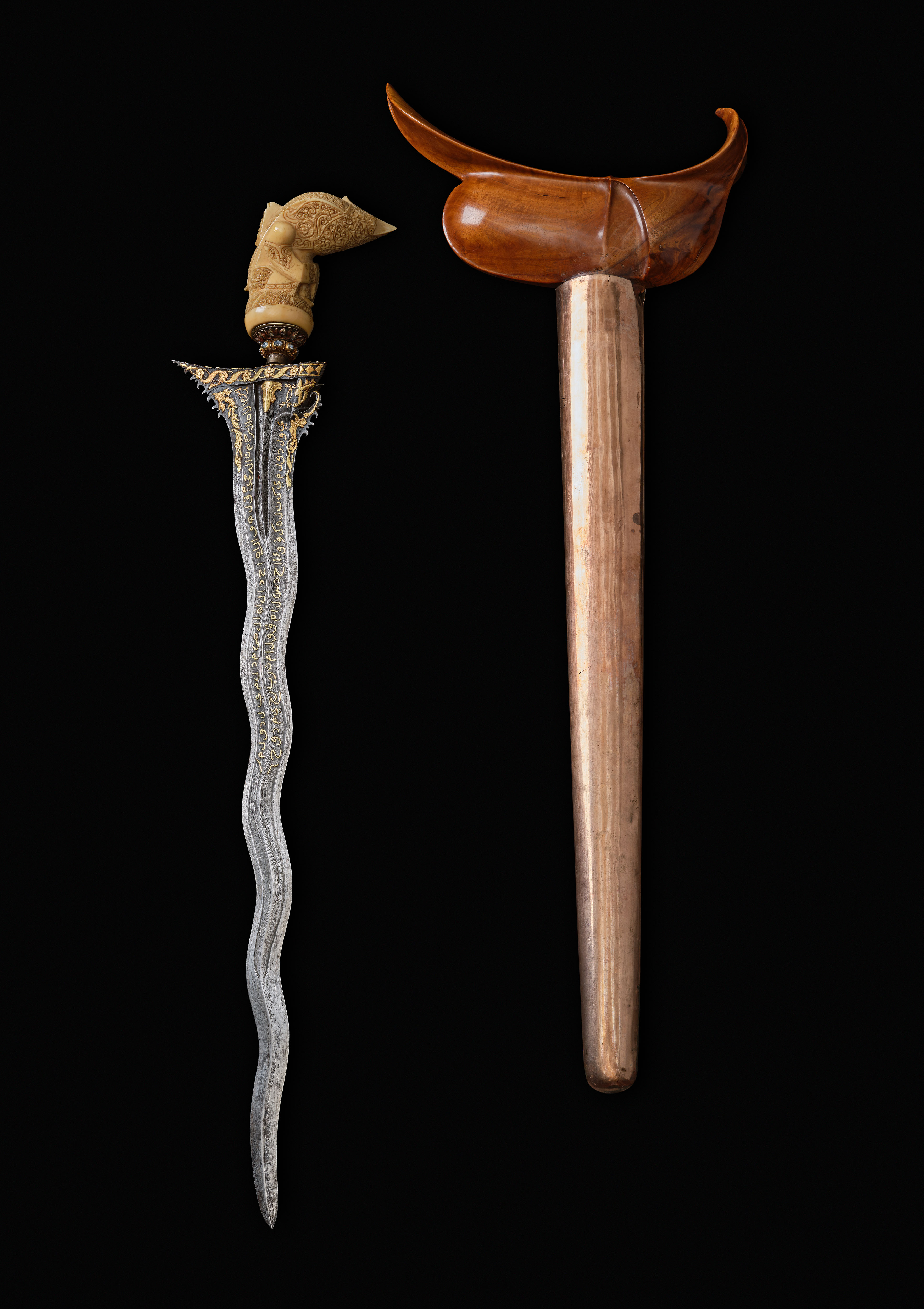
Dagger (kris) of steel inlaid with gold, hilt of hippopotamus tooth and gold inlaid with diamonds, sheath of wood and suasa metal
Indonesia, Sumatra; first third of the 19th century
L (dagger): 47; L (total): 49.5 cm
Inventory number 18a/2022 & 18b/2022
This sculptural weapon is known as a kris (or keris), the preferred sidearm for men in countries such as Malaysia, Indonesia and the Philippines up until modern times.1
The hilt is shaped like a stylised human or animal figure with a pointed, bird-like head. The figure is known as Java Demam (the fever-stricken Javanese) but is also associated with the bird creature Garuda from Hindu mythology.2 While hilts of this shape were widely used, the meticulously carved reliefs with curls and flowers as well as the diamond-encrusted gold ferrule that separates the hilt and blade are characteristic of Sumatra.3
The flame-shaped blade is forged from several bars of steel with the layers folded over and over, causing the surface to shimmer in darker and lighter tones. The blade is also decorated with inlaid gold, and given that the decoration on a kris traditionally reflected the wearer’s social standing, this piece must have belonged to a member of the elite.4
In addition to signifying status, the kris was also believed to have talismanic powers, and the gold-inlaid symbols and inscriptions adorning both sides of the blade were probably intended to strengthen such properties. The Arabic inscriptions consist mainly of Koranic quotations. Initially, the Koran’s sura 112 is quoted in its entirety. This sura, which describes the eternal and indivisible nature of God, was ascribed powerful protective properties throughout the Islamic world. The letters of the text are written out separately and without the joining strokes normally seen in Arabic script, an action which supposedly increased the talismanic effect of the inscription.5
The sheath (18b/2022) has a characteristic sculptural wooden locket, while its main body is made of suasa – an alloy of gold and copper which has a faint pink tinge.
The hilt is shaped like a stylised human or animal figure with a pointed, bird-like head. The figure is known as Java Demam (the fever-stricken Javanese) but is also associated with the bird creature Garuda from Hindu mythology.2 While hilts of this shape were widely used, the meticulously carved reliefs with curls and flowers as well as the diamond-encrusted gold ferrule that separates the hilt and blade are characteristic of Sumatra.3
The flame-shaped blade is forged from several bars of steel with the layers folded over and over, causing the surface to shimmer in darker and lighter tones. The blade is also decorated with inlaid gold, and given that the decoration on a kris traditionally reflected the wearer’s social standing, this piece must have belonged to a member of the elite.4
In addition to signifying status, the kris was also believed to have talismanic powers, and the gold-inlaid symbols and inscriptions adorning both sides of the blade were probably intended to strengthen such properties. The Arabic inscriptions consist mainly of Koranic quotations. Initially, the Koran’s sura 112 is quoted in its entirety. This sura, which describes the eternal and indivisible nature of God, was ascribed powerful protective properties throughout the Islamic world. The letters of the text are written out separately and without the joining strokes normally seen in Arabic script, an action which supposedly increased the talismanic effect of the inscription.5
The sheath (18b/2022) has a characteristic sculptural wooden locket, while its main body is made of suasa – an alloy of gold and copper which has a faint pink tinge.
Published in
Published in
a
Joachim Meyer, Rasmus Bech Olsen and Peter Wandel: Beyond words: calligraphy from the World of Islam, The David Collection, Copenhagen 2024, cat. 124, pp. 298-299;
Joachim Meyer, Rasmus Bech Olsen and Peter Wandel: Beyond words: calligraphy from the World of Islam, The David Collection, Copenhagen 2024, cat. 124, pp. 298-299;
Footnotes
Footnotes
1.
Liana Saif: ‘Amulets, Magic and Talismans’ in Finbarr Barry Flood and Gülru Necipoglu (eds.) A Companion to Islamic art and architecture, Blackwell Companions to art history, Hoboken 2017, pp. 521–556.
2.
Edward Frey: The Kris: Mystic Weapon of the Malay World, 3rd ed., Kuala Lumpur 2010, pp. 21–22.
3.
Robert Hales: Islamic and Oriental Arms and Armour: A Lifetime’s Passion, London 2013, cat. 301.
4.
Lucien de Guise (ed.): The Message and the Monsoon: Islamic Art of Southeast Asia from the Collection of the Islamic Arts Museum Malaysia, Kuala Lumpur 2005, p. 158.
5.
Edward Frey: The Kris: Mystic Weapon of the Malay World, 3rd ed., Kuala Lumpur 2010, p. 17.