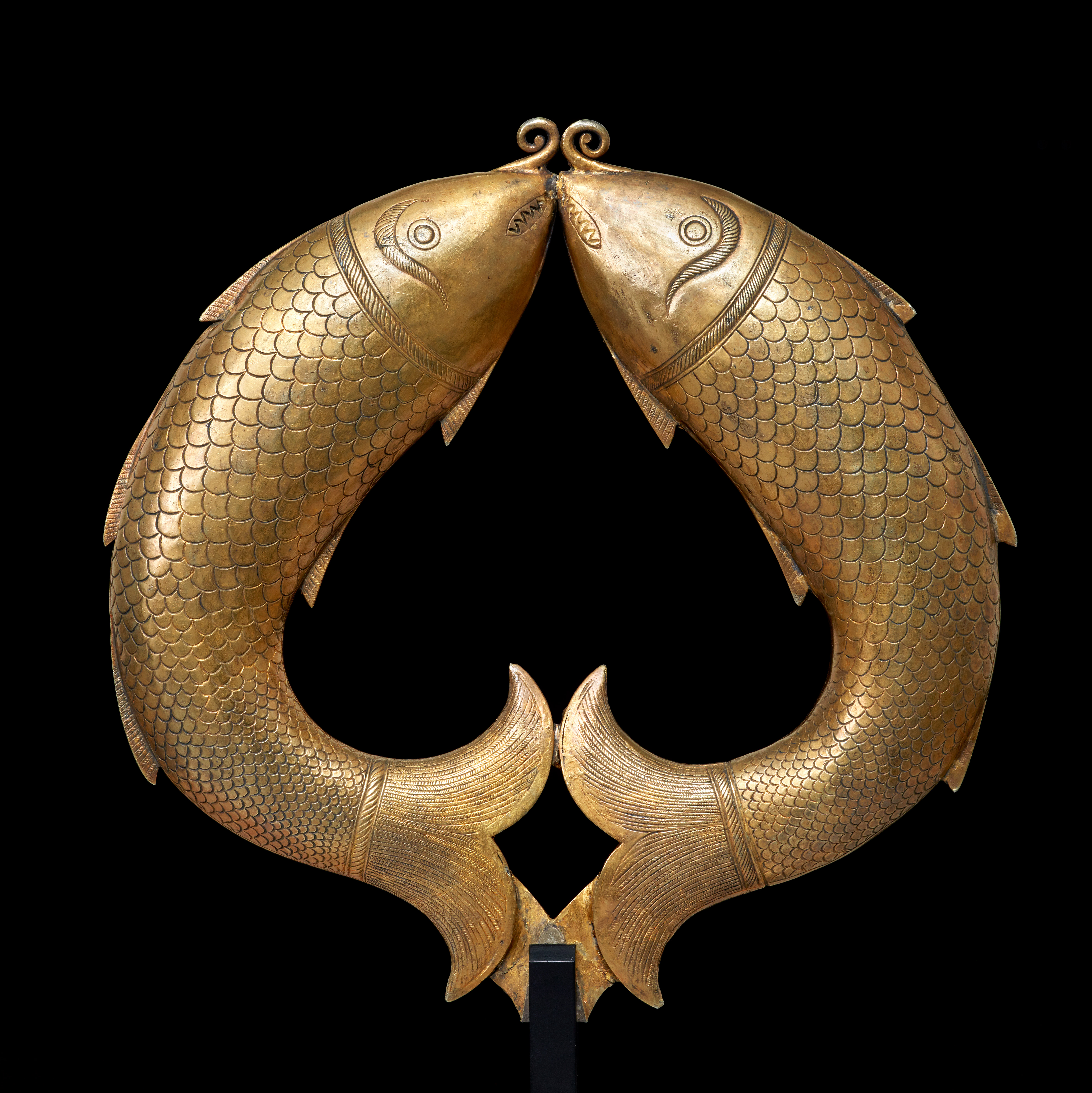
Standard (mahi-maratib) of gilt and engraved silver
India, Awadh, Lucknow; c. 1800
H: 24.5 cm
Inventory number 9/1998
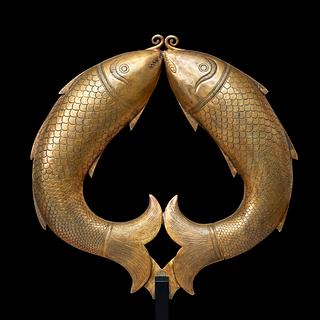
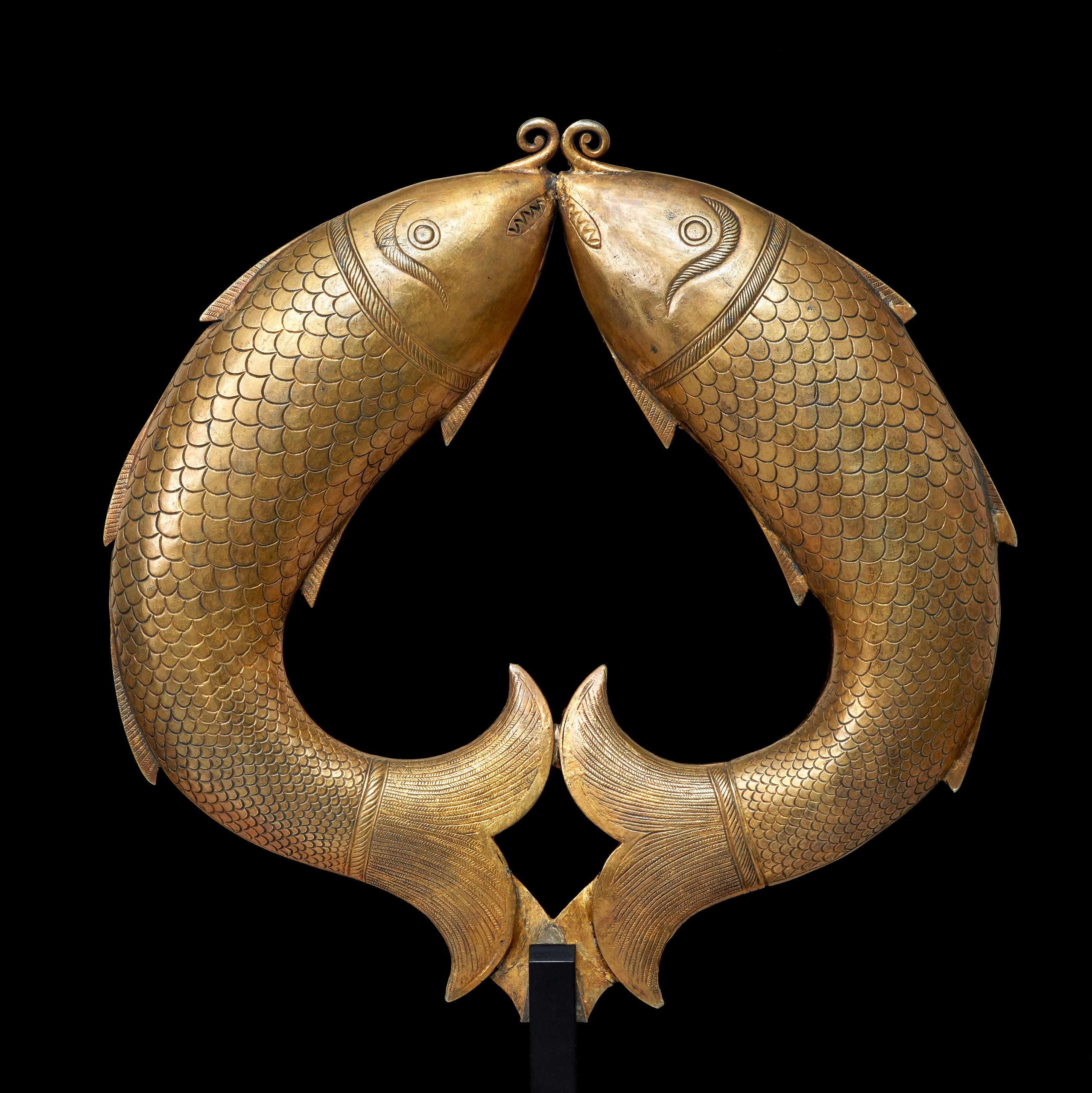
Fish-shaped standards (mahi-maratib) were used as princely and military emblems in several places in the Islamic world, but are especially known from India.
The two fish that make up this standard each consist of two soldered silver shells with engraved details such as fish scales, eyes and even eyebrows (!). Originally mounted on a pole, the standard would have served as an emblem for a member of the dynasty that ruled the North Indian Awadh province as nawwabs (governors) for the Mughal emperors in the period 1722 to 1856.
In the middle of the eighteenth century, the nawwab Safdar Jang (d. 1754), who was also the Grand Vizier of the Mughal emperor, received the emperor’s permission to use the fish as his personal coat of arms. The privilege was passed down to his descendants, and fish symbols can be seen in the architecture of the capital of the nawwabs, Lucknow, as well as on their coins (C 437).
The Indian fish standards also include examples made entirely or partly of fabric. Such standards appear in miniature paintings; for example, the type is depicted at the top left of a princely portrait from seventeenth-century Deccan (13/2015).
India’s Muslim princes may have taken over the fish symbol from the Timurids, who ruled Iran and Central Asia in the fifteenth and sixteenth centuries.1 However, the use of the fish as a symbol of power dates much further back and may have originated in pre-Islamic Iran.
The two fish that make up this standard each consist of two soldered silver shells with engraved details such as fish scales, eyes and even eyebrows (!). Originally mounted on a pole, the standard would have served as an emblem for a member of the dynasty that ruled the North Indian Awadh province as nawwabs (governors) for the Mughal emperors in the period 1722 to 1856.
In the middle of the eighteenth century, the nawwab Safdar Jang (d. 1754), who was also the Grand Vizier of the Mughal emperor, received the emperor’s permission to use the fish as his personal coat of arms. The privilege was passed down to his descendants, and fish symbols can be seen in the architecture of the capital of the nawwabs, Lucknow, as well as on their coins (C 437).
The Indian fish standards also include examples made entirely or partly of fabric. Such standards appear in miniature paintings; for example, the type is depicted at the top left of a princely portrait from seventeenth-century Deccan (13/2015).
India’s Muslim princes may have taken over the fish symbol from the Timurids, who ruled Iran and Central Asia in the fifteenth and sixteenth centuries.1 However, the use of the fish as a symbol of power dates much further back and may have originated in pre-Islamic Iran.
Published in
Published in
Kjeld von Folsach: Art from the World of Islam in The David Collection, Copenhagen 2001 , cat.no. 558;
Filiz Cakir Phillip (ed.): Emperors and jewels: Treasures of the Indian courts from the al-Sabah Collection, Kuwait, Aga Khan Museum, Toronto [2018], p. 33;
Kjeld von Folsach, Joachim Meyer and Peter Wandel: Fighting, Hunting, Impressing. Arms and Armour from the Islamic World 1500-1850, The David Collection, Copenhagen 2021 , cat.no. 15;
Filiz Cakir Phillip (ed.): Emperors and jewels: Treasures of the Indian courts from the al-Sabah Collection, Kuwait, Aga Khan Museum, Toronto [2018], p. 33;
Kjeld von Folsach, Joachim Meyer and Peter Wandel: Fighting, Hunting, Impressing. Arms and Armour from the Islamic World 1500-1850, The David Collection, Copenhagen 2021 , cat.no. 15;
Footnotes
Footnotes
1.
J. Burton-Page: ‘Maratib’ in Encyclopedia of Islam, New edition, Leiden 1960–2002.