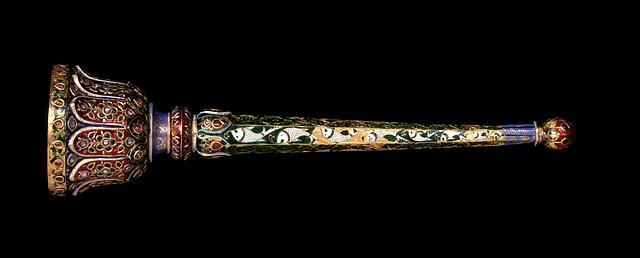
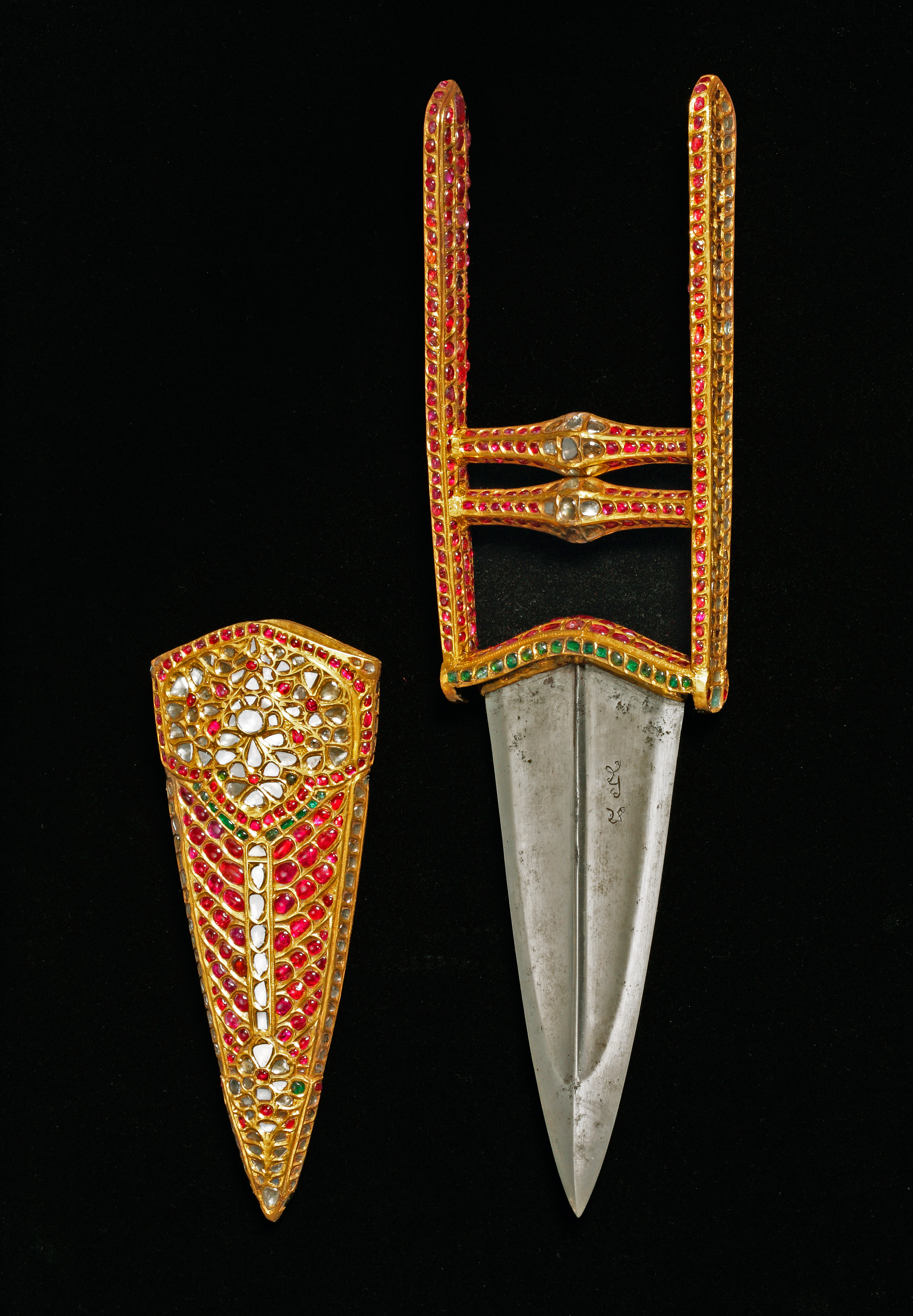
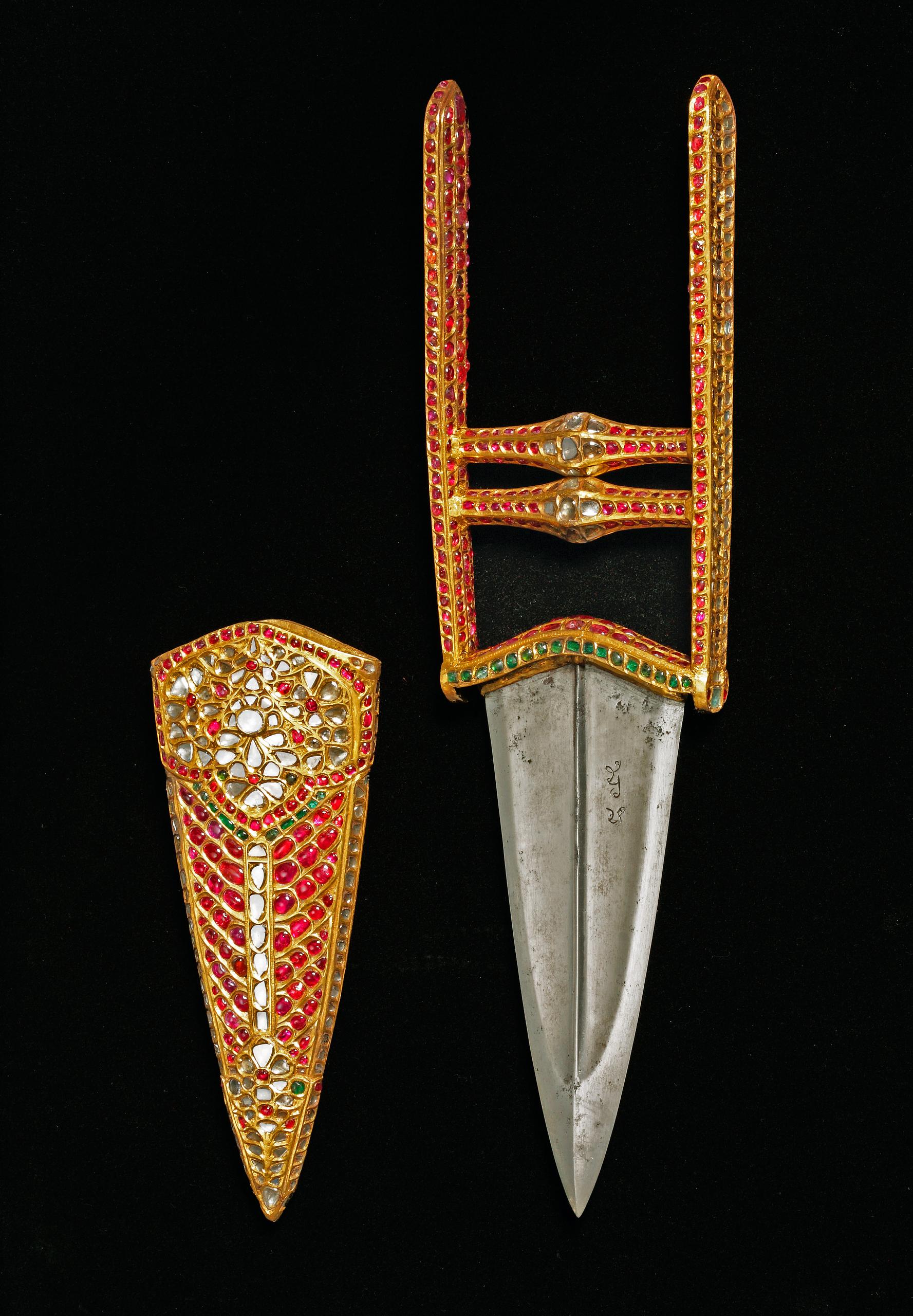
Dagger (katar) with gold hilt and scabbard, set with rubies, emeralds, and diamonds
India; end of 18th century
L. incl. scabbard: 35.9 cm
Inventory number 3/1983
The katar, with its powerful, double-edged blade and H-shaped hilt that protects both hand and wrist, is typical of India. It is often found on miniature paintings after 1550, and jeweled katars seem to have been standard equipment for princes far into the 19th century.
This katar comes from Hyderabad in the Deccan, which was allied with the British against Tipu Sultan from Mysore. The dagger is said to have belonged to Tipu Sultan himself. The “Tiger from Mysore” was a formidable opponent of the British until he was killed in the defense of his capital of Seringapatam in 1799.
This katar comes from Hyderabad in the Deccan, which was allied with the British against Tipu Sultan from Mysore. The dagger is said to have belonged to Tipu Sultan himself. The “Tiger from Mysore” was a formidable opponent of the British until he was killed in the defense of his capital of Seringapatam in 1799.
Published in
Published in
Kjeld von Folsach, Torben Lundbæk and Peder Mortensen (eds.): Sultan, Shah and Great Mughal: the history and culture of the Islamic world, The National Museum, Copenhagen 1996, cat.no. 338;
Kjeld von Folsach: Art from the World of Islam in The David Collection, Copenhagen 2001, cat.no. 573;
Ravinder Reddy: Arms and armour of India, Nepal and Sri Lanka: types, decoration and symbolism, London 2018, p. 215;
Kjeld von Folsach, Joachim Meyer and Peter Wandel: Fighting, Hunting, Impressing. Arms and Armour from the Islamic World 1500-1850, The David Collection, Copenhagen 2021, cat.no. 127 and Appendix, p. 278;
Kjeld von Folsach: Art from the World of Islam in The David Collection, Copenhagen 2001, cat.no. 573;
Ravinder Reddy: Arms and armour of India, Nepal and Sri Lanka: types, decoration and symbolism, London 2018, p. 215;
Kjeld von Folsach, Joachim Meyer and Peter Wandel: Fighting, Hunting, Impressing. Arms and Armour from the Islamic World 1500-1850, The David Collection, Copenhagen 2021, cat.no. 127 and Appendix, p. 278;
Metalwork, Weapons and Jewelry