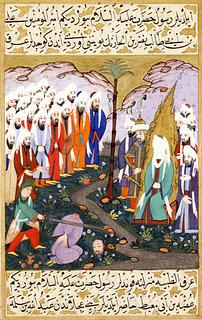
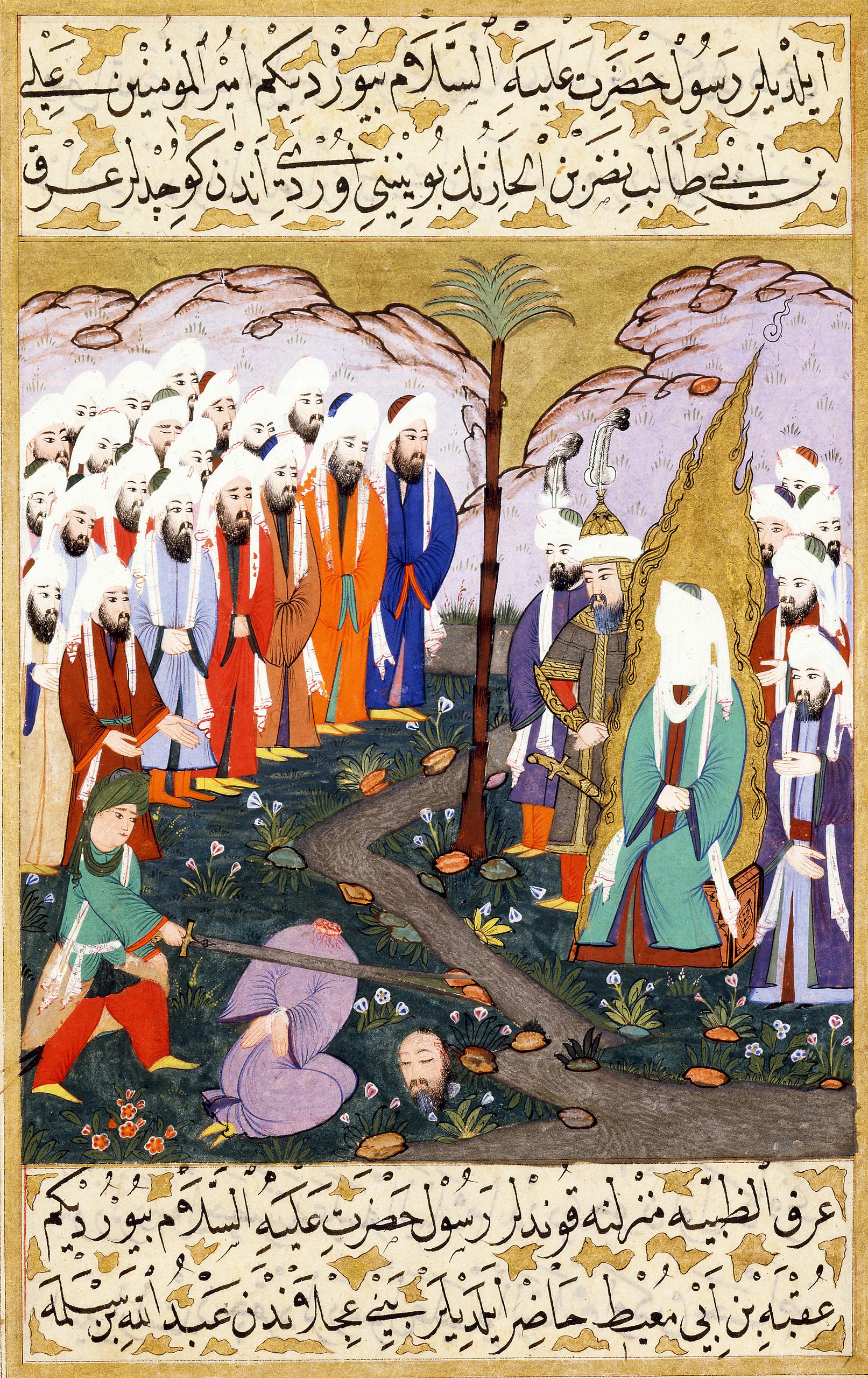
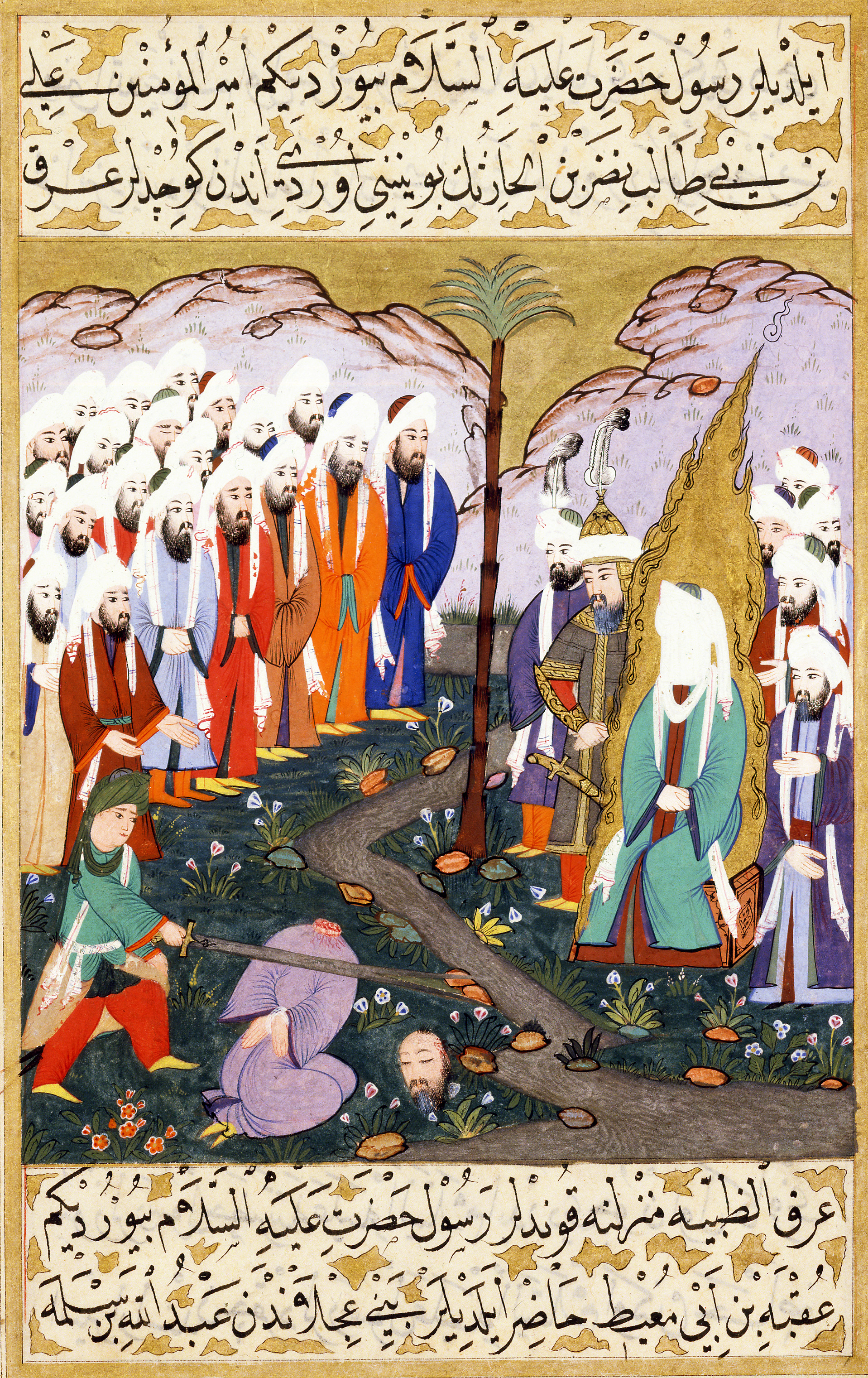
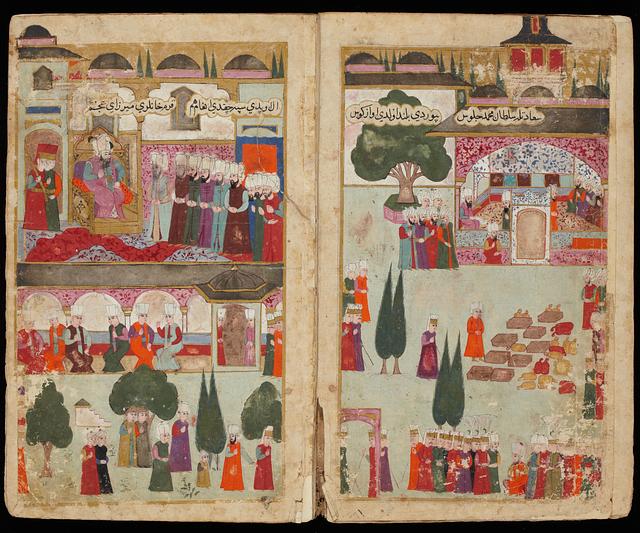
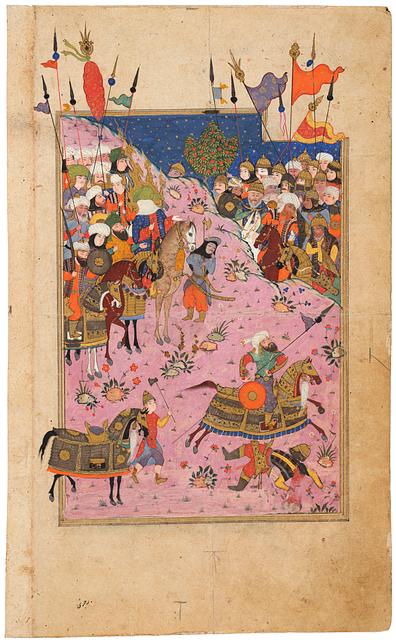
Miniature from volume 4 of a copy of Mustafa al-Darir’s Siyar-i-Nabi (Life of the Prophet). ’Ali Beheading Nadr ibn al-Harith in the Presence of the Prophet Muhammad’
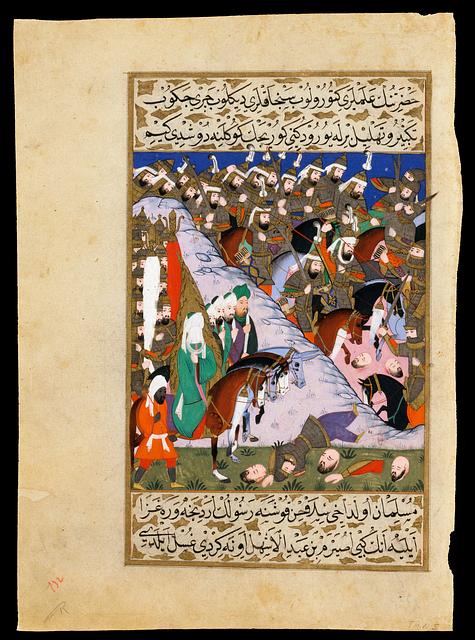
Ottoman painting had its heyday in the latter half of the 16th century. Its palette was simpler and more straightforward than that of its much-admired models from Iran. There is a detached look about the veiled Prophet and the statue-like bystanders, only one of whom shuts his eyes in horror.
Published in
Published in
(V. Minorsky: The Chester Beatty Library. A Catalogue of the Turkish Manuscripts and Miniatures, Dublin 1958, s. 30-40, regarding the manuscript itself, from which the miniature likely originates);
Sotheby’s, London 15/4 1985, lot 176;
Art from the World of Islam. 8th-18th century, Louisiana, Humlebæk 1987, cat. 213;
Kjeld von Folsach: Islamic Art. The David Collection, Copenhagen 1990, cat. 57;
Kjeld von Folsach, Torben Lundbæk and Peder Mortensen (eds.): Sultan, Shah and Great Mughal. The History and Culture of the Islamic World, National Museum, Copenhagen 1996, cat. 44;
Kjeld von Folsach: Art from the world of Islam in the David Collection, Copenhagen 2001, cat. 85;
Kjeld von Folsach: For the Privileged Few. Islamic Miniature Painting from The David Collection, Louisiana, Humlebæk 2007, cat. 60;
Jakob Skovgaard-Petersen: Muslimernes Muhammad, og alle andres, København 2020, s. 344;
Thomas Hoffmann: “The Sword of Islam. Concerning Fighting and Arms in the Koran and Hadith,” in Kjeld von Folsach, Joachim Meyer and Peter Wandel (eds.): Fighting, Hunting, Impressing. Arms and Armour from the Islamic World 1500-1850, Davids Samling, Copenhagen 2021, fig. 3, p. 19;