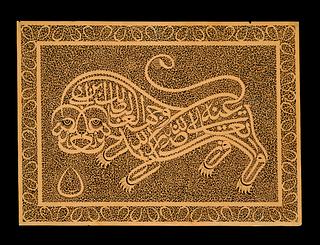
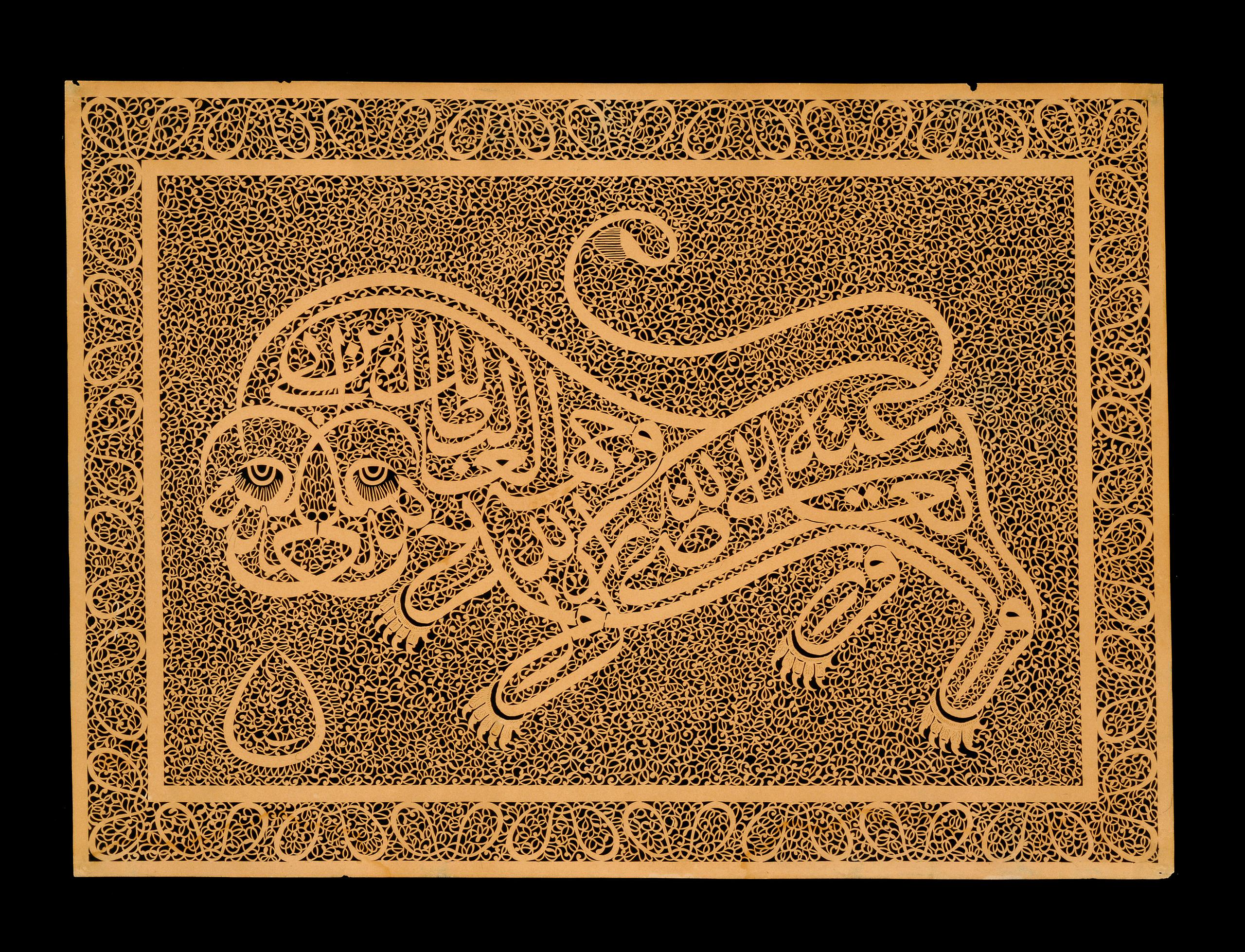
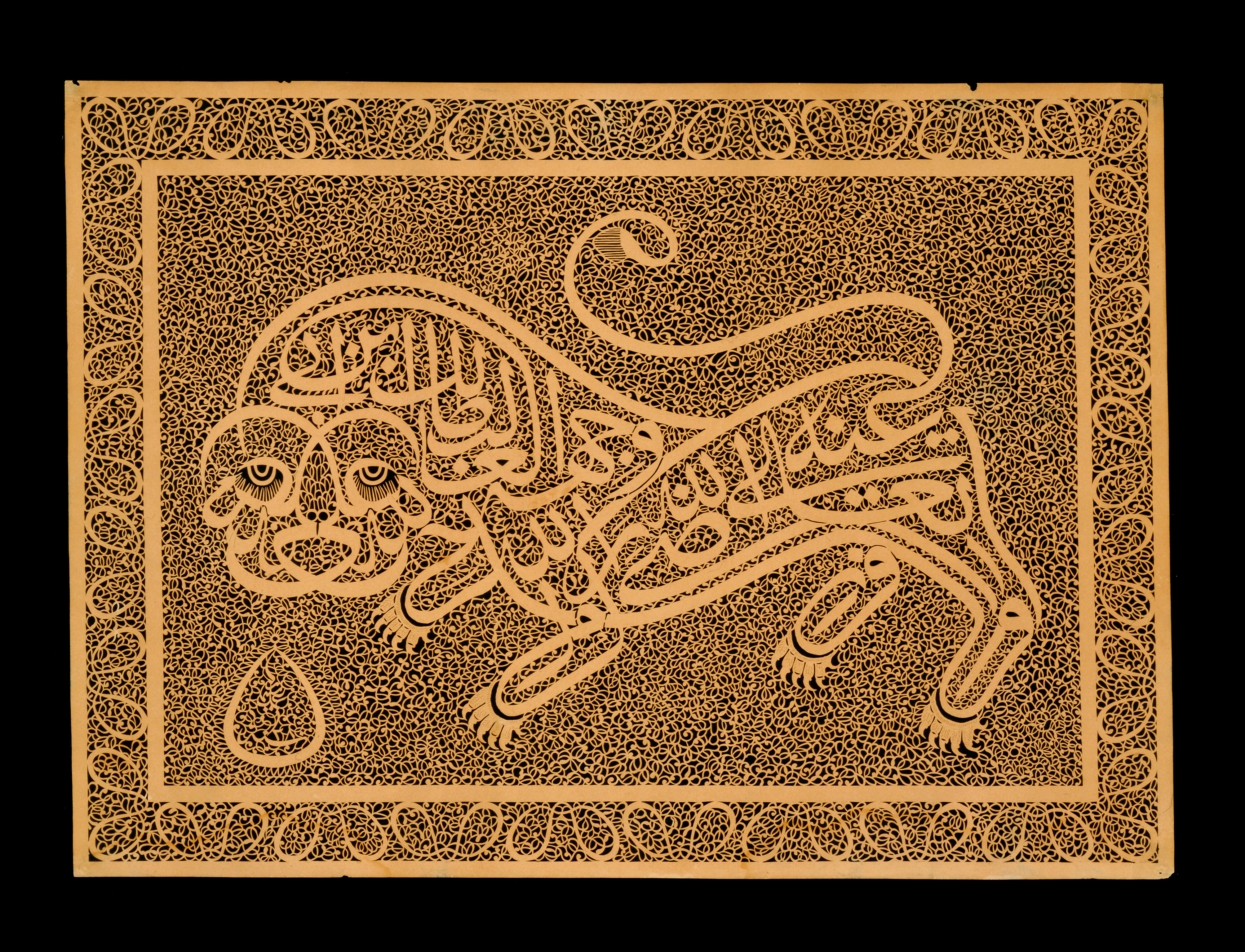
Paper cut with a calligraphic lion
Turkey; 1280 H = 1863-1864
33 × 45,5 cm
Inventory number 21/1974
A calligrapher’s subtle play with script and image are the basis for this paper clip. Read from tail to head, the lion comprises a tribute to the Prophet Muhammad’s cousin and son-in-law, Ali: “May God bless his countenance and be satisfied with him, God’s victorious lion, Ali ibn Abi Talib.”
This motif in particular was popular among the Bektashi Sufi order, which became widespread in Turkey in the 13th century. The Bektashis considered Ali to be a divine manifestation on earth and personified him as a lion, in keeping with Shiite practice. The work is signed in the drop shape in the lower left corner: “Made by Sulayman, 1280 H” (1863-1864). The work was done with a sharp knife, not scissors.
This motif in particular was popular among the Bektashi Sufi order, which became widespread in Turkey in the 13th century. The Bektashis considered Ali to be a divine manifestation on earth and personified him as a lion, in keeping with Shiite practice. The work is signed in the drop shape in the lower left corner: “Made by Sulayman, 1280 H” (1863-1864). The work was done with a sharp knife, not scissors.
Published in
Published in
Sheila S. Blair and Jonathan M. Bloom (eds.): Cosmophilia. Islamic Art from the David Collection, Copenhagen, McMullen Museum of Art, Boston College, Boston 2006, cat.no. 121;
Alina Kokoschka: “Reading between the lines: Arabic script, Islamic calligraphy, and the question of legibility” in Bettina Gräf, Birgit Krawietz, Schirin Amir-Moazami (eds.): Ways of knowing Muslim cultures and societies: studies in honour of Gudrun Krämer, Leiden [2019], p. 258, and p. 261, ill. 11,11;
Marie Møller Kristensen: Skrift – fra billeder til bits, København 2020, fig. 26, pp. 64-65;
Farouk Yahya: “Calligrams of the Lion of ‘Alî in Southeast Asia” in Liana Saif [et al.] (ed.): Islamicate occult sciences in theory and practice, Leiden 2020, fig, 11.1, p. 467;
Asja Gimborg: Velikolepnyj vek osmanskogo iskusstva: dvorcy, meceti, garemy i nocnoj Bosfor, Moskva 2023, pp. 30-31;
Joachim Meyer, Rasmus Bech Olsen and Peter Wandel: Beyond words: calligraphy from the World of Islam, The David Collection, Copenhagen 2024, cat. 31, pp. 164-165;
Rasmus Bech Olsen: “Beyond words: calligraphy from the World of Islam”, Orientations, 55:4, 2024, fig. 1, p. 34;
Alina Kokoschka: “Reading between the lines: Arabic script, Islamic calligraphy, and the question of legibility” in Bettina Gräf, Birgit Krawietz, Schirin Amir-Moazami (eds.): Ways of knowing Muslim cultures and societies: studies in honour of Gudrun Krämer, Leiden [2019], p. 258, and p. 261, ill. 11,11;
Marie Møller Kristensen: Skrift – fra billeder til bits, København 2020, fig. 26, pp. 64-65;
Farouk Yahya: “Calligrams of the Lion of ‘Alî in Southeast Asia” in Liana Saif [et al.] (ed.): Islamicate occult sciences in theory and practice, Leiden 2020, fig, 11.1, p. 467;
Asja Gimborg: Velikolepnyj vek osmanskogo iskusstva: dvorcy, meceti, garemy i nocnoj Bosfor, Moskva 2023, pp. 30-31;
Joachim Meyer, Rasmus Bech Olsen and Peter Wandel: Beyond words: calligraphy from the World of Islam, The David Collection, Copenhagen 2024, cat. 31, pp. 164-165;
Rasmus Bech Olsen: “Beyond words: calligraphy from the World of Islam”, Orientations, 55:4, 2024, fig. 1, p. 34;
The Ottomans
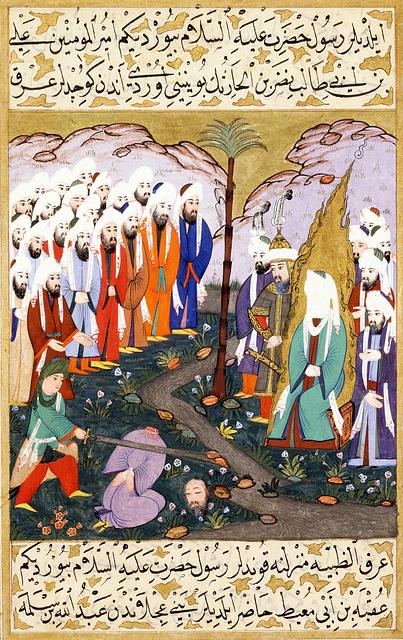
Miniature from volume 4 of a copy of Mustafa al-Darir’s Siyar-i-Nabi (Life of the Prophet). ’Ali Beheading Nadr ibn al-Harith in the Presence of the Prophet Muhammad’
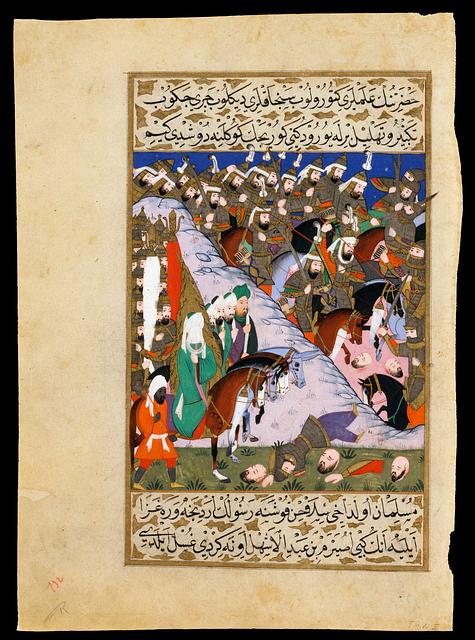
Miniature from volume 4 of a copy of Mustafa al-Darir’s Siyar-i Nabi (Life of the Prophet). ’The Prophet Muhammad and the Muslim Army at the Battle of Uhud’
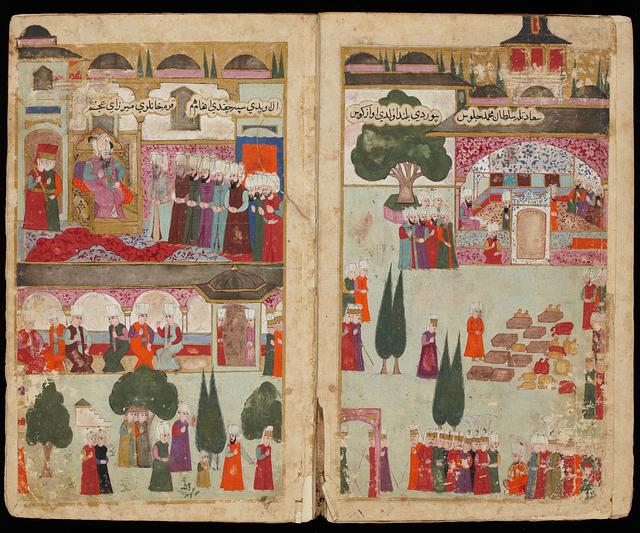
Manuscript written by Seyyid Lokman on Mehmed III’s Campaign in Hungary. First double miniature fol. 15v-16r, ’Mehmed III’s Coronation in the Topkapi Palace in 1595’
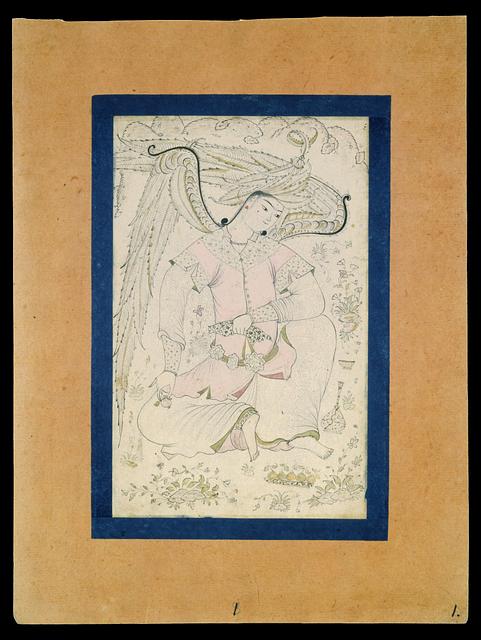
Partly colored drawing pasted on an album leaf. ‘Seated Peri with a Pomegranate’