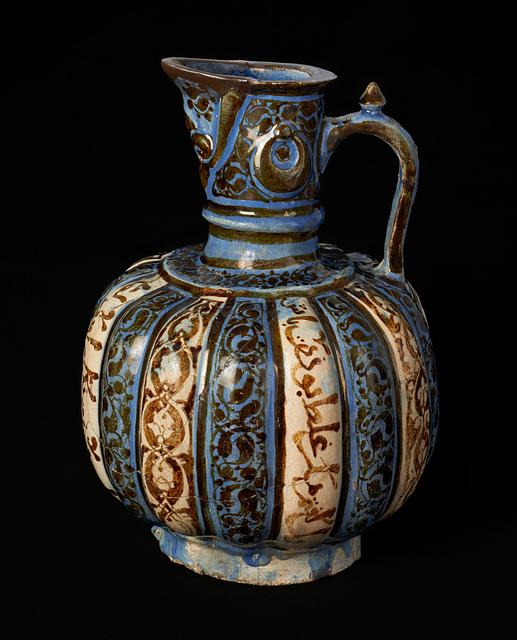
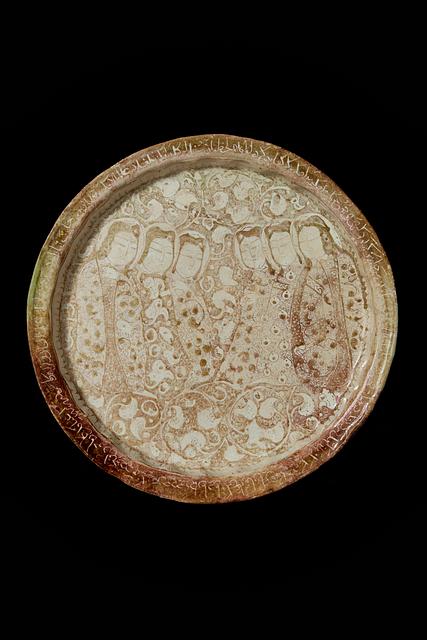
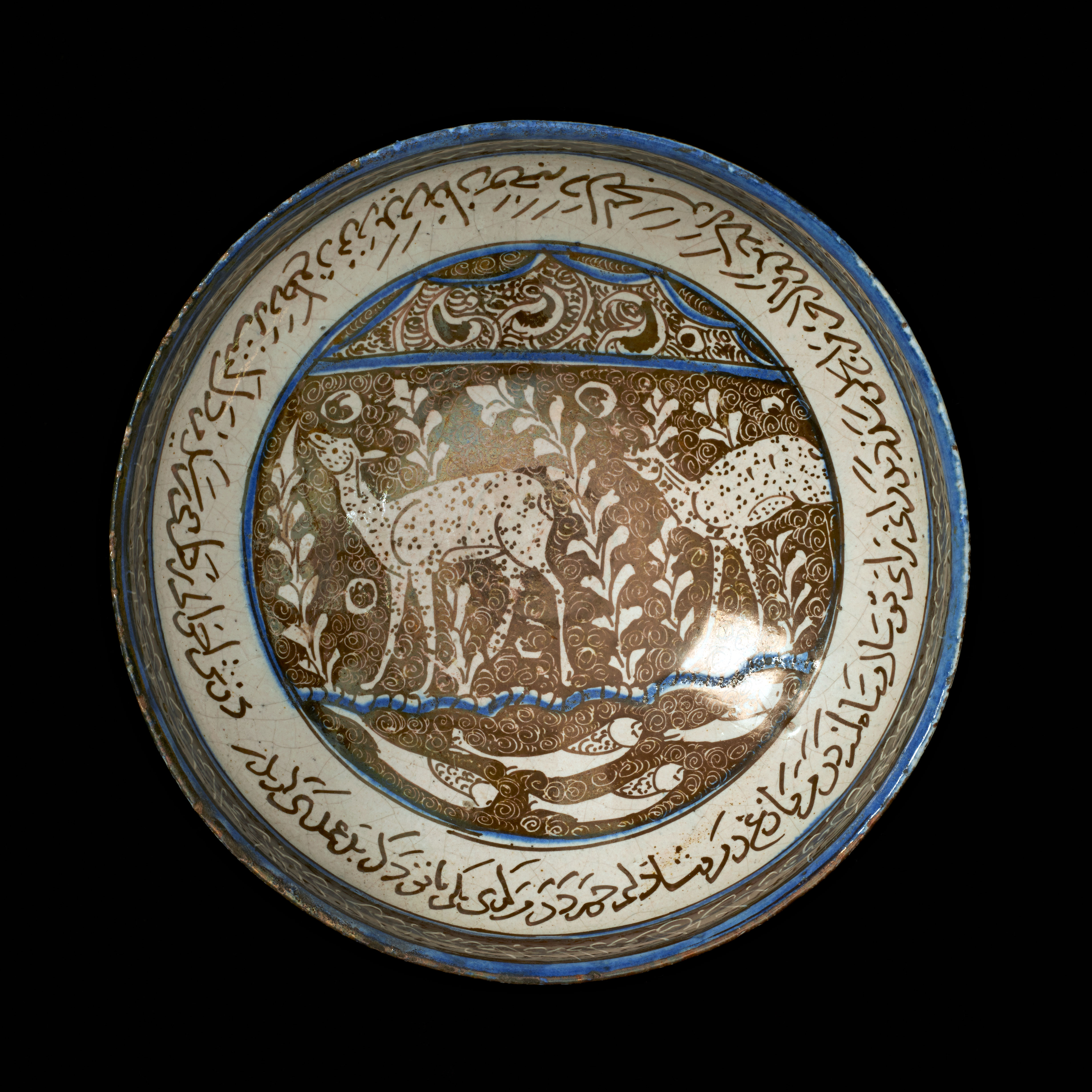
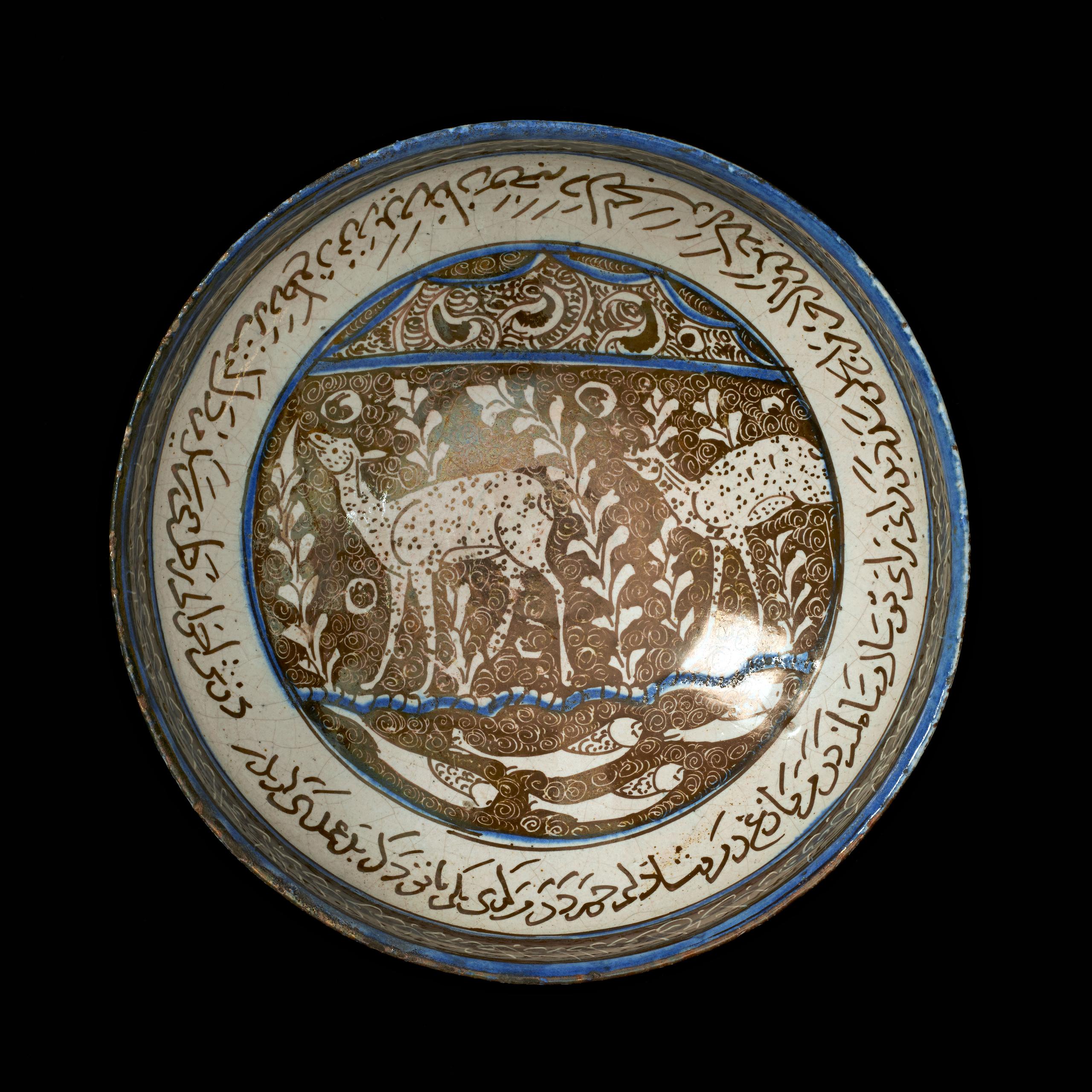
Fritware bowl, painted in blue in, and in lustre over, an opaque, white glaze
Iran, Kashan; beginning of 13th century
H: 8; Diam: 15.3 cm
Inventory number Isl 64
This elegant and very well-preserved bowl belongs to a group that after World War II was found buried in large, unglazed jars in Gorgan, east of the Caspian Sea. The jars were undoubtedly a merchant’s hoard hidden away in advance of the Mongols’ destructive attack in 1220.
An inscription on a bowl from the group that is found today in the Victoria and Albert Museum in London shows that the pottery was not made locally. It carries the potter’s signature: “Muhammad from Nishapur, living in Kashan.” The inscriptions on these two bowls are Persian love poems that might have had a mystical, religious significance.
An inscription on a bowl from the group that is found today in the Victoria and Albert Museum in London shows that the pottery was not made locally. It carries the potter’s signature: “Muhammad from Nishapur, living in Kashan.” The inscriptions on these two bowls are Persian love poems that might have had a mystical, religious significance.
Published in
Published in
Mehdi Bahrami: Gurgan faiences, Cairo 1949, pl. 56 and fig. 28;
André Leth: Davids Samling. Islamisk kunst = The David Collection. Islamic Art, København 1975, pp. 53-54;
Art from the World of Islam. 8th-18th century, Louisiana, Humlebæk 1987, cat.no. 104;
Kjeld von Folsach: Islamic art. The David Collection, Copenhagen 1990, cat.no.102;
Kjeld von Folsach, Torben Lundbæk and Peder Mortensen (eds.): Sultan, Shah and Great Mughal: the history and culture of the Islamic world, The National Museum, Copenhagen 1996, cat.no. 245;
Kjeld von Folsach: Art from the World of Islam in The David Collection, Copenhagen 2001, cat.no. 156;
André Leth: Davids Samling. Islamisk kunst = The David Collection. Islamic Art, København 1975, pp. 53-54;
Art from the World of Islam. 8th-18th century, Louisiana, Humlebæk 1987, cat.no. 104;
Kjeld von Folsach: Islamic art. The David Collection, Copenhagen 1990, cat.no.102;
Kjeld von Folsach, Torben Lundbæk and Peder Mortensen (eds.): Sultan, Shah and Great Mughal: the history and culture of the Islamic world, The National Museum, Copenhagen 1996, cat.no. 245;
Kjeld von Folsach: Art from the World of Islam in The David Collection, Copenhagen 2001, cat.no. 156;
The Seljuks and their Successors