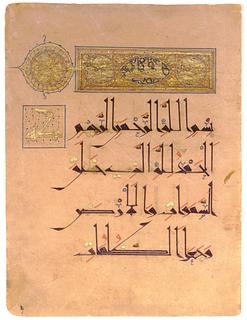
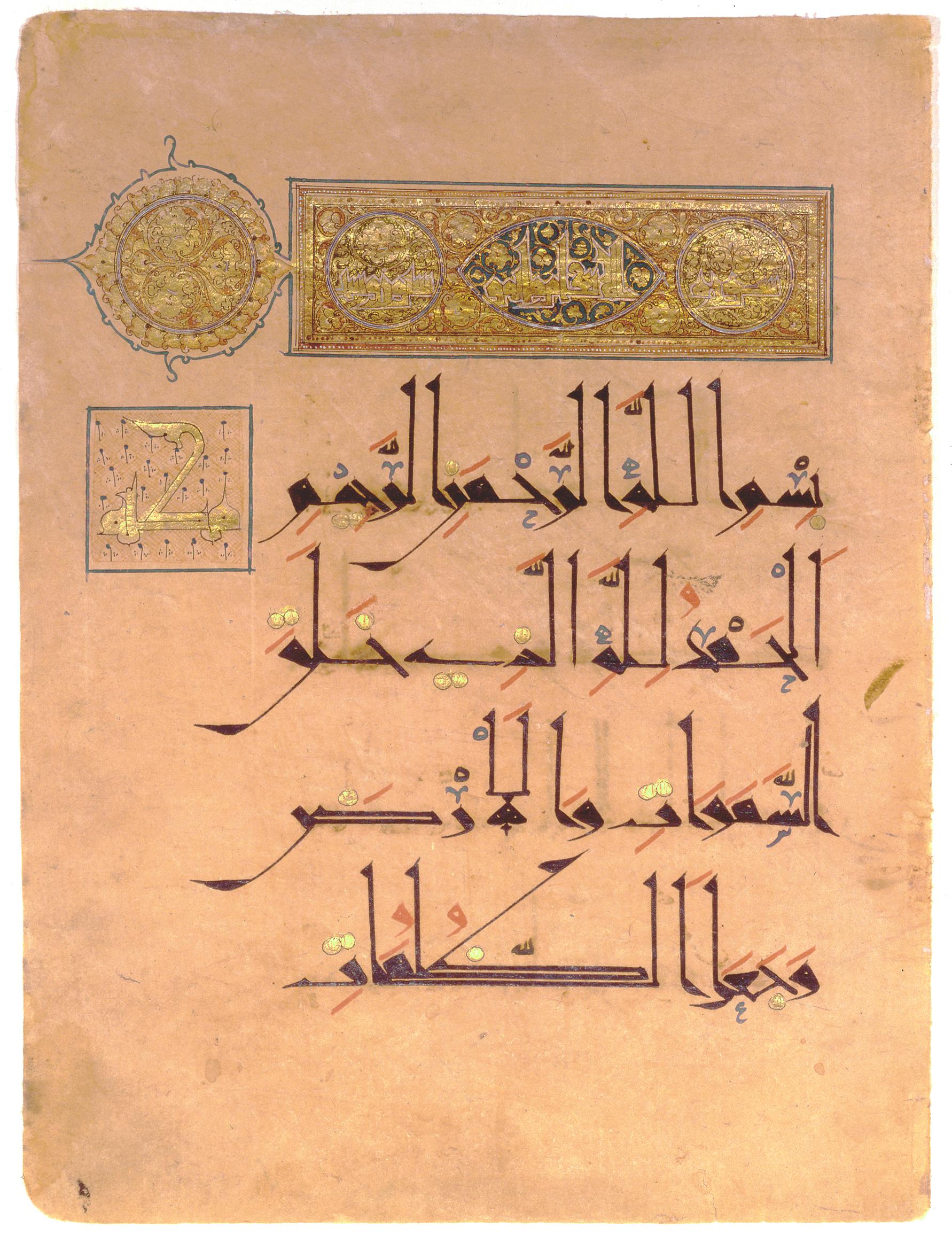
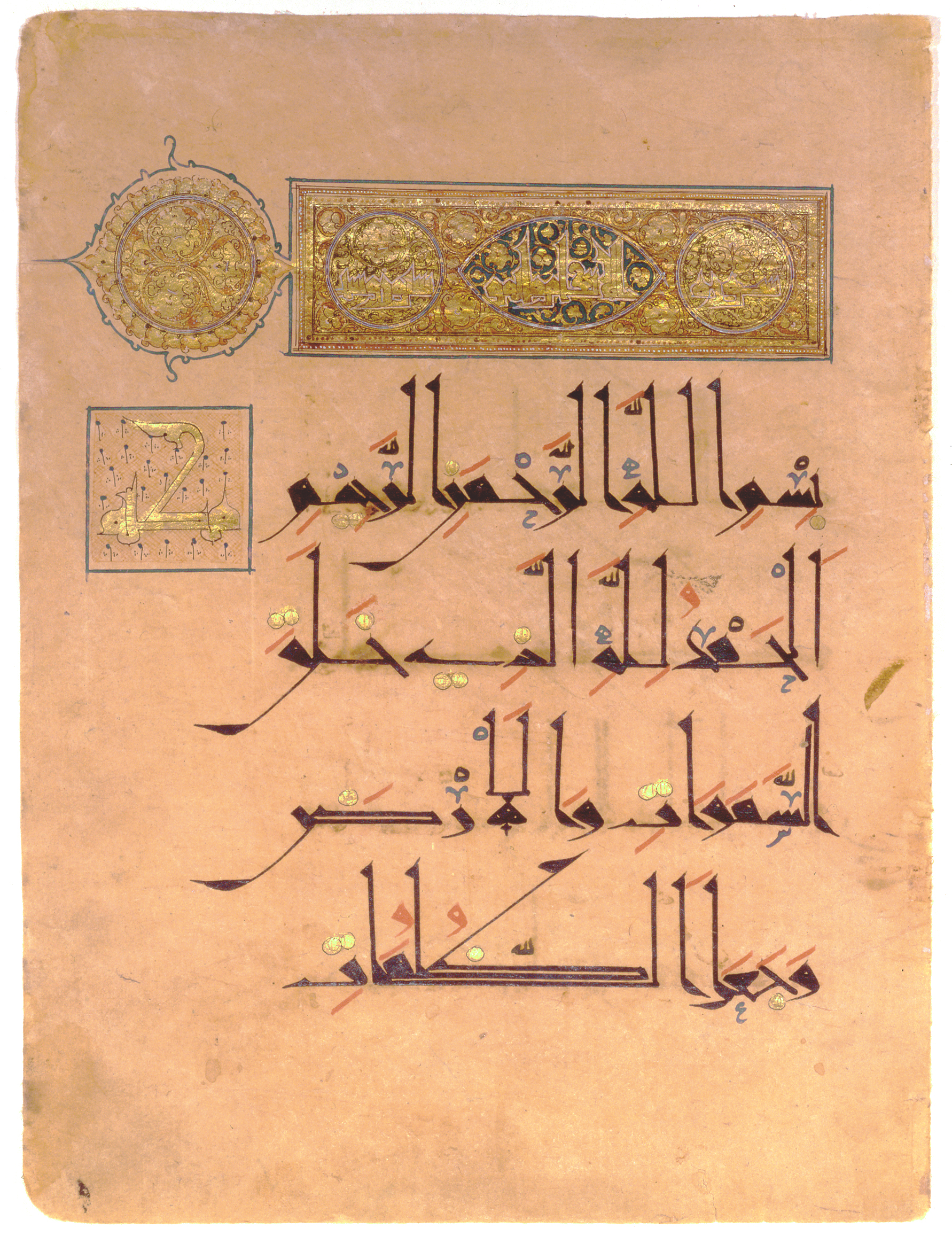
Leaf from a Koran with a vertical format, written in eastern Kufi
Iran or Iraq; beginning of 12th century
26,5 × 19,9 cm
Inventory number 5/2004
Eastern Kufi, of which this leaf is a classical example, is characterized by long upstrokes, left-facing downstrokes, and dense serifs. The consonant marks are denoted with gold dots and the vowels with red. The special blue diacritical marks show a doubling of a consonant, vowelless words, etc.
This leaf, with a sura heading and verses 1-2 from sura 6, comes from a Koran in 30 volumes, each one containing a section (juz) of the Koran, corresponding to the recommended reading for one of Ramadan’s c. 30 days. Eastern Kufi was developed by Persian calligraphers in the course of the 10th century.
This leaf, with a sura heading and verses 1-2 from sura 6, comes from a Koran in 30 volumes, each one containing a section (juz) of the Koran, corresponding to the recommended reading for one of Ramadan’s c. 30 days. Eastern Kufi was developed by Persian calligraphers in the course of the 10th century.
Published in
Published in
Sotheby’s, London, 7.-8.7/1980, lot 159;
Anthony Welch: “The Arts of the Book: The Arab Lands” in Toby Falk (ed.): Treasures of Islam, Musée d’art et d’histoire, Geneve, London 1985, cat.no. 14;
David James et al.: Islamic calligraphy / Calligraphie islamique, Musée d'art et d'histoire, Geneve, Geneve 1988, cat.no. 17;
Anthony Welch: “The Arts of the Book: The Arab Lands” in Toby Falk (ed.): Treasures of Islam, Musée d’art et d’histoire, Geneve, London 1985, cat.no. 14;
David James et al.: Islamic calligraphy / Calligraphie islamique, Musée d'art et d'histoire, Geneve, Geneve 1988, cat.no. 17;