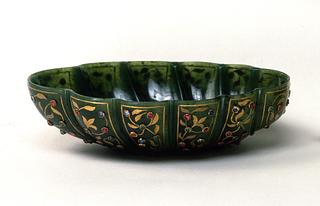
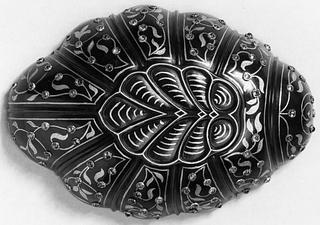
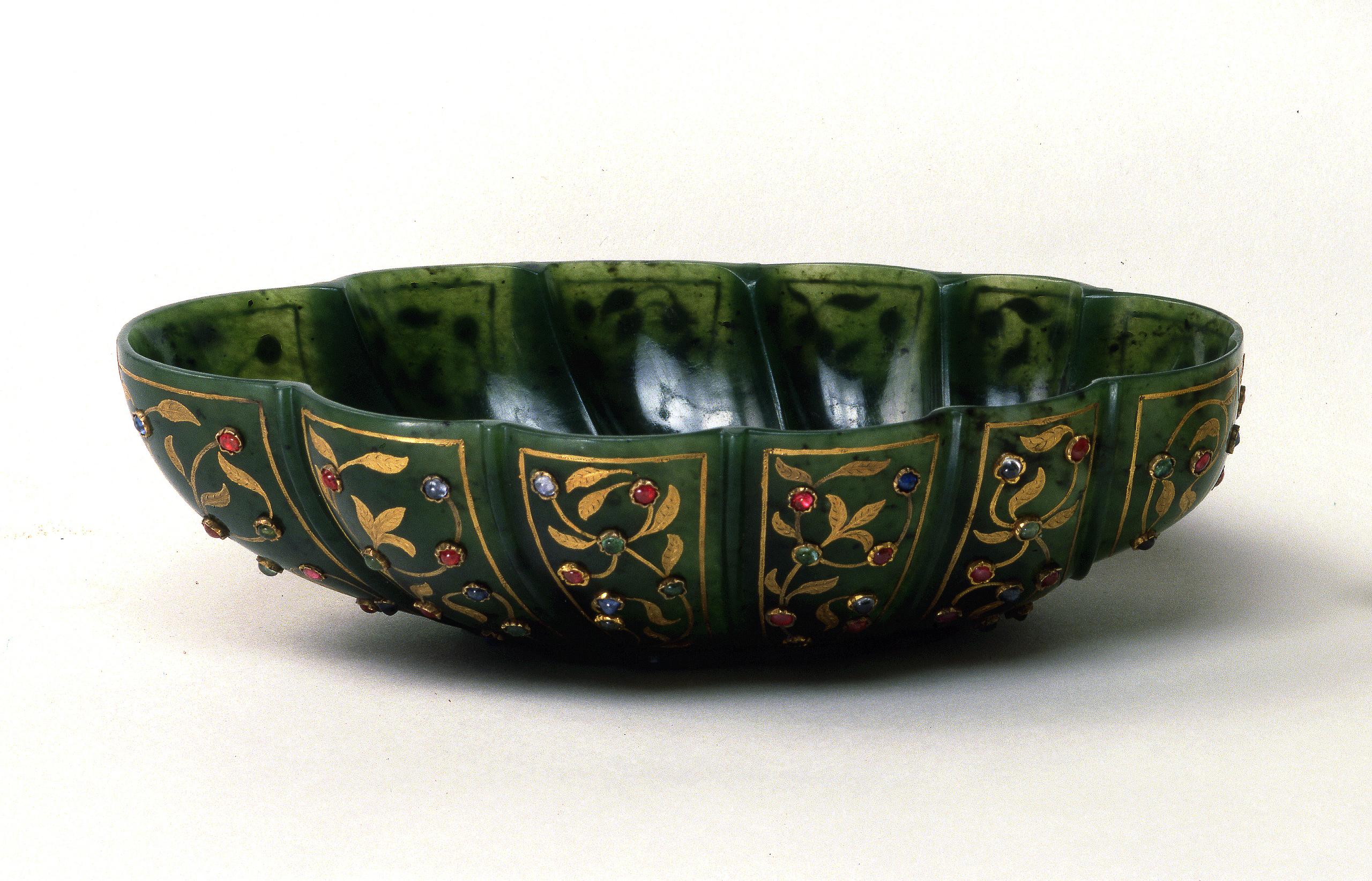
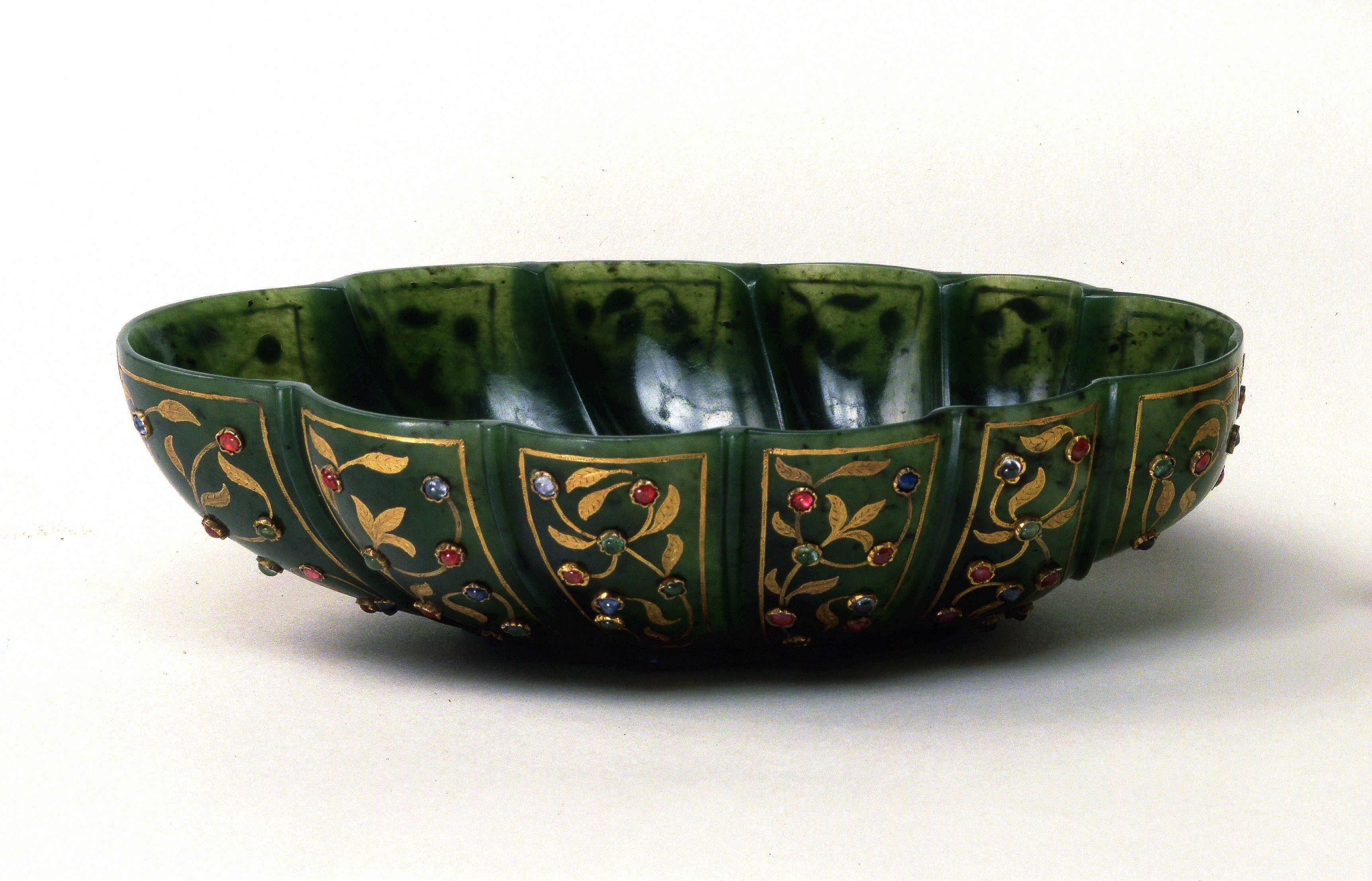
Bowl, green jade, inlaid with gold and precious stones
India or Central Asia (?); 17th century
H: 4.6; B: 11.7; L: 16.5 cm
Inventory number 5/1981
Jade became a popular material in the 16th-18th century in both Mughal India and the Ottoman Empire, in the wake of the Central Asian Timurids’ love of the material in the 15th century. In contrast to earlier periods, many jade objects were also embellished with gold and precious stones under the Mughals and Ottomans.
This bowl was previously attributed to both Turkey and India, but details in its shape and inlaying seem alien to the jade carved in these areas.
The bowl comes from the collection of the Russian tsar Alexander III, who supposedly received it as a gift from the Emir of Bukhara. Perhaps it was also made in this region, the ancient home of the Timurids.
This bowl was previously attributed to both Turkey and India, but details in its shape and inlaying seem alien to the jade carved in these areas.
The bowl comes from the collection of the Russian tsar Alexander III, who supposedly received it as a gift from the Emir of Bukhara. Perhaps it was also made in this region, the ancient home of the Timurids.
Published in
Published in
The arts of Islam : Hayward gallery, 8 April - 4 July 1976, London 1976, cat.no. 115;
Barbara Kellner-Heinkele, Dorothea Rohwedder (eds.): Türkische Kunst und Kultur aus osmanischer Zeit, Museum für Kunsthandwerk, Frankfurt am Main, Recklinghausen 1985, cat.no. 7/7, p. 310;
Kjeld von Folsach: Islamic art. The David Collection, Copenhagen 1990, cat.no. 264;
Kjeld von Folsach: Art from the World of Islam in The David Collection, Copenhagen 2001, cat.no. 377;
Barbara Kellner-Heinkele, Dorothea Rohwedder (eds.): Türkische Kunst und Kultur aus osmanischer Zeit, Museum für Kunsthandwerk, Frankfurt am Main, Recklinghausen 1985, cat.no. 7/7, p. 310;
Kjeld von Folsach: Islamic art. The David Collection, Copenhagen 1990, cat.no. 264;
Kjeld von Folsach: Art from the World of Islam in The David Collection, Copenhagen 2001, cat.no. 377;