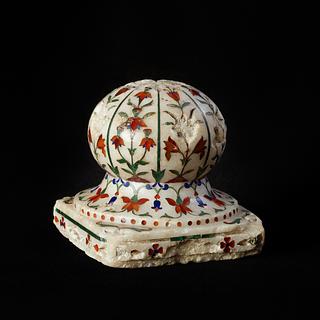
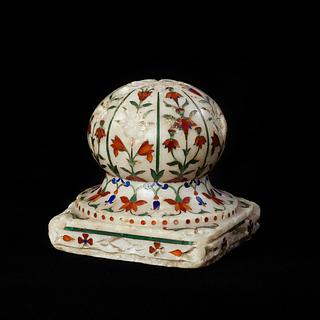
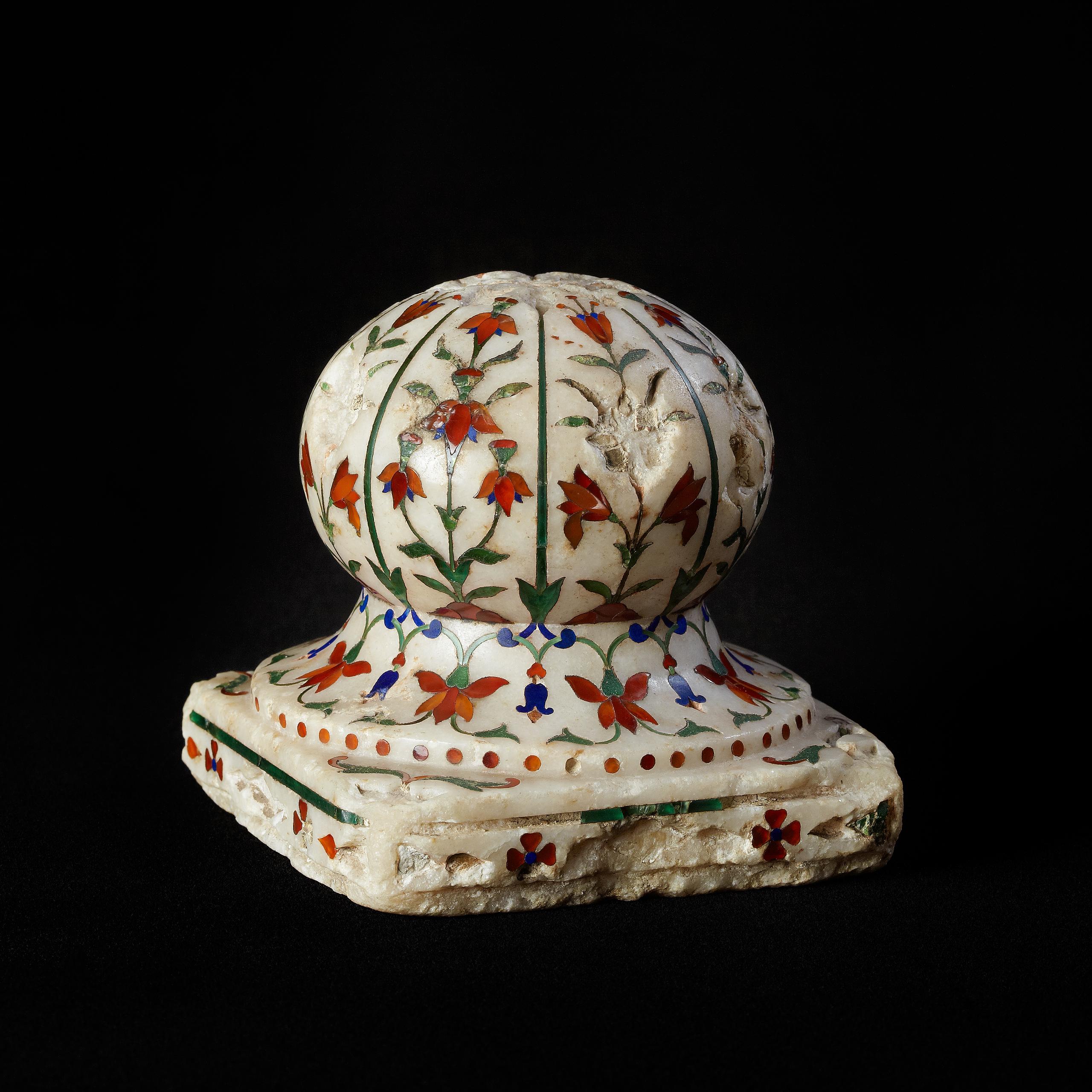
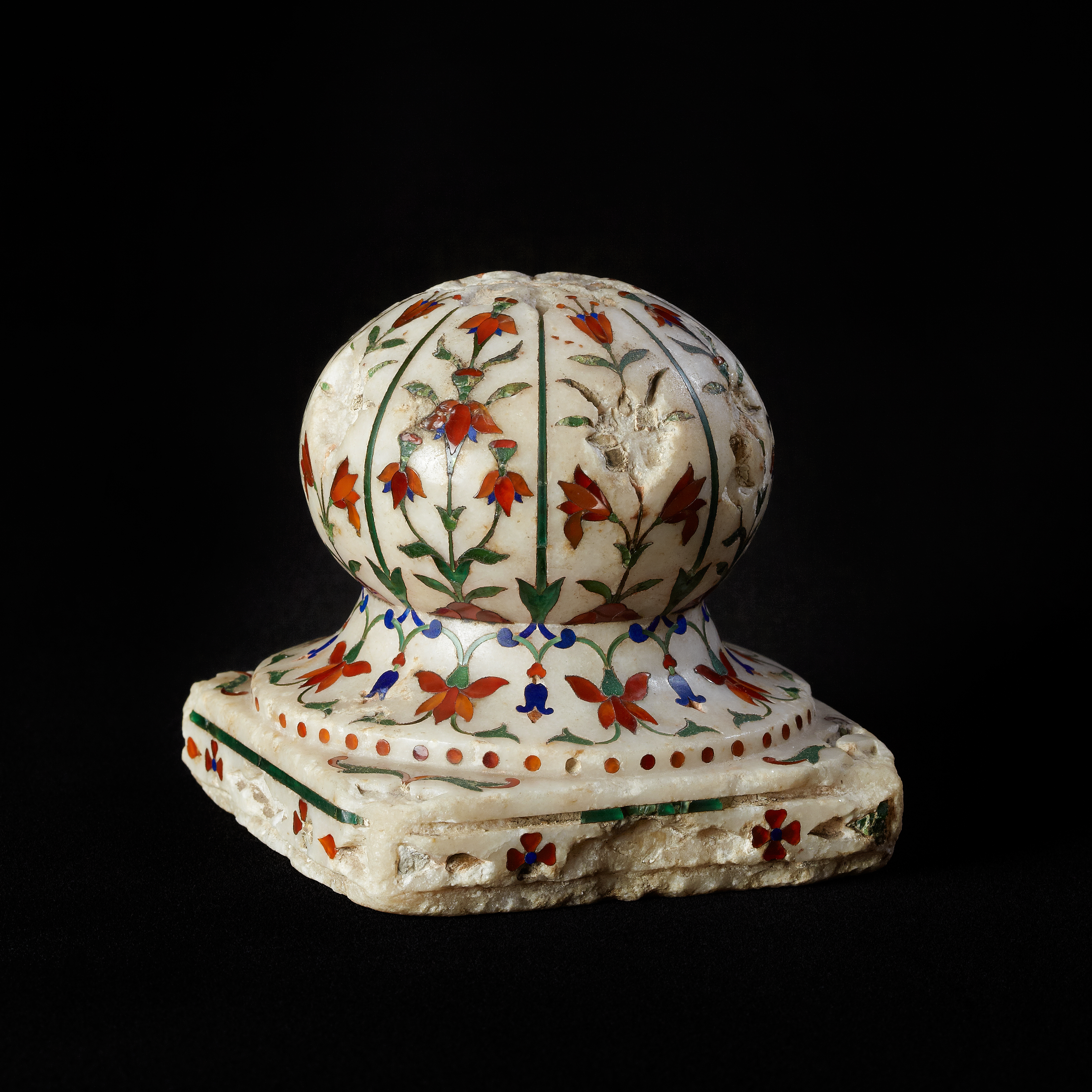
Marble carpet weight, inlaid with semi-precious stones
India, Mughal; mid-17th century
H: 9.8; W: 9.9 cm
Inventory number 12/2012
Pietra dura, the technique of inlaying marble with semi-precious stones and other hard materials, came to India from Italy in around 1600. This form of decoration reached its zenith in India in the 17th century, and much architecture from the time, for example the Taj Mahal, has inlaid plant motifs of this type.
The carpet weight (mir-i farsh, the master of the carpet) is often found in sets of four, intended to hold light summer carpets in place if there should be a breeze.
The elegant decoration of this carpet weight, primarily lilies in ornamental and more naturalistic forms, consists of carnelian, lapis lazuli, amber, and green glass inlaid over a ground of gold leaf, which enhances the lustre of the transparent materials.
The carpet weight (mir-i farsh, the master of the carpet) is often found in sets of four, intended to hold light summer carpets in place if there should be a breeze.
The elegant decoration of this carpet weight, primarily lilies in ornamental and more naturalistic forms, consists of carnelian, lapis lazuli, amber, and green glass inlaid over a ground of gold leaf, which enhances the lustre of the transparent materials.
Published in
Published in
Kjeld von Folsach: Flora islamica: plantemotiver i islamisk kunst, Davids Samling, København 2013, cat.no. 67;
Kjeld von Folsach: “Monumentality en miniarure: on two dome-shaped carpet weights - mir-i farsh” in Robert Hillenbrand (ed.): The making of Islamic art : studies in honour of Sheila Blair and Jonathan Bloom, Edinburgh 2021, pp. 37-48, fig 3.2;
Kjeld von Folsach: “Monumentality en miniarure: on two dome-shaped carpet weights - mir-i farsh” in Robert Hillenbrand (ed.): The making of Islamic art : studies in honour of Sheila Blair and Jonathan Bloom, Edinburgh 2021, pp. 37-48, fig 3.2;