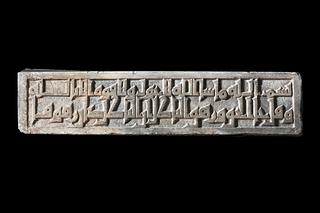
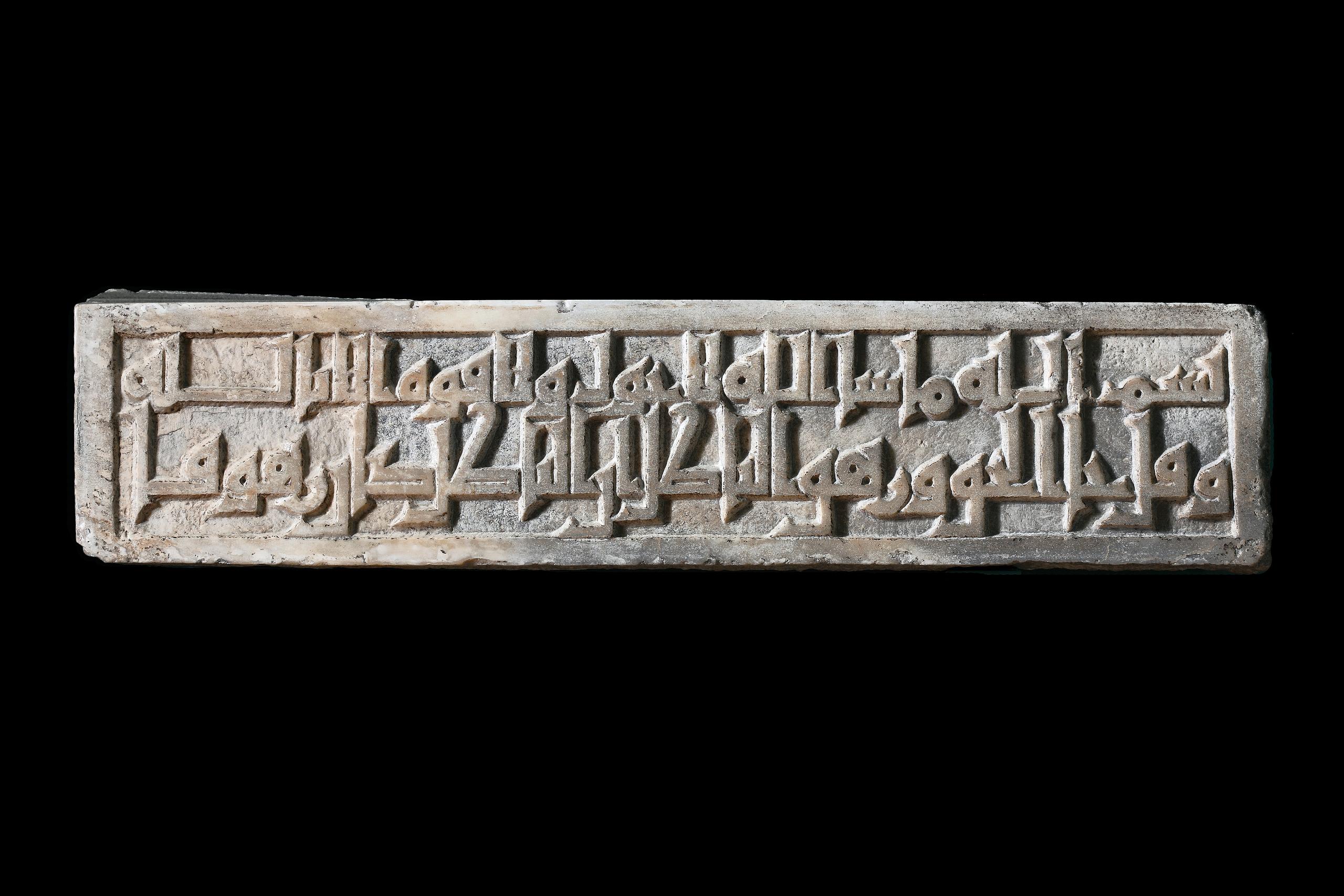
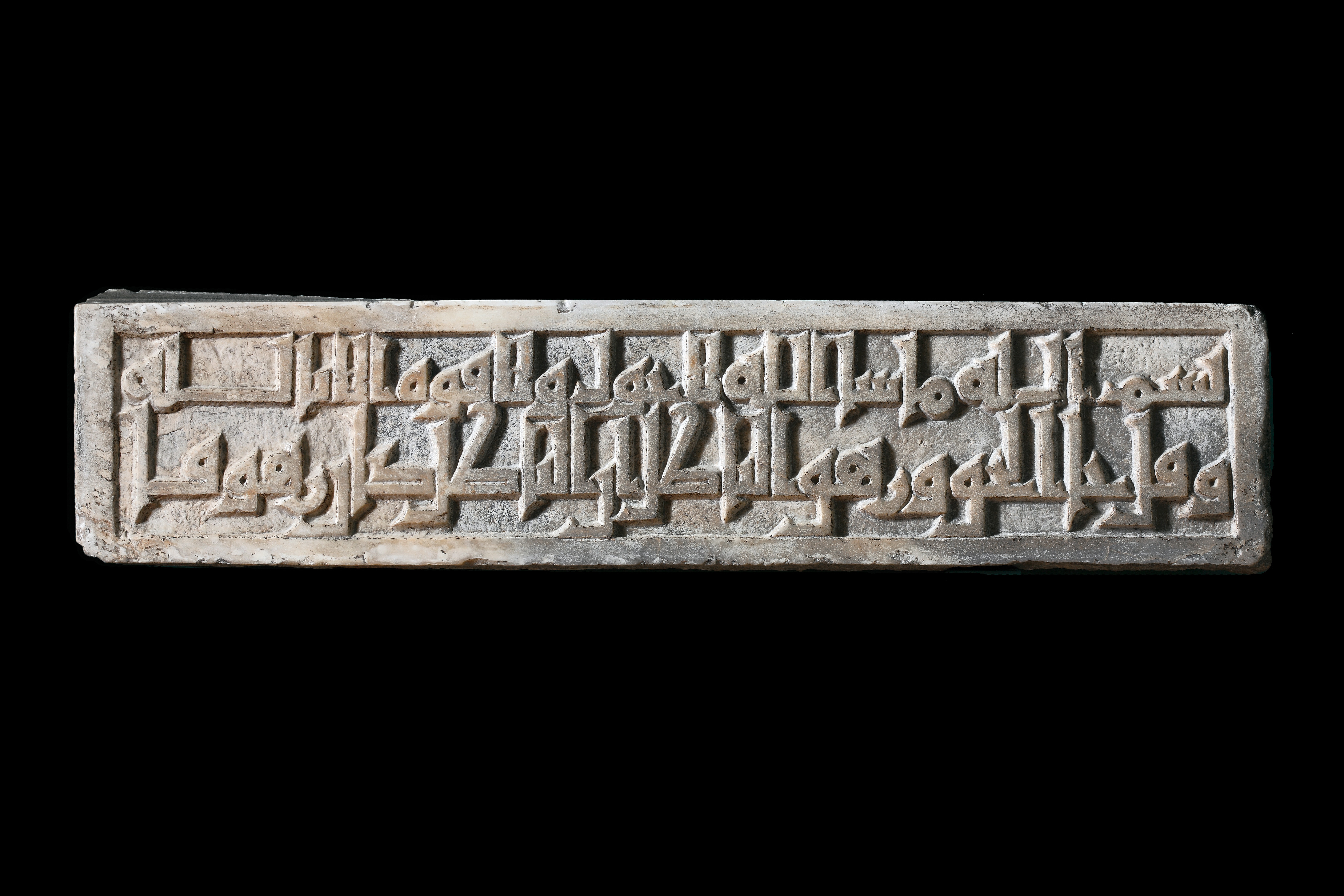
Inscription frieze, marble, from the Nilometer
Egypt, Cairo; 861-862
H: 23; W: 104.5 cm
Inventory number D 1/2005
The Nilometer is the oldest extent Islamic structure in Egypt, built on the Nile island of al-Rauda in Cairo in 861. It consists of a shaft that is connected with the Nile through three channels. In the middle of the shaft stands a column, and its markings from the bottom up make it possible to measure the water level, providing information that is of fundamental importance for people and crops in the Nile river valley.
The Nilometer’s interior is decorated with inscriptions that primarily consist of passages from the Koran. Similar friezes once embellished the entrance, since demolished, from which this inscription frieze probably came.
It was purchased in Cairo in 1824 by F. C. Münter, Bishop of Zealand, Denmark.
The Nilometer’s interior is decorated with inscriptions that primarily consist of passages from the Koran. Similar friezes once embellished the entrance, since demolished, from which this inscription frieze probably came.
It was purchased in Cairo in 1824 by F. C. Münter, Bishop of Zealand, Denmark.
Published in
Published in
Johan Herman Rump: ”Skriften på væggen: om koranfriser i islamisk arkitektur” in Carsten Niebuhr Biblioteket, 2003:2, p. 8, fig. 7;
Mentioned, with drawing in Jes P. Asmussen: Islam, [København] 1981, p. 382;
Joachim Meyer, Rasmus Bech Olsen and Peter Wandel: Beyond words: calligraphy from the World of Islam, The David Collection, Copenhagen 2024, fig. 12, pp. 22 and 25;
Mentioned, with drawing in Jes P. Asmussen: Islam, [København] 1981, p. 382;
Joachim Meyer, Rasmus Bech Olsen and Peter Wandel: Beyond words: calligraphy from the World of Islam, The David Collection, Copenhagen 2024, fig. 12, pp. 22 and 25;