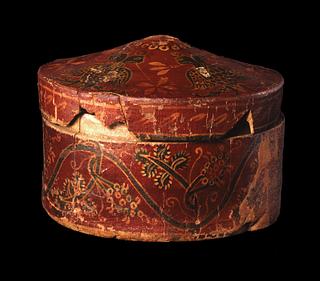
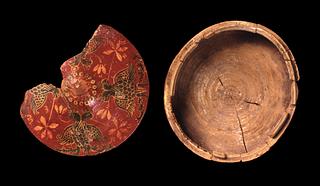
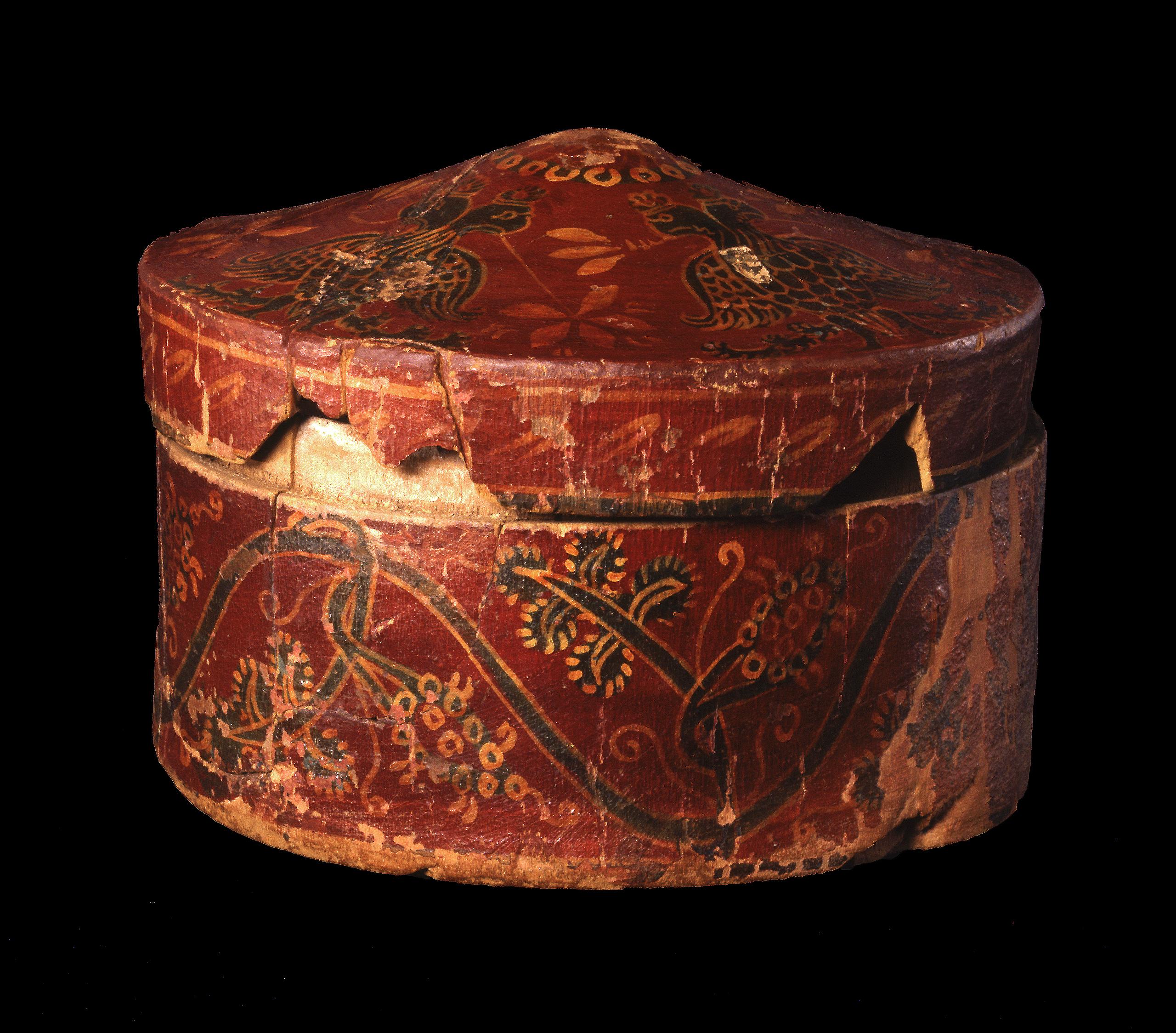
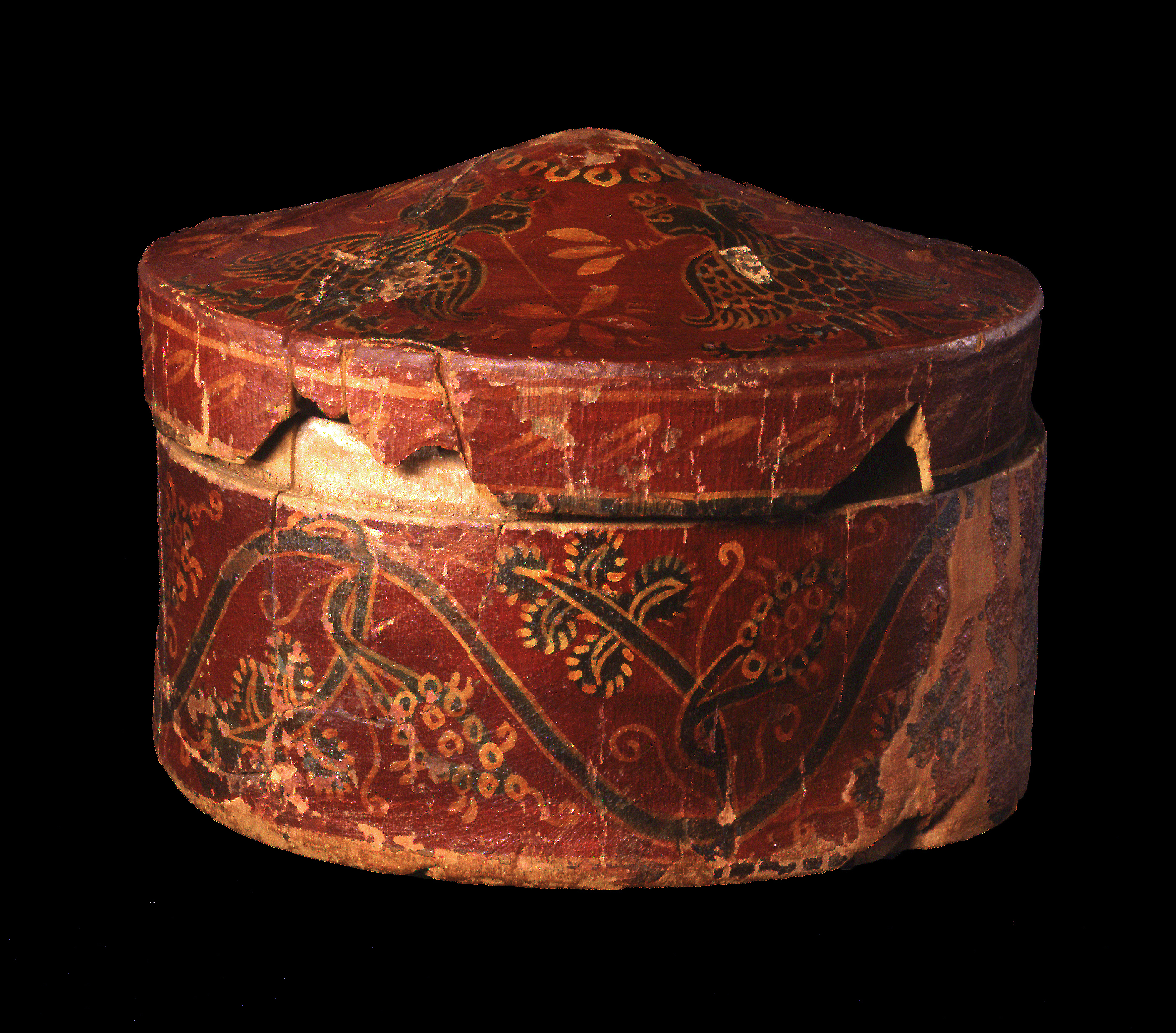
Box, turned wood with painted decoration
Central Asia; 3th-5th century
H with lid: 7.3; Diam: 10.3 cm
Inventory number 2/2003
Probably the most distinctive feature of the box’s painted decoration is the lid’s two-headed eagle with large, tufted tail feathers. The eagle’s beaks hold long tendrils.
The form and decoration of the box are related to those on a number of somewhat larger reliquaries that were excavated in Kuqa on the Silk Road and have been dated to the 6th-7th century. A carbon-14 analysis of this box shows that it dates to the 3rd-5th century.
The tradition of making turned, painted boxes continued in Central Asia, Afghanistan, and northern India in the Islamic Middle Ages and was carried on right to modern times. Because of the perishability of the material, old boxes of this type are extremely rare.
The form and decoration of the box are related to those on a number of somewhat larger reliquaries that were excavated in Kuqa on the Silk Road and have been dated to the 6th-7th century. A carbon-14 analysis of this box shows that it dates to the 3rd-5th century.
The tradition of making turned, painted boxes continued in Central Asia, Afghanistan, and northern India in the Islamic Middle Ages and was carried on right to modern times. Because of the perishability of the material, old boxes of this type are extremely rare.
Published in
Published in
Kjeld von Folsach: “A number of pigmented wooden objects from the Eastern Islamic worlds” in Journal of the David Collection, 1, 2003, figs. 22 and 23, and cat.no. 8, p. 92;