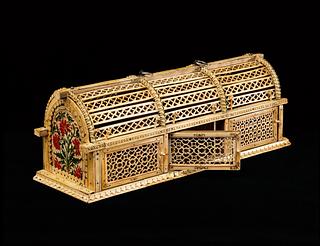
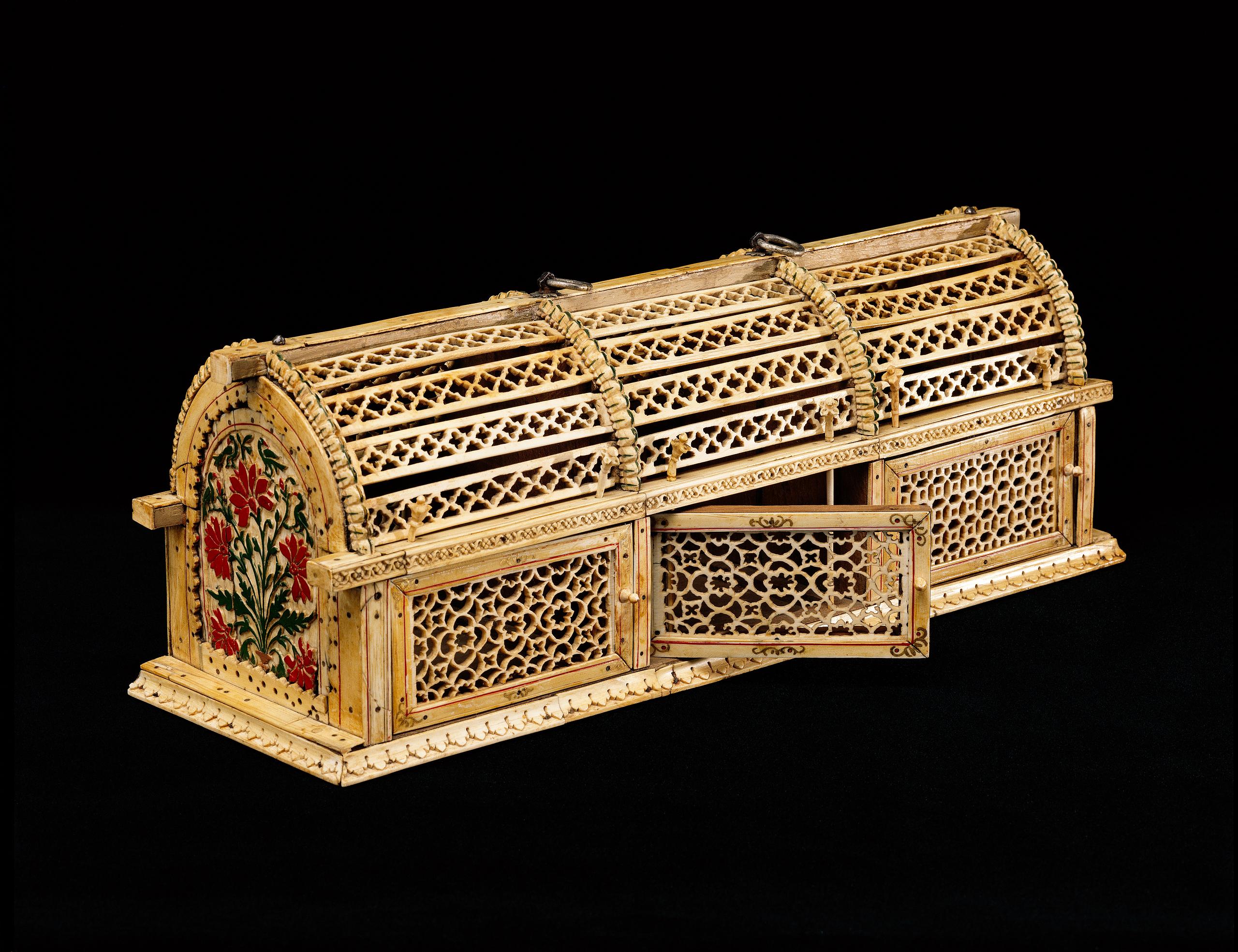
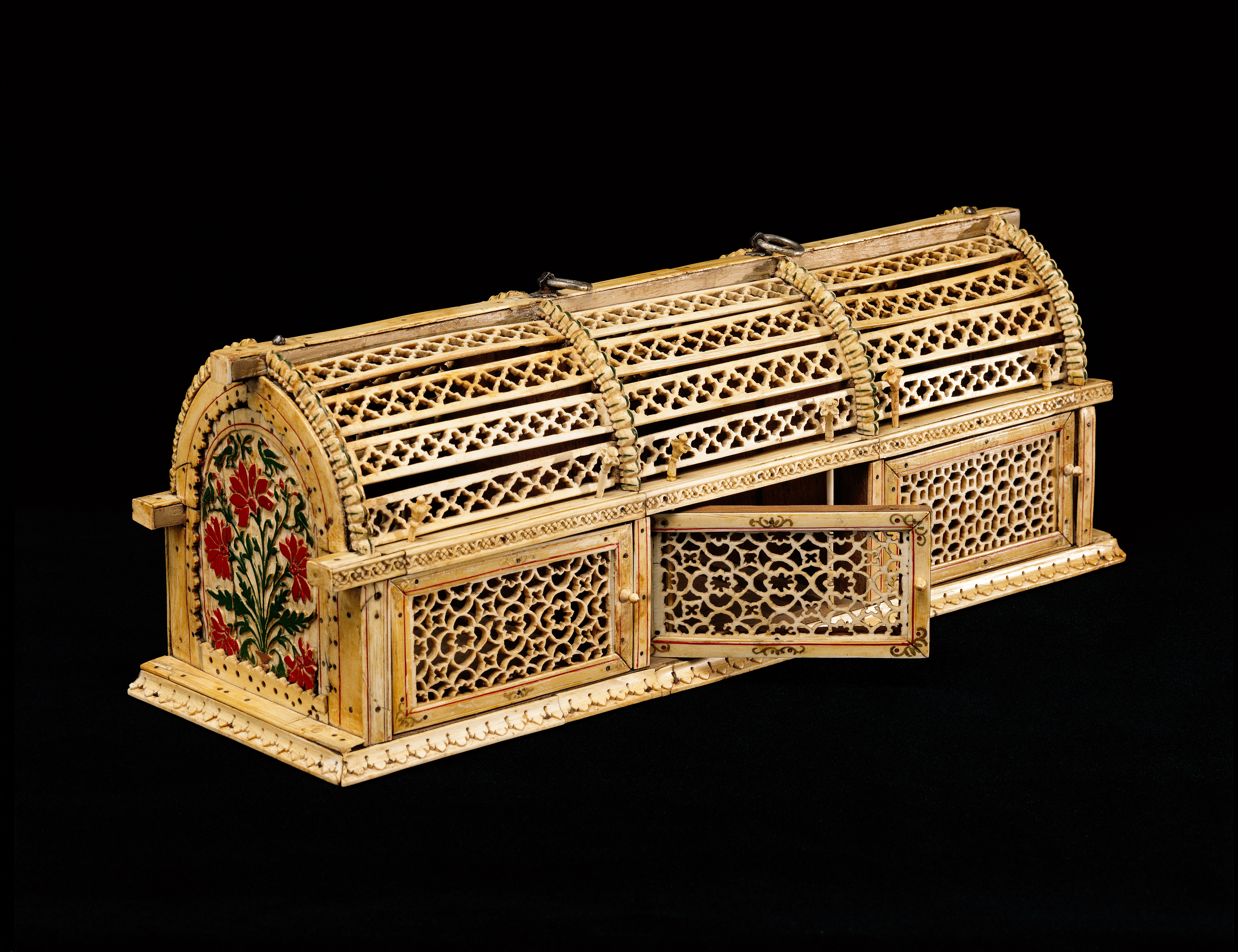
Cricket cage, wood and ivory panels with carved, openwork, and painted decoration
India; 18th century
H: 15.8; W: 15,1; L: 44.6 cm
Inventory number 37/1980
The cage was designed with three different sections with doors that could be opened individually. They were carved with openwork, geometrical patterns like the ones that embellish the stone jalis of Mughal buildings. The flowering plants in bright colors that decorate the end panels are also a favorite type of motif in the art of the Mughal period and are found frequently on textiles.
The disproportionately small birds placed among the plants are a more unconventional element – a combination that seems rather curiously to refer to the natural environment of the cage’s inhabitants: crickets or other “singing” insects.
The disproportionately small birds placed among the plants are a more unconventional element – a combination that seems rather curiously to refer to the natural environment of the cage’s inhabitants: crickets or other “singing” insects.
Published in
Published in
Spink & Son: Islamic art from India, London 1980, cat.no. 92, pp. 65 and 71;
Kjeld von Folsach: Islamic art. The David Collection, Copenhagen 1990, cat.no. 289;
Kjeld von Folsach, Torben Lundbæk and Peder Mortensen (eds.): Sultan, Shah and Great Mughal: the history and culture of the Islamic world, The National Museum, Copenhagen 1996, cat.no. 353;
Kjeld von Folsach: Art from the World of Islam in The David Collection, Copenhagen 2001, cat.no. 416;
Kjeld von Folsach: Islamic art. The David Collection, Copenhagen 1990, cat.no. 289;
Kjeld von Folsach, Torben Lundbæk and Peder Mortensen (eds.): Sultan, Shah and Great Mughal: the history and culture of the Islamic world, The National Museum, Copenhagen 1996, cat.no. 353;
Kjeld von Folsach: Art from the World of Islam in The David Collection, Copenhagen 2001, cat.no. 416;