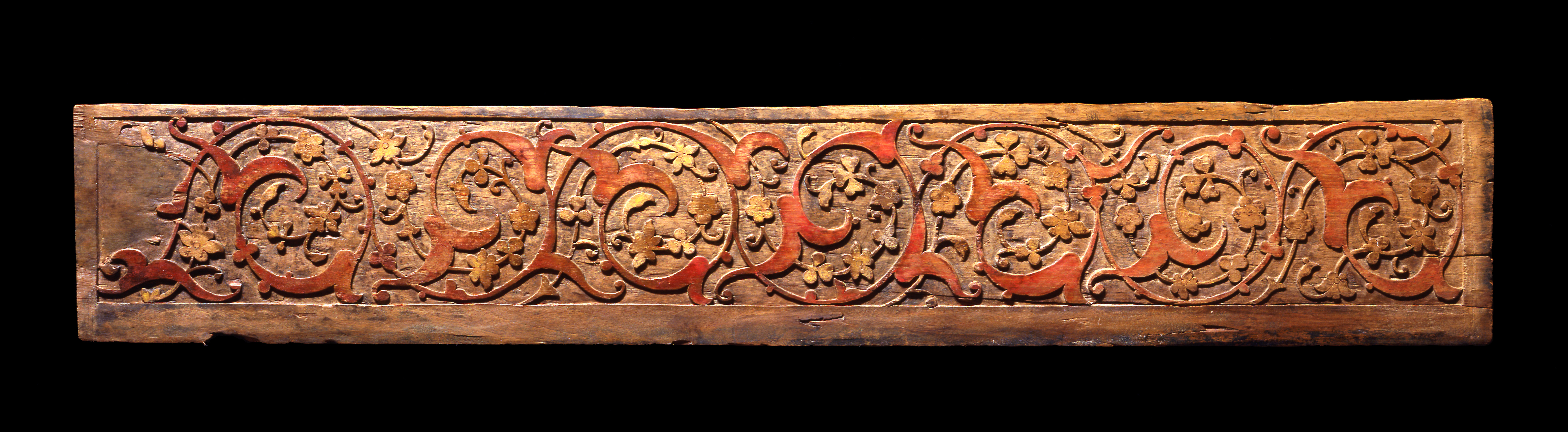
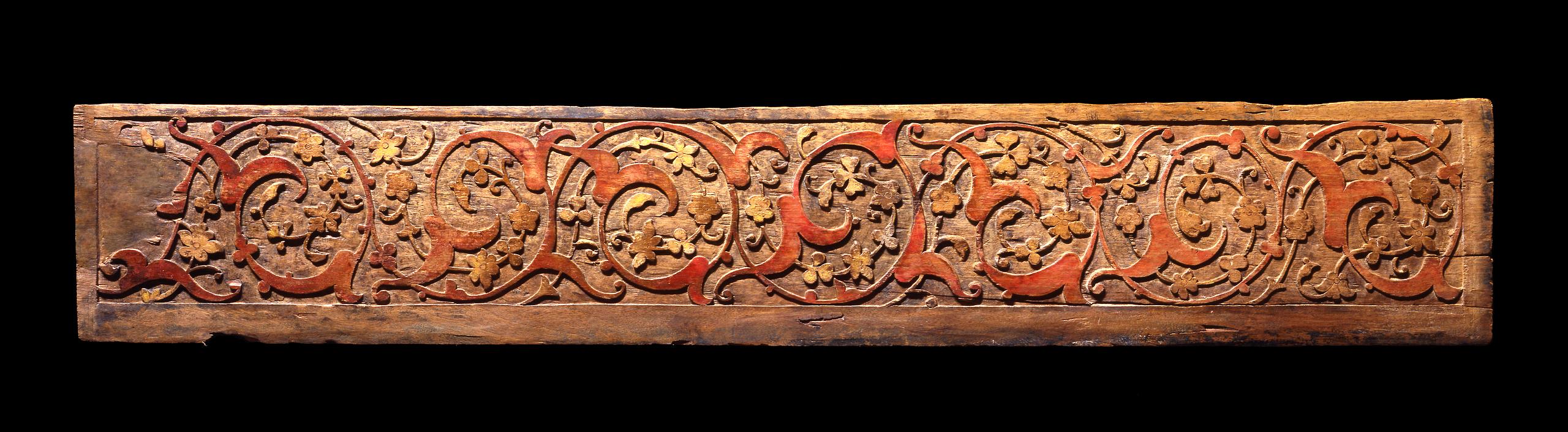
Panel of carved, painted wood
Iran, perhaps Turkey; 15th century
H: 17.5; L: 102 cm
Inventory number 34/1989
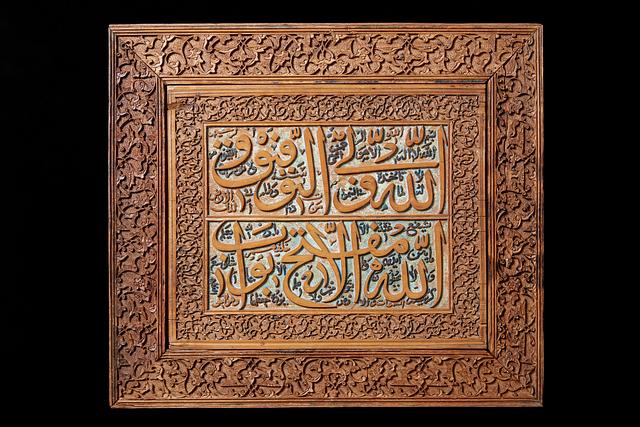
Woodcarving of a very high quality was produced under the Timurids. Motifs were based on stylized vegetal forms, often influenced by Chinese ornaments, and carved in fairly low relief. This type of decoration, which could be very detailed, was also used on larger surfaces in stone, where the decoration was not painted.
The rather large shapes on this panel indicate that it was intended to be seen from a distance.
The panel was masterfully designed, with a continuous red vine of palmettes that winds in circles, no two of which are identical. Under them run floral vines that spring from the upper and lower edges. The original color contrasts were stronger since the two vines in red and yellow were found against a bluish-green background.
The rather large shapes on this panel indicate that it was intended to be seen from a distance.
The panel was masterfully designed, with a continuous red vine of palmettes that winds in circles, no two of which are identical. Under them run floral vines that spring from the upper and lower edges. The original color contrasts were stronger since the two vines in red and yellow were found against a bluish-green background.
Published in
Published in
Sotheby’s, London, 11/10-1989, lot 100;
Spink & Son: Persian and Islamic art, London 1977, cat.no. 192;
Kjeld von Folsach, Torben Lundbæk and Peder Mortensen (eds.): Sultan, Shah and Great Mughal: the history and culture of the Islamic world, The National Museum, Copenhagen 1996, cat.no. 57;
Kjeld von Folsach: Art from the World of Islam in The David Collection, Copenhagen 2001, cat.no. 438;
Spink & Son: Persian and Islamic art, London 1977, cat.no. 192;
Kjeld von Folsach, Torben Lundbæk and Peder Mortensen (eds.): Sultan, Shah and Great Mughal: the history and culture of the Islamic world, The National Museum, Copenhagen 1996, cat.no. 57;
Kjeld von Folsach: Art from the World of Islam in The David Collection, Copenhagen 2001, cat.no. 438;
Ivory, Wood, and Papier-mâché