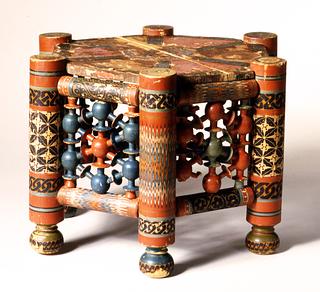
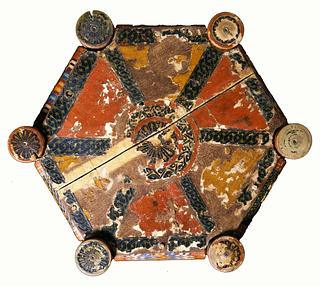
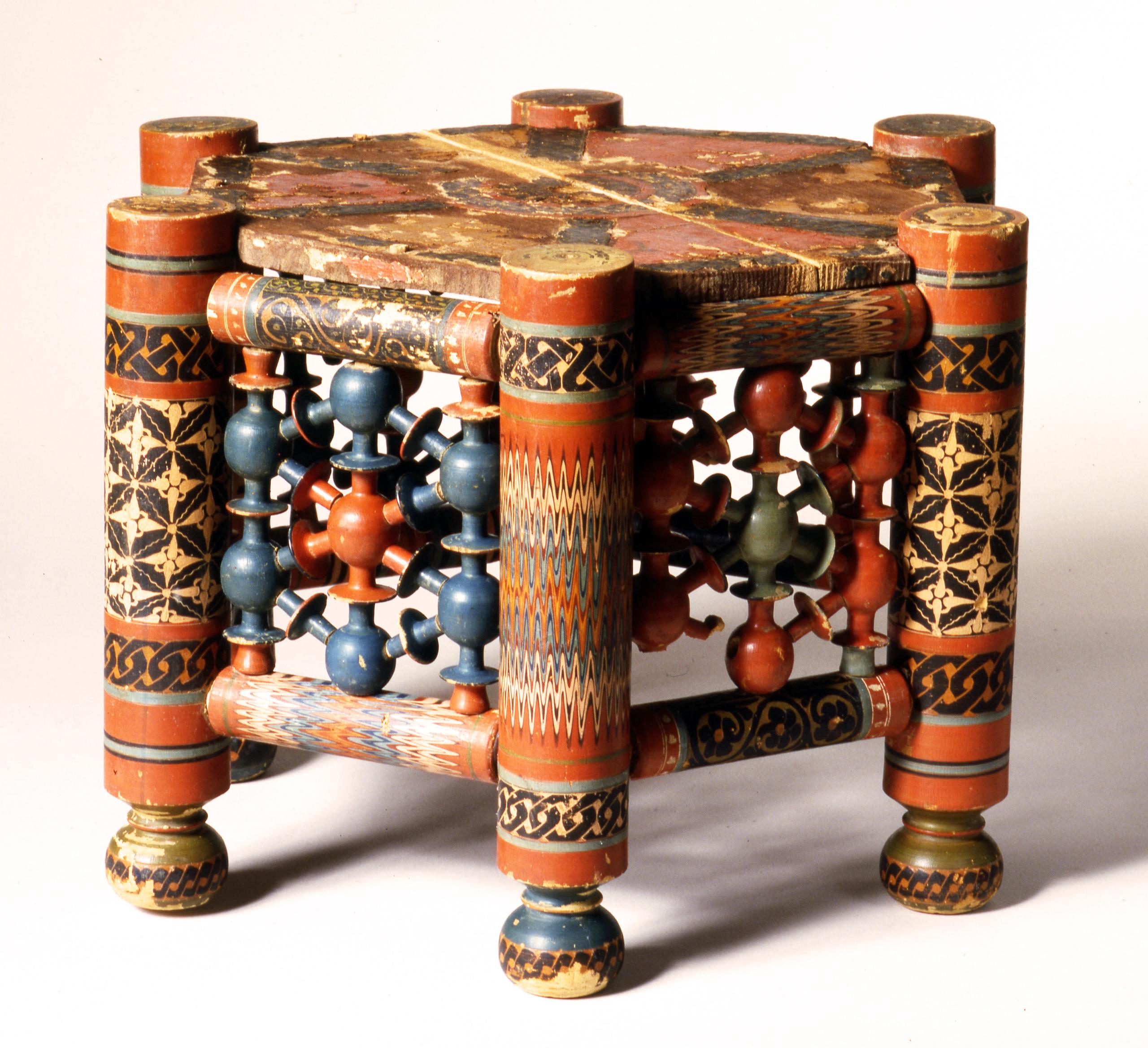
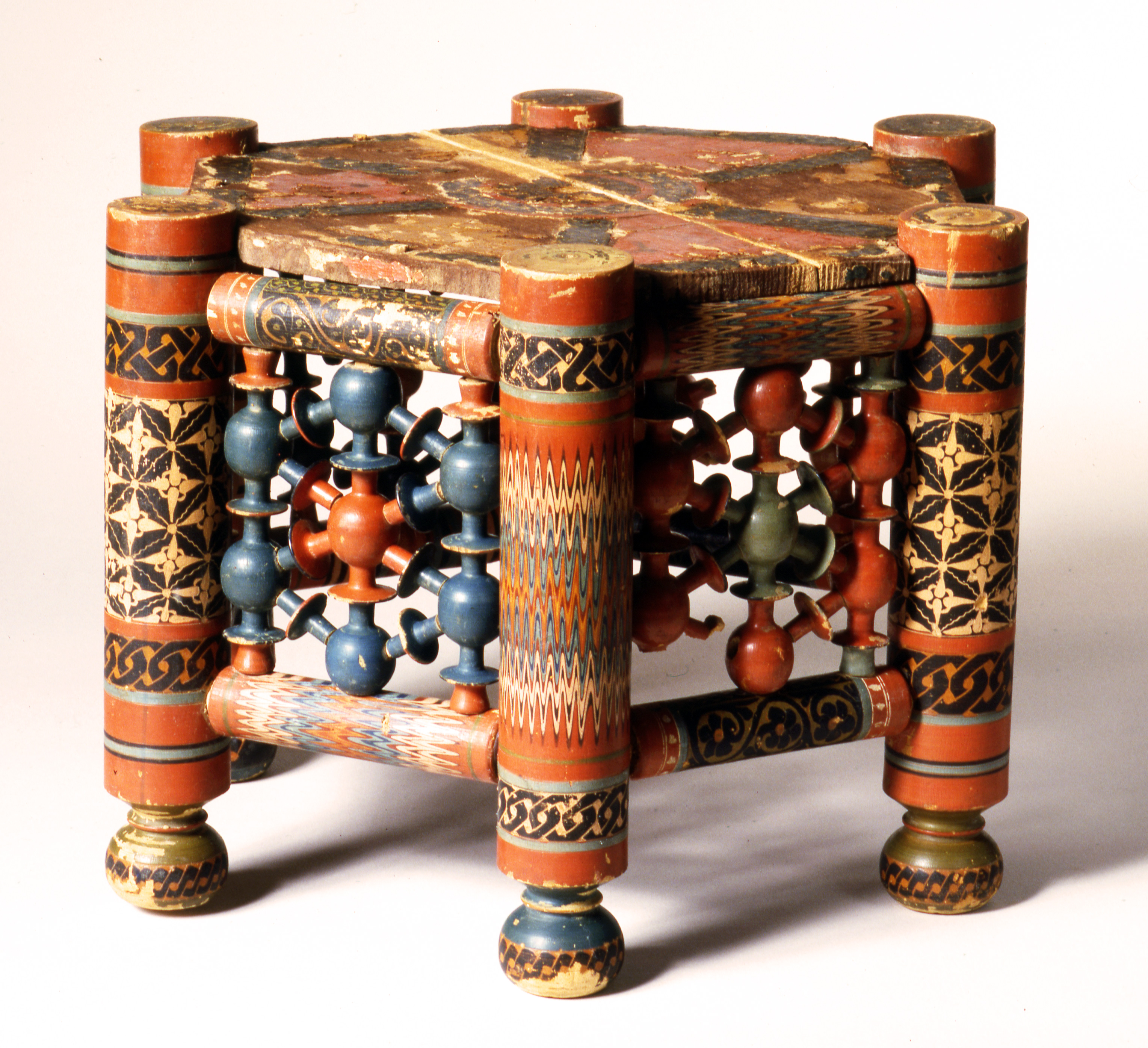
Hexagonal table, poplar, tabletop covered with paper and colored lacquer, and with incised decoration
Afghanistan; 11th-12th century
H: 26; Diam: 38 cm
Inventory number 33/1997
Carbon-14 analyses show that the exceedingly well-preserved table was made in the 11th-12th century. This means that along with the one in the al-Sabbah Collection in Kuwait, it is the oldest known table of a popular type in the Islamic world. The type was also made in other materials, such as ceramics and metal.
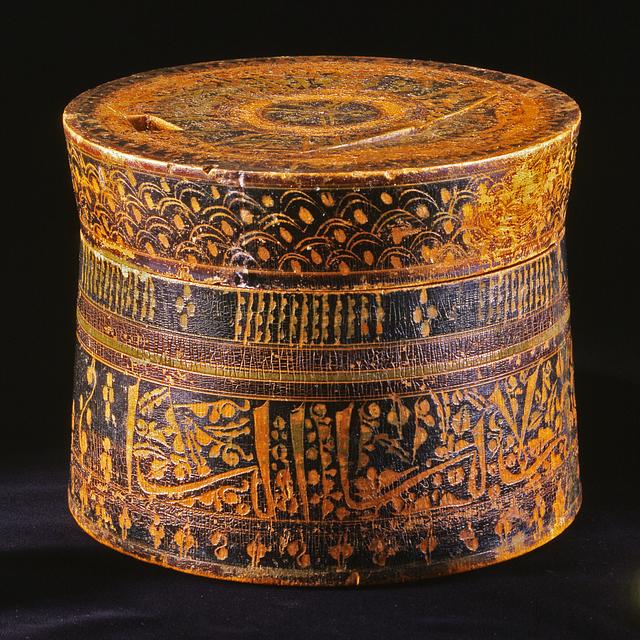
Its decorative details, especially the ones made in black and the incising technique itself, are elements that are also found in slightly older Samanid ceramics from the 10th century. These elements lived on under the Ghaznavids in Central Asia and Afghanistan.
Its decorative details, especially the ones made in black and the incising technique itself, are elements that are also found in slightly older Samanid ceramics from the 10th century. These elements lived on under the Ghaznavids in Central Asia and Afghanistan.
Published in
Published in
Kjeld von Folsach: Art from the World of Islam in The David Collection, Copenhagen 2001, cat.no. 427;
Kjeld von Folsach: “A number of pigmented wooden objects from the Eastern Islamic worlds” in Journal of the David Collection, 1, 2003, figs. 7-9 and cat.no. 2, p. 91;
Oliver Watson: “The case of the Ottoman table” in Journal of the David Collection, 2010, 3, fig. 26, p. 40 (wrong acc.no.);
Margaret S. Graves: “The aesthetics of simulation: architectural mimicry on medieval ceramic tabourets” in Margaret Graves (ed): Islamic art, architecture and material culture: new perspectives, Oxford 2012, fig. 14, p. 73;
Sheila S. Blair: Text and image in Medieval Persian art, Edinburgh 2014, pp. 98-99, fig. 3.25;
Mark Kerr-Smiley: Mamluks, Conquest and Culture: The Ghurid Empire and Early Delhi Sultanate C.1150-1236, London 2025, fig. 9;
Kjeld von Folsach: “A number of pigmented wooden objects from the Eastern Islamic worlds” in Journal of the David Collection, 1, 2003, figs. 7-9 and cat.no. 2, p. 91;
Oliver Watson: “The case of the Ottoman table” in Journal of the David Collection, 2010, 3, fig. 26, p. 40 (wrong acc.no.);
Margaret S. Graves: “The aesthetics of simulation: architectural mimicry on medieval ceramic tabourets” in Margaret Graves (ed): Islamic art, architecture and material culture: new perspectives, Oxford 2012, fig. 14, p. 73;
Sheila S. Blair: Text and image in Medieval Persian art, Edinburgh 2014, pp. 98-99, fig. 3.25;
Mark Kerr-Smiley: Mamluks, Conquest and Culture: The Ghurid Empire and Early Delhi Sultanate C.1150-1236, London 2025, fig. 9;