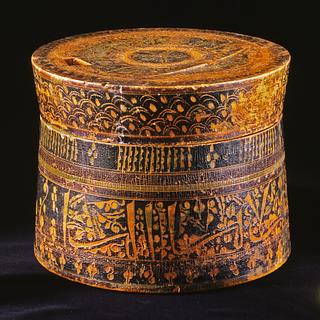
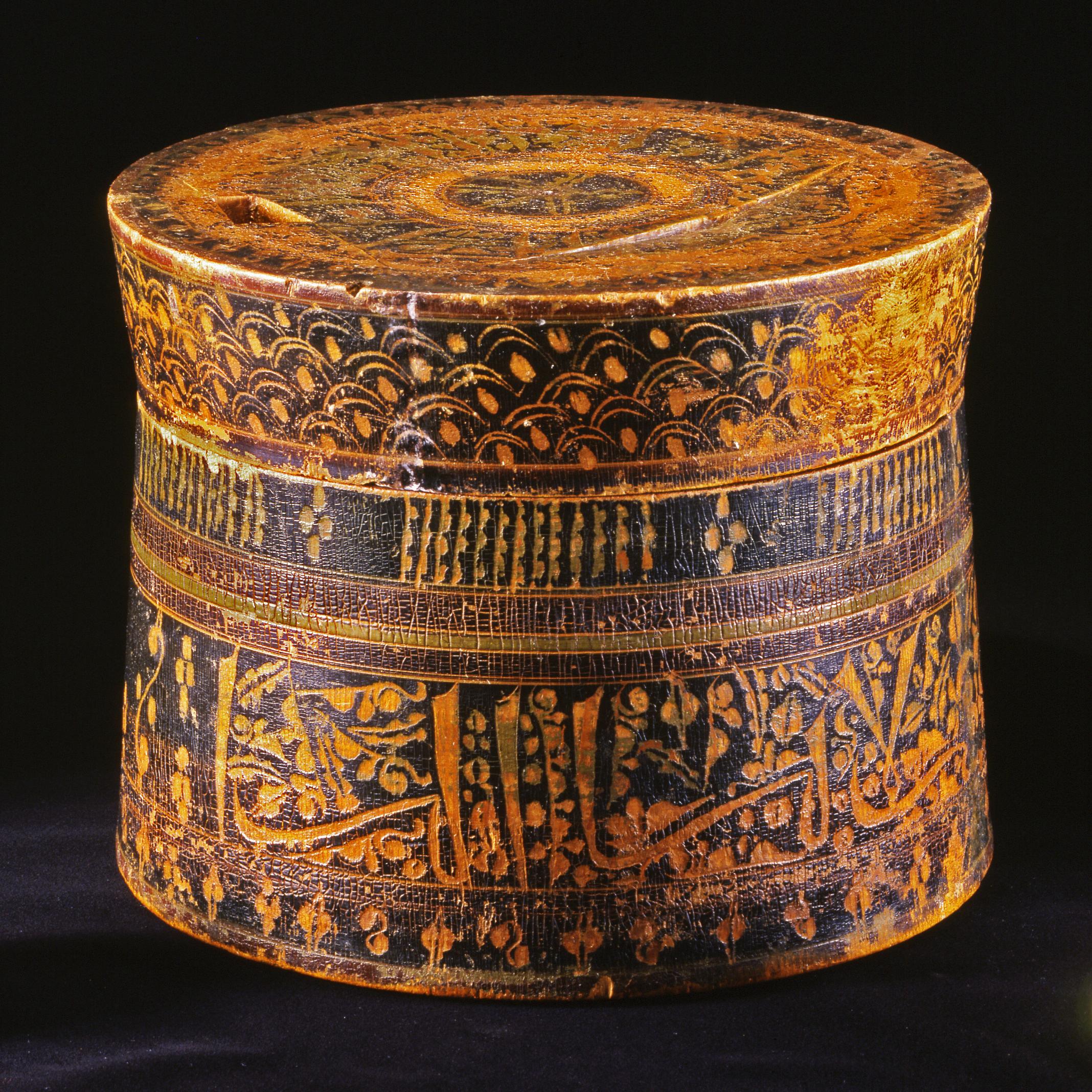
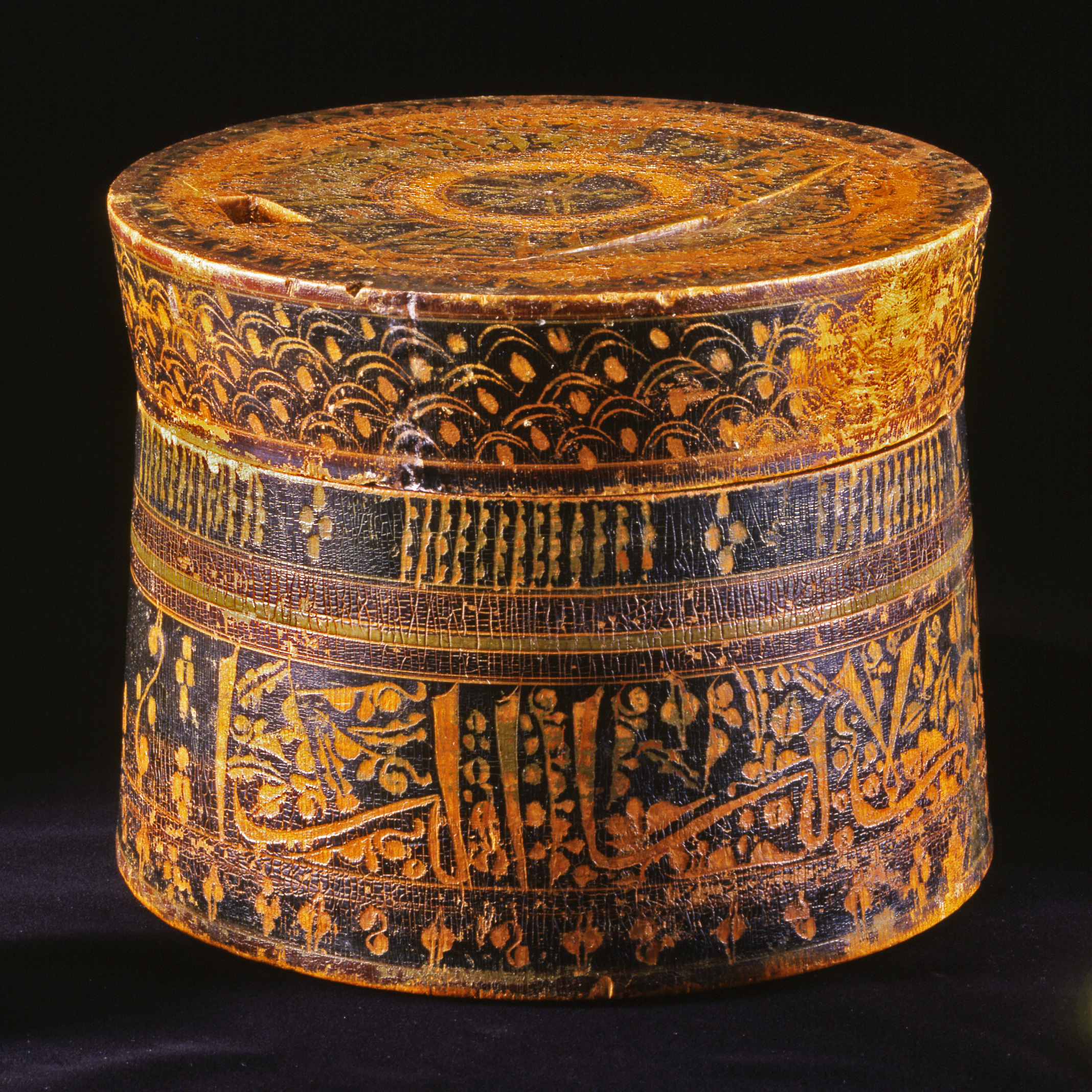
Box, turned wood, with colored lacquer and incised decoration
Afghanistan; 11th-12th century
H: 24.5; Diam: 30.8 cm
Inventory number 49/1998
The box’s function is unknown, and its cursive inscriptions belong to the common type that simply invokes “eternal happiness” for its owner.
Very few painted wooden containers have survived from the Islamic Middle Ages, partly because the material was not as durable as ceramics, metal, and stone, and partly because they belong to a category of utility ware with no great value and were consequently not handled with care.
The forms and colors often reflect those of objects made of more costly materials, and there are bronze containers with the same form as this one, with fine metal inlays and inscription bands, from the east Iranian region.
Very few painted wooden containers have survived from the Islamic Middle Ages, partly because the material was not as durable as ceramics, metal, and stone, and partly because they belong to a category of utility ware with no great value and were consequently not handled with care.
The forms and colors often reflect those of objects made of more costly materials, and there are bronze containers with the same form as this one, with fine metal inlays and inscription bands, from the east Iranian region.
Published in
Published in
Kjeld von Folsach: Art from the World of Islam in the David Collection, Copenhagen 2001, cat. 423;
Kjeld von Folsach: “A Number of Pigmented Wooden Objects from the Eastern Islamic Worlds,” Journal of the David Collection, 1, 2003, fig. 18, cat. 4;
Barry Knight: “The Heart Case of Abbot Roger de Norton from St. Albans Abbey. An Islamic Object in a Medieval English Context,” Muqarnas, 36, 2019, pp. 224-226, fig. 5;
A Seat at the Table. Food and Feasting in the Islamic World, Museum of Islamic Art, Doha 2025, p. 77, note 1;
Kjeld von Folsach: “A Number of Pigmented Wooden Objects from the Eastern Islamic Worlds,” Journal of the David Collection, 1, 2003, fig. 18, cat. 4;
Barry Knight: “The Heart Case of Abbot Roger de Norton from St. Albans Abbey. An Islamic Object in a Medieval English Context,” Muqarnas, 36, 2019, pp. 224-226, fig. 5;
A Seat at the Table. Food and Feasting in the Islamic World, Museum of Islamic Art, Doha 2025, p. 77, note 1;