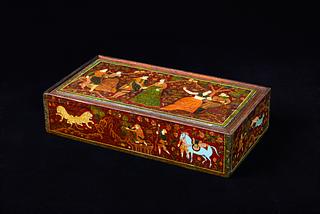
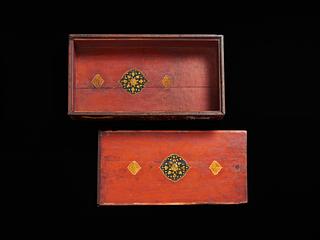
Box with a sliding cover, painted, lacquered wood
India, probably Gujarat; 1610-1620
H: 8.5; L: 37.4; Diam: 19.7 cm
Inventory number 29/2014
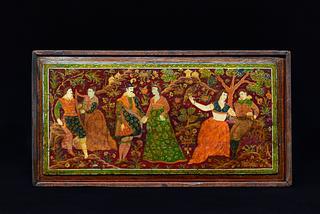
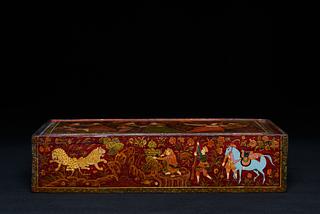
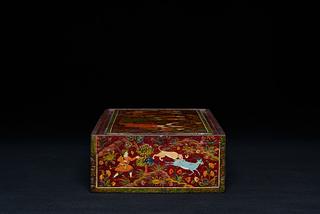
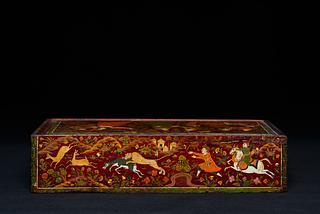
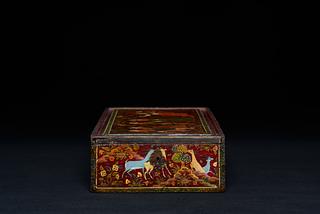
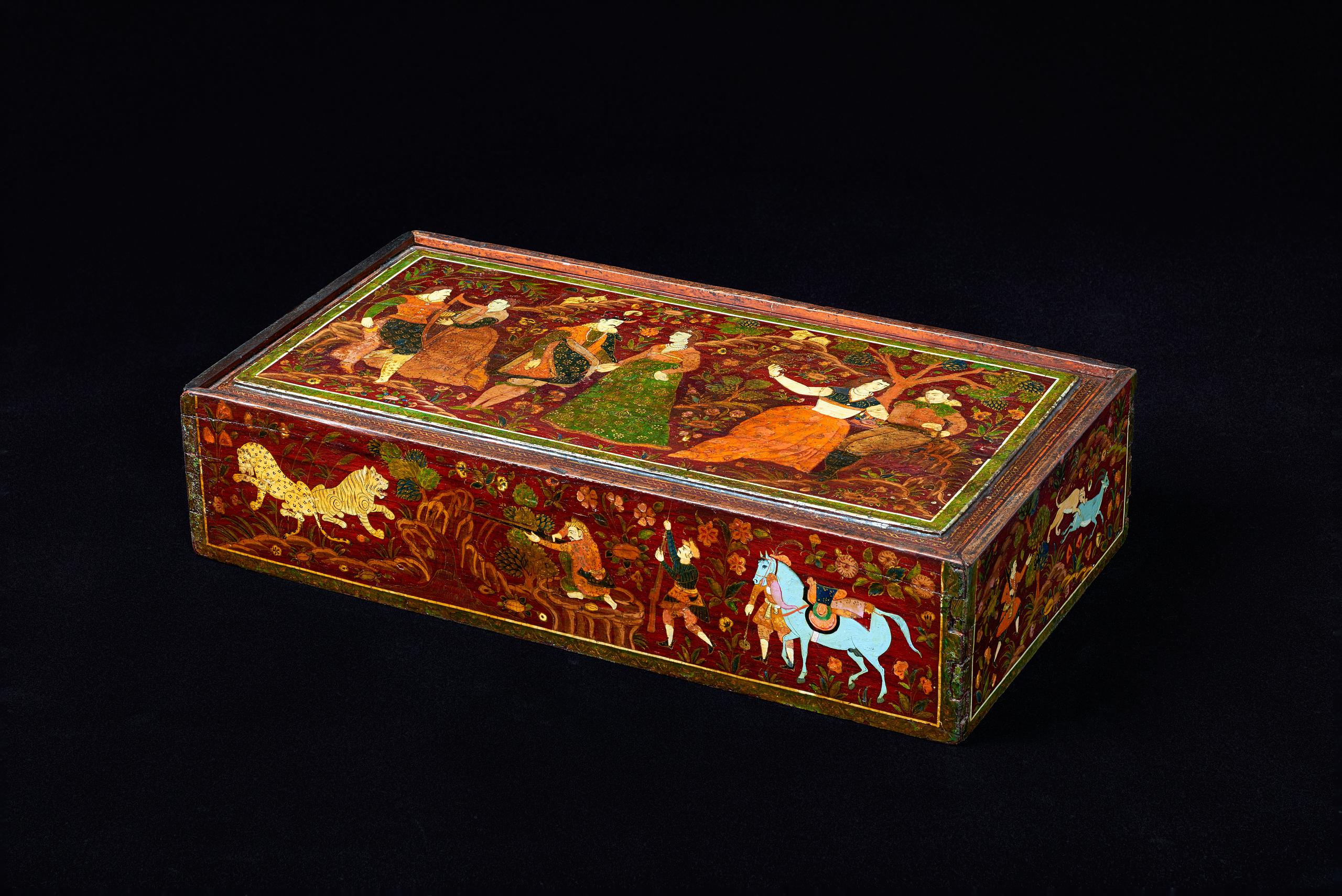
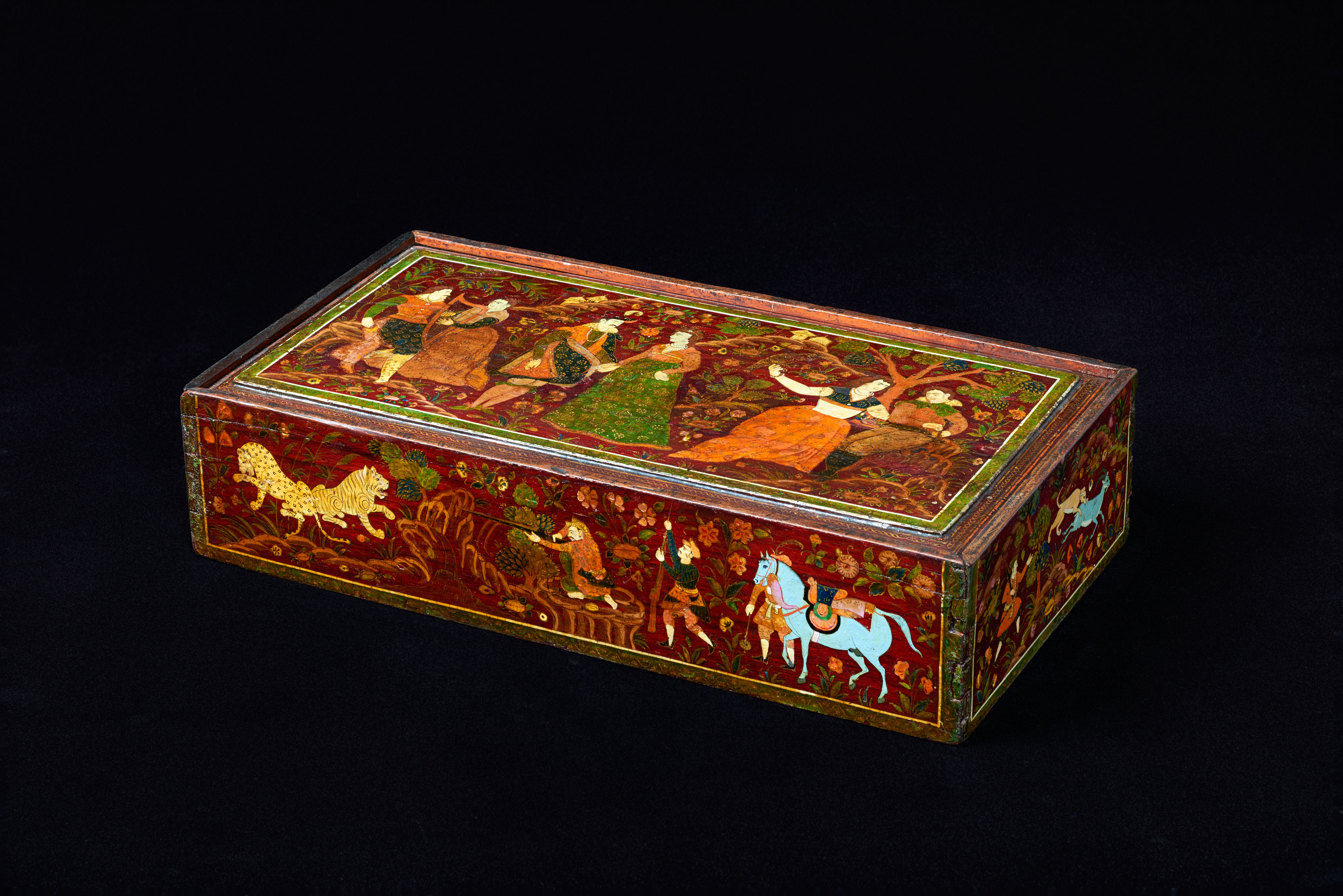
Only relatively few pieces of painted wooden “furniture” from 17th-century India have survived to the present day.1 This box, which could very well have been a pen case, was painted on all four sides with lively outdoor scenes displaying various animals, and three sides also feature hunters, all of them wearing contemporary Indian clothing. The monumental depiction on the cover, in contrast, features three couples, of which the men, at least, are clearly Europeans. The ethnic affiliation of the women is more ambiguous; one of them is wearing an Indian blouse and the other two seem to be swarthier than the men.
Mughal painting after the 1580s displayed a pronounced interest in exotic, European motifs, whether of a secular or a religious nature. (See e.g. 6/1981.) At the same time, Indian artists learned from the Europeans’ feel for naturalism, depth, and shadowing.
The Indian hunting scenes are in what is called the sub-imperial style, a provincial version of works that were made in the Mughals’ court studios. The European scene was probably inspired by prints from Europe combined with personal observations. The stylized landscape background that is found on all of the box’s paintings is characteristic of work of this type. (See also 56/1999.)
Painted objects in wood of this type were probably made in Gujarat, where there were many Europeans and where objects with related shapes inlaid with mother-of-pearl were also produced. (See 35/1976.)
Mughal painting after the 1580s displayed a pronounced interest in exotic, European motifs, whether of a secular or a religious nature. (See e.g. 6/1981.) At the same time, Indian artists learned from the Europeans’ feel for naturalism, depth, and shadowing.
The Indian hunting scenes are in what is called the sub-imperial style, a provincial version of works that were made in the Mughals’ court studios. The European scene was probably inspired by prints from Europe combined with personal observations. The stylized landscape background that is found on all of the box’s paintings is characteristic of work of this type. (See also 56/1999.)
Painted objects in wood of this type were probably made in Gujarat, where there were many Europeans and where objects with related shapes inlaid with mother-of-pearl were also produced. (See 35/1976.)
Published in
Published in
Alexis Renard: Wunderkammer Exotica, Residenz München, Paris 2014, cat.no. 37;
Kjeld von Folsach: ”"Exoticism" reversed. On a painted wooden box from Mughal India” in Journal of the David Collection, 5, 2021, pp. 152-177;
Kjeld von Folsach: ”"Exoticism" reversed. On a painted wooden box from Mughal India” in Journal of the David Collection, 5, 2021, pp. 152-177;
Footnotes
Footnotes
1.
Kjeld von Folsach: ”"Exoticism" reversed. On a painted wooden box from Mughal India” in Journal of the David Collection, 5, 2021, pp. 152-177.