Johan Thomas Lundbye (1818–1848)
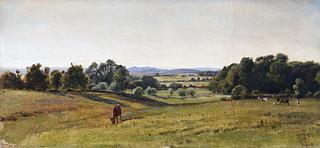
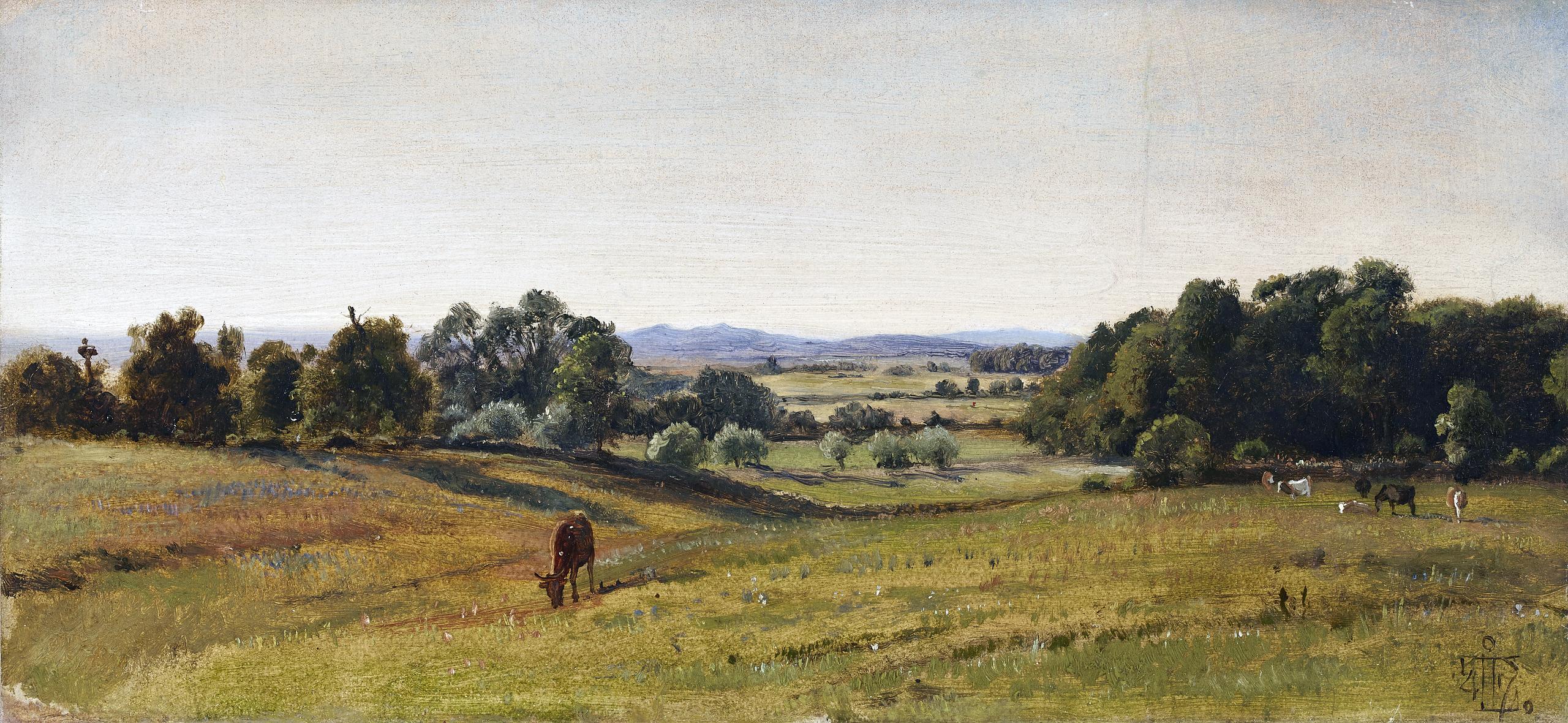
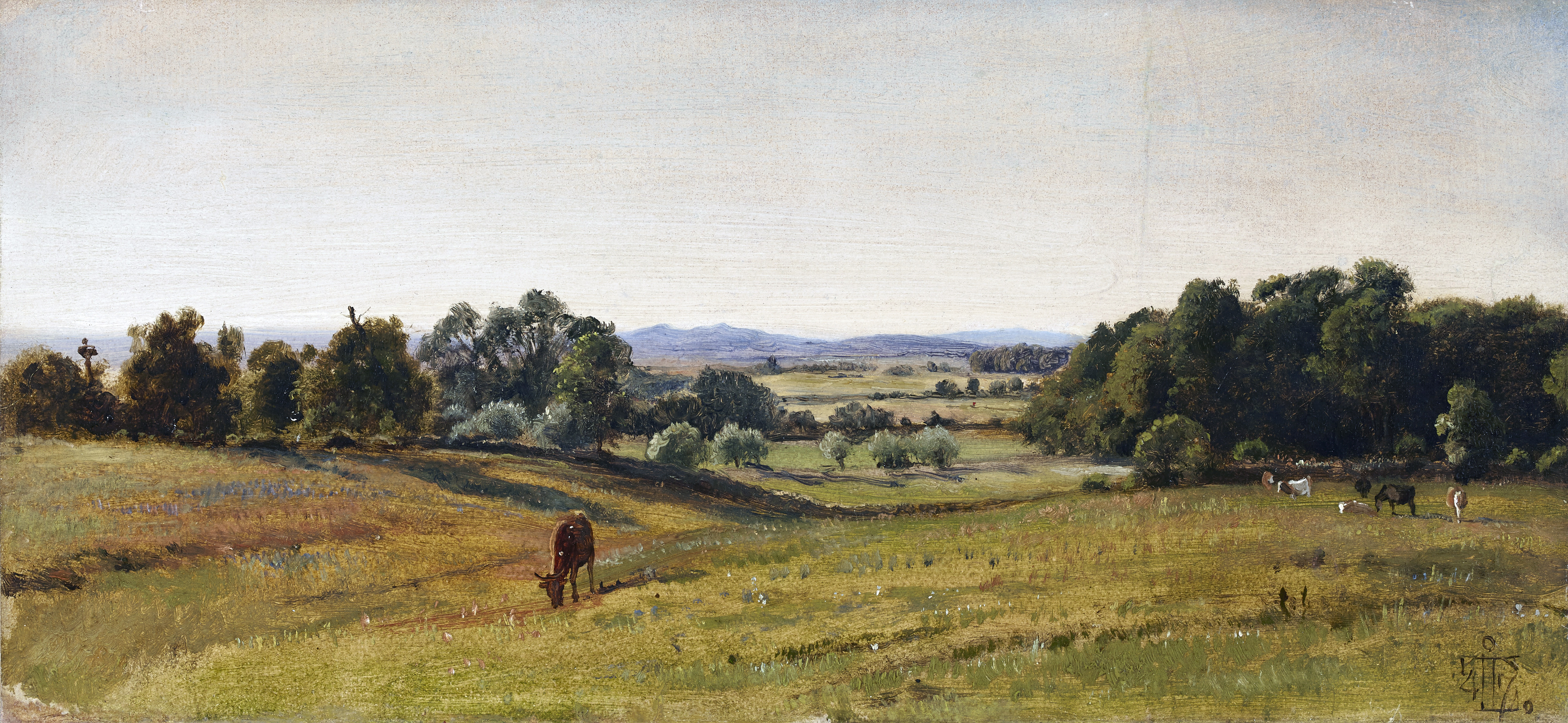
View from ‘Lundbye’s Mound’ in the Garden of Dortheaslyst, 1847
Oil on paper
17 x 38 cm
Inventory number B 371
By the middle of the nineteenth century, it had become a widespread practice for artists to paint small studies en plein air, directly in front of their chosen subject. The method allowed for the best possible approximation to reality, the effect of daylight and the finer nuances of colour. For a painter like Johan Thomas Lundbye, the method was also about identifying and depicting the typical and universal aspects of the Danish landscape.1 To achieve this, he often went out into the countryside to find scenes of unspoilt nature which was not always easy to find. Still, he was occasionally lucky enough to find overgrown pastures where the signs of human intervention were less obvious.
In the summer of 1847, Lundbye went on a long sojourn which in June brought him to Kalundborg and Røsnæs, where his work included numerous studies of the beach and coast. The following month, Lundbye painted this open, gently hilly summer landscape with grazing cows as seen from the garden of the country estate Dortheaslyst.2 He had come to know the place quite well, having lived at Dortheaslyst for most of the month of June. In addition to landscapes, he also painted horses and other animals while staying there. There is much to suggest that he thrived at Dortheaslyst. In a letter to his friend Svend Grundtvig (1824–1883), Lundbye writes:
‘My life here is as snug as a bug in a rug, and my host’s family is so amiable and cultivated, in the very best way, that I am never even tempted to doze off until between 6 and 7 in the morning.’3
Lundbye stayed with the Lunn family, whose head was Major Willars Knudsen Lunn (1775–1865) – the man who bred the Knabstrupper horse breed on the Knabstrup estate. There are many indications that this small landscape study used to belong to the family and was inherited through generations. Before it came into C.L. David’s possession, it belonged to his aunt, Agnes Lunn (1850–1941).4 It is likely that it was a gift from her to C.L. David, who appreciated Lundbye’s oil paintings as well as the drawings.5
In the summer of 1847, Lundbye went on a long sojourn which in June brought him to Kalundborg and Røsnæs, where his work included numerous studies of the beach and coast. The following month, Lundbye painted this open, gently hilly summer landscape with grazing cows as seen from the garden of the country estate Dortheaslyst.2 He had come to know the place quite well, having lived at Dortheaslyst for most of the month of June. In addition to landscapes, he also painted horses and other animals while staying there. There is much to suggest that he thrived at Dortheaslyst. In a letter to his friend Svend Grundtvig (1824–1883), Lundbye writes:
‘My life here is as snug as a bug in a rug, and my host’s family is so amiable and cultivated, in the very best way, that I am never even tempted to doze off until between 6 and 7 in the morning.’3
Lundbye stayed with the Lunn family, whose head was Major Willars Knudsen Lunn (1775–1865) – the man who bred the Knabstrupper horse breed on the Knabstrup estate. There are many indications that this small landscape study used to belong to the family and was inherited through generations. Before it came into C.L. David’s possession, it belonged to his aunt, Agnes Lunn (1850–1941).4 It is likely that it was a gift from her to C.L. David, who appreciated Lundbye’s oil paintings as well as the drawings.5
Published in
Published in
Arbejder af Johan Thomas Lundbye, udstillede i Kunstforeningen i København, oktober 1893, København 1893, cat. 140. (Belonged to Agnes Lunn / title: Landskabsstudie);
Karl Madsen: Johan Thomas Lundbye 1818-1848, Kunstforeningen, København 1895, cat. 245, p. 263;
Verner Jul Andersen: Dansk kunst og kunsthåndværk, Davids Samling, 2. ed., København 1983, cat. 429;
Bente Bramming, Hans Edvard Nørregård-Nielsen and Ettore Rocca (eds.): Længsel. Lundbye og Kirkegaard, Ribe Kunstmuseum, Nivaagaards Malerisamling and Skovgaard Museet in Viborg, Århus 2013, cat. 33, p. 135;
Eskil Vagn Olsen, Ulla Lunn: Knabstrupperens 200 års jubilæum: festskrift 2013, Holbæk 2013, p. 26;
Karl Madsen: Johan Thomas Lundbye 1818-1848, Kunstforeningen, København 1895, cat. 245, p. 263;
Verner Jul Andersen: Dansk kunst og kunsthåndværk, Davids Samling, 2. ed., København 1983, cat. 429;
Bente Bramming, Hans Edvard Nørregård-Nielsen and Ettore Rocca (eds.): Længsel. Lundbye og Kirkegaard, Ribe Kunstmuseum, Nivaagaards Malerisamling and Skovgaard Museet in Viborg, Århus 2013, cat. 33, p. 135;
Eskil Vagn Olsen, Ulla Lunn: Knabstrupperens 200 års jubilæum: festskrift 2013, Holbæk 2013, p. 26;
Footnotes
Footnotes
1.
After C.L. David’s death in 1960, a significant part of the Danish works in the collection were auctioned off, including some twenty drawings by Lundbye.
2.
Arbejder af Johan Thomas Lundbye, udstillede i Kunstforeningen i København, oktober 1893, København 1893, cat. 140.
3.
Karl Madsen: Johan Thomas Lundbye 1818–1848, Kunstforeningen, Copenhagen 1895, p. 210. Translated by René Lauritsen.
4.
Dortheaslyst is a small neoclassical country house located some 10 kilometers southwest of Holbæk, designed and built in 1799–1802 by the Danish architect Philip Lange. The building was commissioned by Christian Ditlev Lunn, who owned the nearby manor Knabstrup, where David’s aunt, Agnes Lunn, grew up. Dortheaslyst was built as a dower house for the Knabstrup estate.
5.
For more information about landscape painting in the Golden Age, see the article by Torsten Gunnarsson: ‘Verden som landskab. Fem aspekter af nordisk landskabsmaleri 1840-1910’ in Peter Nørgaard Larsen et al. (eds): Verden som landskab. Nordisk landskabsmaleri 1840-1910, Statens Museum for Kunst, Copenhagen 2006, pp. 11–36.
Danish Paintings and Drawings
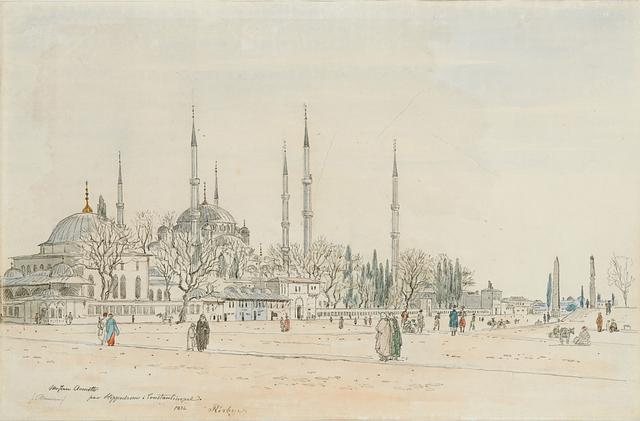
Martinus Rørbye (1803-1848)
The Mosque of Acmette at the Hippodrome in Constantinople, 1836
Pencil on paper, partly coloured
The Mosque of Acmette at the Hippodrome in Constantinople, 1836
Pencil on paper, partly coloured
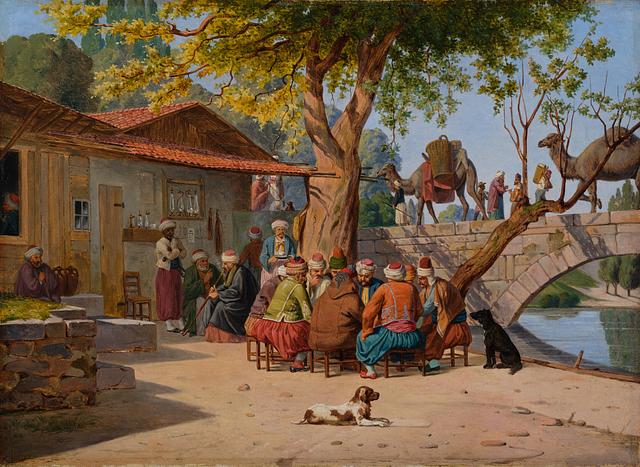
Martinus Rørbye (1803–1848)
The Caravan Bridge at Smyrna, c. 1837
Oil on canvas
The Caravan Bridge at Smyrna, c. 1837
Oil on canvas
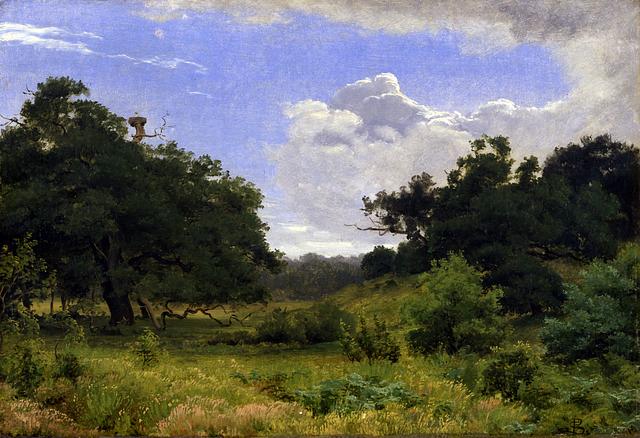
P.C. Skovgaard (1817–1875)
The North Woods at Jægerspris, 1842–1843
Oil on canvas
The North Woods at Jægerspris, 1842–1843
Oil on canvas
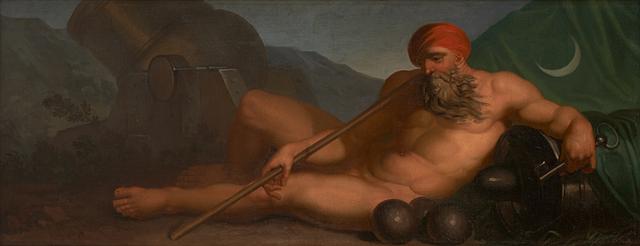
Nicolai Abildgaard (1743–1809)
Bosporus, c. 1800
Oil on canvas
Bosporus, c. 1800
Oil on canvas