The Injuyid Rulers of Fars and southern Jibal, c. 725-754 H/1325-1353 AD
Legend & Design
Legend & Design
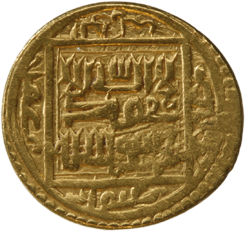
Obverse
In central square
la ilah illa allah / muhammad / rasul allah
“no god but God, unique, Muhammad is the messenger of God”
in marginal segments
the names of the four “Rightly Guided” Caliphs
at 12:00 abu bakr, at 9:00 ‘umar, at 6:00 ‘uthman, at 9:00 ‘ali
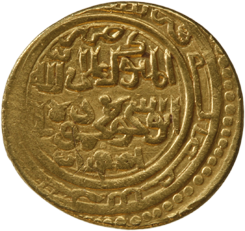
Reverse
Field
duriba / al-mutawakkil ‘ala allah / abu ishaq ibn mahmud / isfahan
“struck, he who puts his trust in God, Abu Ishaq bin Mahmud, Isfahan"
Margin
fi sh(uhur sana kham)sin wa sab’mi’a
“in the mo(nths of the year fif)ty and six hundred"
Historical Note
Historical Note
The Injuyids, who were originally governors for the Ilkhans, became independent in the early 740s H (1340s AD). Their name derives from the position of their ancestor, Sharaf al-Din Mahmud Shah, overseer of the Ilkhans’ royal estates in Fars, which were known in Mongolian as inju. The Injuyid dynasty lasted for only seventeen years under two rulers, Mahmud Shah and Abu Ishaq, before being swept away by the Muzaffarid Mubariz al-Din Muhammad in 757 (1356).
Mahmud Shah consolidated his power in Shiraz during the reign of the Ilkhan Abu Sa‘id, and became the virtually independent ruler of Fars. Abu Sa‘id suspected his intentions, and tried to appoint a governor to replace him, but Mahmud Shah’s son, Ghiyath al-Din Kaykhusraw, who ruled in Shiraz in his father’s name, refused to agree to this.
Abu Sa‘id died shortly after and his successor Arpa Ga‘un had Mahmud Shah executed.
As so often happened, internecine strife broke out over the possession of Fars among his four sons, Jalal al-Din Mas‘ud Shah, who became vizier to the Ilkhan Muhammad Khan, Kaykhusraw, who set himself up as his father’s successor, Shams al-Din Muhammad, who was murdered by the Chobanid Pir Husayn, and Jamal al-Din Abu Ishaq who emerged victorious.
Abu Ishaq became ruler of Shiraz and all of Fars, having already been entrusted with Isfahan by Pir Husayn. He then tried to extend his control over Yazd and Kirman, but came into conflict with the Muzaffarids who drove him from Yazd and Kirman, and then besieged Shiraz, which surrendered to them in 754 (1353).
Abu Ishaq made his way to Isfahan, but that too was besieged by the Muzaffarids, and Abu Ishaq was taken prisoner by the Muzaffarid leader ‘Imad al-Din Mubariz al-Din, who had him executed.
This dinar is the only gold issue known for the Injuids. While the Jalayirid ruler Hasan Buzurg struck anonymous coinage, his neighbour Abu Ishaq took a more forthright course by inscribing his own name on his coins, but without any regal title. He came close to it, however, by reviving an old caliphal name al-Mutawakkil ‘ala Allah, “He who puts his trust in God”.
The Injuyids inherited the Ilkhanid coinage traditions, and, as with this coin, continued to use the square in circle design on the obverse. At this time Iran was a silver currency area where gold was used only rarely.