Batu‘ids / Jujids / The Golden Horde, 665-859 H/1267-1464 AD
Legend & Design
Legend & Design
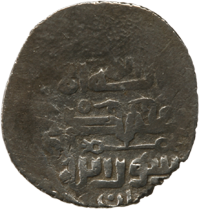
Obverse
Field
(la) ilah illa (Allah) / muhammad / rasul allah
“no god but God, Muhammad is the messenger of God”
Margin (virtually illegible)
the names of the four “Rightly Guided” Caliphs
abu Bakr, ‘umar, ‘uthman, ’ali
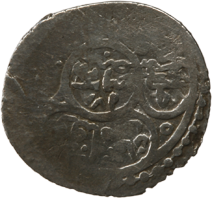
Reverse
In central circle
darb / shabiran 789
“struck Shabiran 789”
Around in four cartouches (virtually illegible)
(al-sultan) / (al-‘adil) / tuqtamish khan / khallada allah mulkahu
“The just Sultan Tuqtamish Khan, may God perpetuate his sovereignty”
Historical Note
Historical Note
The Golden Horde were descended from Juji, the eldest son of Chingiz Khan, who, when his father divided his territories among him and his three brothers, was assigned to rule the north-eastern territories.
The sons of Juji founded the two branches of the dynasty, Batu being the first of the Batu’ids, or Khans of the Blue Horde, and Orda, the first ruler of the Khans of the White Horde. After the death of Jani Beg ibn Özbeg the Batu’ids, experienced a period of anarchy that ended with the murder of Berdi Beg Khan in around 761 H (1360 AD).
After this, during the reign of Ghiyath al-Din Tuqtamish, the two dynasties were reunited as the Jujids, or Golden Horde. While little is known of the origins of Tuqtamish, he is known to have been a client of Timur (Tamerlaine) who made him ruler of Utrar north of Shash (Tashkent). In 784 (1382) Tuqtamish ravaged Russia, pillaging and destroying Moscow and reestablishing Jujid control there.
Although Timur was not a demanding overlord to Tuqtamish, they were always at loggerheads and rivalry was stirred up between them, because both clearly loved nothing better than a good battle, and year after year they fought one another all over central Asia.
Finally, in the spring of 797 (1395), in retaliation for Jujid incursions into Caucasia, Timur smashed Tuqtamish’s army, destroyed and looted his capital, Saray, in the Volga region of Russia, and forced him to give up his khanship.
Even then Tuqtamish went on fighting for ten more years, even seeking reconciliation with Timur shortly before the latter’s death in 807 (1405). Tuqtamish, who is said to have died in battle later in the same year, entered into folklore as a heroic figure in central Asian oral epic tradition.
On this coin Tuqtamish does not claim any elaborate titles for himself, but is named simply as “the Just Sultan”. Its light weight showed the declining value of the silver coinage of the region at this time.