The Abbasid Caliphate, 4th period, 555-656 H/1160-1258 AD
Legend & Design
Legend & Design
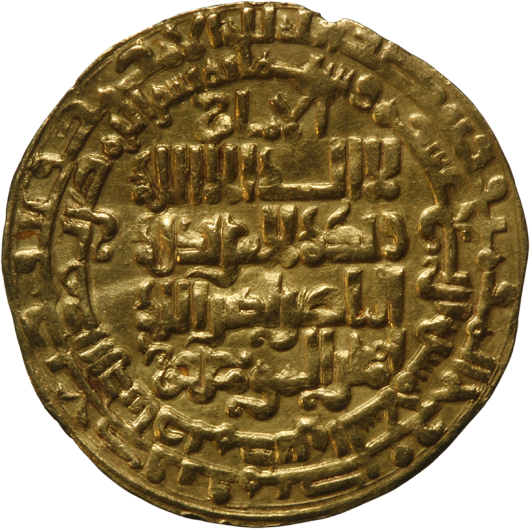
Obverse
Field
al-imam / la ilah illa allah / wahdahu la sharik lahu / al-nasir li-din allah / amir al-mu’minin
“the Imam, no god but God, unique, He has no associate, al-Nasir li-Din Allah, Commander of the Faithful”
Inner margin
bism allah duriba hadha’l-dinar bi-madinat al-salam sana arba‘ ‘ashar wa sittmi’a
“in the name of God this dinar was struck in Madinat al-Salam the year four and ten and six hundred”
Outer margin
lillah al-amr min qabl wa min ba’d wa yawma’idhin yafrahu al-mu’minin bi-nasr allah
“the command is God’s, past and future, and on that day the faithful will rejoice in the victory granted by God”
Sura 30 (al-Rum), vv. 4-5 (in part)
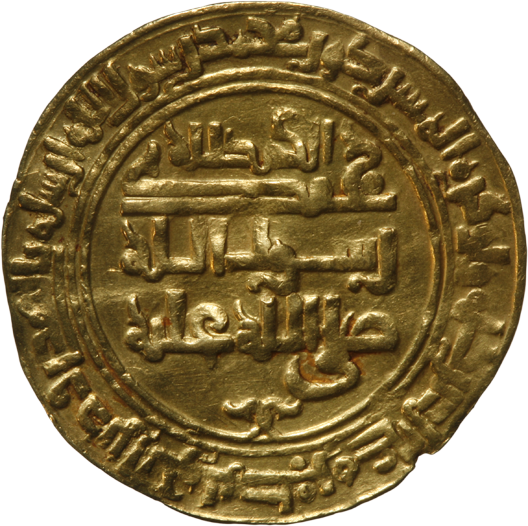
Reverse
Field
al-hamd lillah / muhammad / rasul allah / salla allah ’alayhi
“the praise be to God, Muhammad is the messenger of God, God’s blessing be upon him”
Margin
muhammad rasul allah arsalahu bi’l-huda wa din al-haqq li-yuzhirahu ’ala al-din kullihi wa law kariha al-mushrikun
“Muhammad is the messenger of God who sent him with guidance and the religion of truth that he might make it supreme over all other religions even though the polytheists may detest it”
Sura 9 (al-Tawba), v. 33
Historical Note
Historical Note
When the Buyids, who were Shi‘ites, occupied Baghdad in 334 H (946 AD), the Sunni Abbasid caliph al-Muti‘ and his successor al-Ta’i‘ found themselves to be no more than puppets, entirely under Buyid control.
The Buyids were supplanted by the Great Saljuqs, who were Sunni, and were more favourably disposed to the Abbasid Caliphate. During the reign of Alp Arslan the caliph al-Qa’im recovered control of the Baghdad mint. From then on the Abbasids enjoyed administrative power in Baghdad but were required to acknowledge the overlordship of whichever Great Saljuq was in power.
When Saljuq power disappeared, the caliph al-Mustanjid (555-566/1160-1170) recovered political control of Baghdad and its surrounding territory, and no longer acknowledged any secular overlord.
While al-Mustanjid and his successor al-Mustadi had very little temporal authority, al-Mustadi’s ambitious son and successor, al-Nasir li-Din Allah, spent thirty-two years of his long reign trying to restore the power of the Abbasid Caliphate.
With the Ayyubids of Egypt and Syria at war with the Crusaders, and the Khwarazmshahs in the east fighting the various other Turkish dynasties, as well as trying to prevent the advance of the Mongols, the time was propitious.
Al-Nasir secured the allegiance of the people of Baghdad and became the effective ruler of what is now the core of modern Iraq.
While the gold coins of the Abbasid fourth period are still referred to as dinars, their weight and diameter are quite different from those of former Islamic gold coins. In fact they were no more than gold ingots, not struck to any definite monetary standard, but varying as much as from three to twenty grams in weight.
Their handsome traditional design is similar to the gold coinage of the neighbouring Zangid Atabegs of Mosul, but those were very frequently much less carefully struck.