The Abbasid Caliphate, 4th period, 555-656 H/1160-1258 AD
Legend & Design
Legend & Design
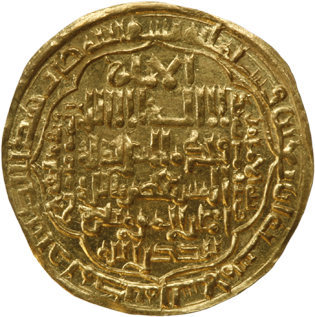
Obverse
Field
in octafoil al-imam / la ilah illa allah / wahdahu la sharik lahu / al-musta’sim billah / amir al-mu’minin
“the Imam, no god but God, unique, He has no associate, al-Musta‘sim billah, Commander of the Faithful”
Right upwards lillah al-amr min / qabl wa min ba’d
Left downwards wa yawma’idhin yafrahu / al-mu’minin
Bottom line bi-nasr allah
“the command is God’s, past and future, and on that day the faithful with rejoice in the victory granted by God’
Sura 30 (al-Rum), vv. 4-5 (in part)
Margin
bism allah duriba hadha’l-dinar bi-madinat al-salam sana arba‘in wa sittmi’a
“in the name of God this dinar was struck in Madinat al-Salam the year forty and six hundred”
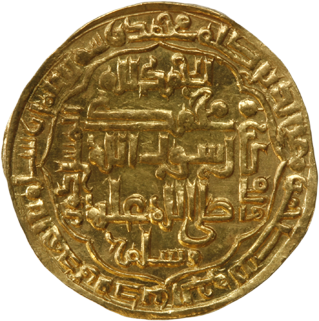
Reverse
In octafoil
al-hamd lillah / muhammad / rasul allah / salla allah ’alayhi / wa sallam
“the thanks be to God, Muhammad is the messenger of God, blessings and peace be upon him”
upwards at 3:00 wa law kariha, downwards at 9:00 al-mushrikun
“even though the polytheists may detest it”
Margin
at 12:00 muhammad rasul allah arsalahu bi’l-huda wa din al-haqq li-yuzhirahu ‘ala al-din kullihi
“Muhammad is the messenger of God who sent him with guidance and the religion of truth that he might make it supreme over all other religions
Sura 9 (al-Tawba), v. 33
Historical Note
Historical Note
The successors of the Abbasid caliph al-Nasir were less competent than he, and as the Mongol army made its way through Iran and advanced on Baghdad the newly regenerated power of the Abbasids began to wane once again. When the Mongol general, Hulagu, having destroyed the fortresses of the Isma‘ilis and ravaged their community, went on to lay siege to Baghdad the Abbasids were forced to surrender the city on 4 Safar 656 H (10 February 1258 AD).
Baghdad was then sacked by Hulagu’s troops, and ten days after its capture Hulagu issued the order that the caliph al-Musta‘sim was to be executed. The execution was carried out by having him wrapped up in a rug and trampled to death by elephants, presumably so as to abide by the Mongol tradition of avoiding spilling royal blood. The murder of al-Musta‘sim lowered the curtain forever on Abbasid rule in Iraq after nearly five and a half centuries.
One Abbasid prince, al-Musta‘sim’s uncle Abu’l-Qasim Ahmad al-Mustansir, managed to escape and took refuge with the Mamluks in Egypt, where he was the first of a dynasty of shadow Abbasid caliphs with no power whatsoever that lasted until the end of Burji Mamluk rule in Egypt in 922 (1517).
This dinar, struck in the first year of al-Musta‘sim’s reign, introduced a new and attractive style of ornamentation, with the field legends enclosed in an octafoil. Like the other later Abbasid gold coins they were not struck to any fixed weight standard, and were clearly intended for use as a commodity rather than as coins for general circulation.