The Zangid Atabegs of Mosul, 521-631 H/1126-1234 AD
Legend & Design
Legend & Design
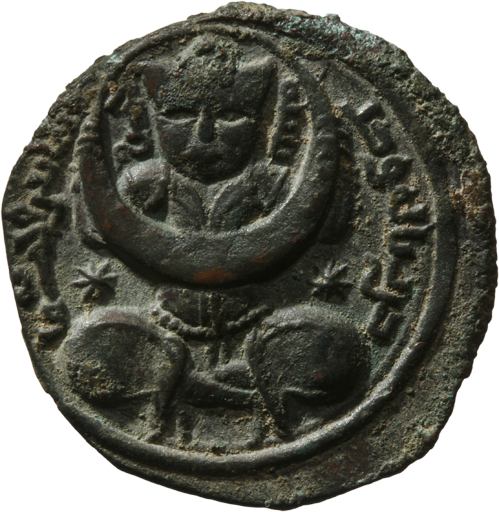
Obverse
Field
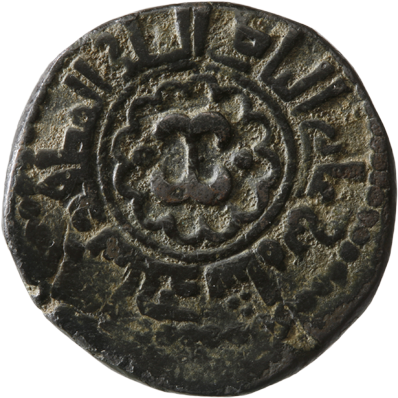
crowned female figure seated facing cross-legged with right boot visible, holding in uplifted hands a large crescent which forms a complete circle tapering towards the top over the figure’s head
Margin
upwards on right duriba bi’l-mawsil, upwards on crescent to right sana, to left khams, downwards on left wa thamanin wa khamsmi’a
“struck in al-Mawsil the year five and eighty and five hundred”
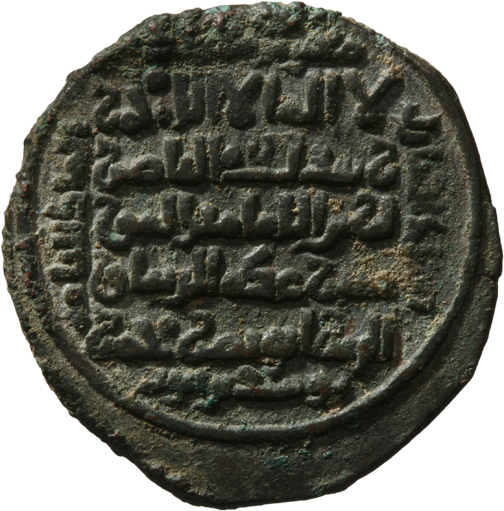
Reverse
Field
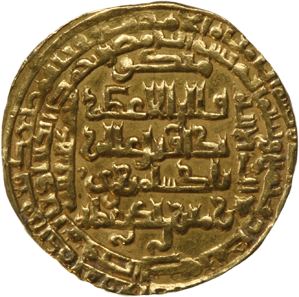
la ilah illa allah muhammad / rasul allah al-nasir / li-din allah amir al-mu’ / minin ‘uddat al-dunya wa / ’l-din abu nasr muhammad
“no god but God, Muhammad is the messenger of God, al-Nasir li-Din Allah, Commander of the faithful,
‘Uddat al-Dunya wa’l-Din, Father of Victory, Muhammad”
Margin
upwards on right al-malik al-‘adil, at top mas‘ud ibn mawdud, downwards on left al-malik al-nasir, at bottom yusuf ibn ayyub
“the Just King, Mas’ud ibn Mawdud, the Victorious King, Yusuf ibn Ayyub”
Historical Note
Historical Note
Al-Jazira, meaning “the Island”or “the Peninsula”, is given this name because it is bounded to east and west by the rivers Tigris and Euphrates. It was divided into three districts, Diyar Rabi‘a, Diyar Mudar and Diyar Bakr. Mosul, on the banks of the River Tigris, was the chief town of Diyar Rabi‘a, Raqqa of Diyar Mudar and Amid (today’s city of Diyarbakir) of Diyar Bakr.
The main line of Zangid atabegs (guardians) had been established in Mosul in 521 H (1127 AD) by ‘Imad al-Din Zangi ibn Aqsunqur, formerly the Saljuqs’ governor of Aleppo. During his twenty-year rule ‘Imad al-Din rebuilt Mosul from its ruined condition, including its fortifications, while expanding his territory to include lands that had been held by the Saljuqs, both to the north and to the west as far as Aleppo and Damascus.
The ruler named on this coin was ‘Izz al-Din Mas’ud I ibn Mawdud, who carried on the practice of striking large copper pictorial dirhams. The reverse bears the kalima, with the names of the Abbasid caliph al-Nasir li-Din Allah and his son and heir, ‘Uddat al-Dunya wa’l-Din (the future caliph al-Zahir), with that of ‘Izz al-Din Masud in the margin. The obverse, with its image of a crowned, cross-legged female figure holding a large crescent, has been popularly described as “the Melon Eater” type. In fact, this is the classical personification of Luna, the moon, rendered here as a voluptuous woman crowned as Queen of the Night, holding the upturned crescent moon in her hands. This depiction of Luna was peculiar to Mosul.
Luna appeared on the coinage of three different Zangid rulers of Mosul, and then on that of their successors the Ilkhans, as well as on much of the famous metalwork produced in the workshops of Mosul at that time.