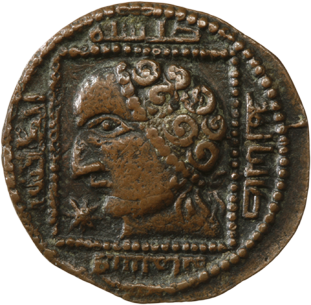
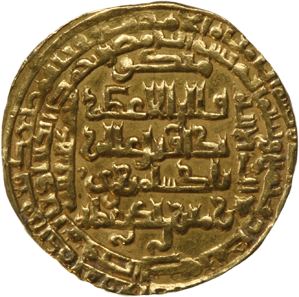
The Zangid Atabegs of Aleppo, 541-577 H/1146-1181 AD
Legend & Design
Legend & Design
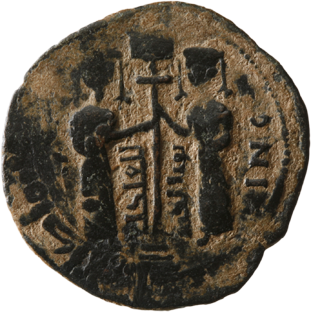
Obverse
Within circle of small beads, two Byzantine-style standing figures facing forwards supporting a labarum (standard) resting on three steps
Downwards on left: downwards left of the standard: al-‘adil, downwards right of the standard: nur al-din, to the right: ING
“the Just, Light of the Faith”
Margin
malik …
“King …”
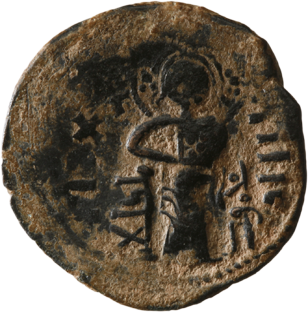
Reverse
Within a circle of small beads, figure of Christ standing, facing forward, holding book in left hand and with right hand on hip, with blundered imitations of Greek legends to left and right
Downwards on right: mahmud downwards on left: malik al-umara’
“Mahmud, King of the Princes”
Historical Note
Historical Note
The founder of the Zangid dynasty was Qasim al-Dawla Aqsunqur, a Turkish slave of the Great Saljuq Sultan Malik Shah I. He was appointed hajib (chamberlain) and then became governor of the town of Aleppo in Syria from 479 until his death in 487 H (1086-1094 AD).
Control of Aleppo was then contested among the Saljuqs, Artuqids and Crusaders until the Zangid ruler of Mosul, ‘Imad al-Din Zangi ibn Aqsunqur, seized it in 523 (1129). On his death in 541 (1146) Aleppo passed to his second son, Nur al-din Mahmud, who not only reconstructed the city and strengthened its renowned fortifications, but also gained fame in the Muslim world by his victories against the Crusaders. He was a staunch Sunni Muslim, who built schools, mosques and other public buildings, but he was tolerant of the Christians, Jews and Shi‘ites who lived within his realm.
This coin, believed to be Nur al-Din’s first copper issue, imitates the standard Byzantine Christian types. Given the large number of specimens and their generally poor condition it probably remained in circulation for many years. Christian imagery on figural copper struck by Muslim rulers was not introduced by the Zangids, for it had been seen on the coinages of the Salduqids of Erzurum, the Inalids of Amid, the Danishmendids of Malatya and the Rum Saljuq Rukn al-Din Mas’ud.
This piece bears no Muslim characteristics whatever, apart from the name Nur al-Din, which means “Light of the Faith”. It is likely that the prototype, with two figures on the obverse and that of Christ on the reverse, was a follis of the Byzantine Emperor Constantine X (451-459/1059-1067). Examples of this type of coinage probably circulated widely in eastern Anatolia and were thus judged to be a suitable model for Nur al-Din’s earliest coinage, because they would generally be acceptable to his many Christian subjects.