The Ayyubid Rulers of Aleppo, 582-658 H/1186-1259 AD
Legend & Design
Legend & Design
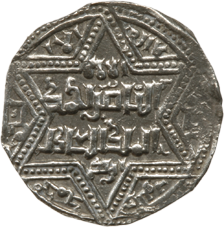
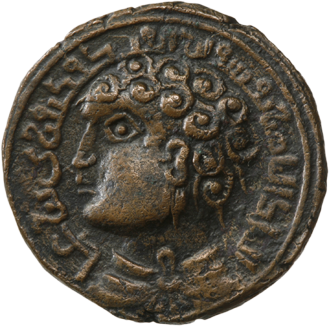
Obverse
In six-pointed star
al-imam / al-nasir ahmad / al-malik al-’adil / abu bakr
“the Imam al-Nasir Ahmad, the Just King, Abu Bakr”
Marginal segments
at 1:00 la ilah, 11:00 illa, 9:00 allah, 7:00 muhammad, 5:00 rasul, 3:00 allah
“no god but God, Muhammad is the messenger of God”
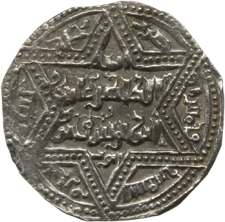
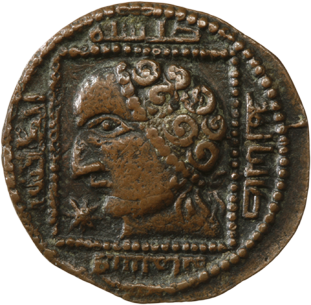
Reverse
In six pointed star
al-malik / al-zahir ghazi / ibn yusuf ibn / ayyub
“the King, al-Zahir Ghazi ibn Yusuf ibn Ayyub”
In marginal segments
at 1:00 duriba, 11:00 bi-halab, 9:00 sana, 7:00 thaman wa, 5:00 tis’in, 3:00 wa khamsmi’a
“struck in Halab year eight and ninety and five hundred”
Historical Note
Historical Note
Al-Zahir Ghazi was the third and most competent of Saladin’s sons, whom the latter named princely governor of Aleppo in 582 H (1186 AD). However, he never became leader of the main line of Ayyubids in Egypt and Syria, for when Saladin died in 589 (1193) it was al-Zahir’s eldest brother al-‘Aziz ‘Uthman who succeeded. This caused bitter fratricidal strife between al-‘Aziz and his younger brother, al-Afdal, but al-Zahir himself did not get involved in the conflict. The forces of al-‘Aziz and his uncle, al-‘Adil Abu Bakr, drove al-Afdal from Damascus, and al-‘Adil was appointed viceroy in Egypt.
When al-‘Aziz died after a six-year reign his ten-year-old son al-Mansur Muhammad succeeded him, but he too died no more than a year later. Throughout this time the loyalty of the Egyptian army was divided between al-Afdal and al-‘Adil Abu Bakr, who succeeded to the Egyptian throne in 596 (1199).
It was only after Saladin’s death that al-Zahir began to strike coinage in his own name in the principality of Aleppo, employing the same distinctive six-pointed star design that had been introduced by his father in 579 (1183). This type became standard not only in Aleppo but also in the Jazira under the Artuqids of Mardin and the Lu‘lu‘ids of Mosul until the conquests of the Ilkhan Hulagu in 656 H.
On the obverse the kalima is found in the border segments, while the name of the caliph is in the field as the ruler’s spiritual overlord, frequently followed by the name of another neighbouring ruler as a secular overlord or particularly close ally. On this coin the secular lord is al-‘Adil Abu Bakr, the uncle of al-Zahir who by this time was the head of the Ayyubid family.