The Ayyubid Rulers of Egypt and Syria, 564-652 H/1169-1254 AD
Legend & Design
Legend & Design
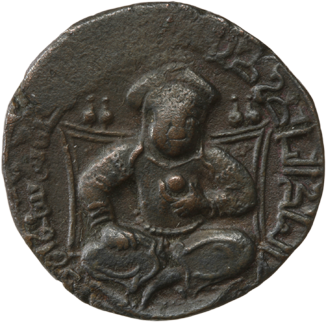
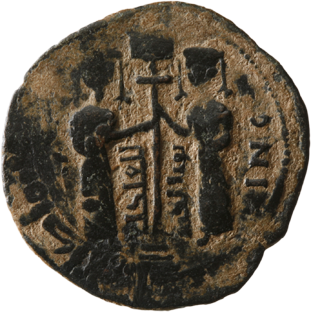
Obverse
Field
male figure facing, seated cross-legged on a low square-backed throne surmounted by two pinnacles at
the upper corners, wearing a turban, left hand holding an orb and right hand resting on his thigh
Around
from 5:00 to 7:00
al-malik al-nasir salah (al-dunya wa’l-din) yusuf ibn ayyub
“the Victorious King, Righteousness of the World and the Faith, Yusuf ibn Ayyub”
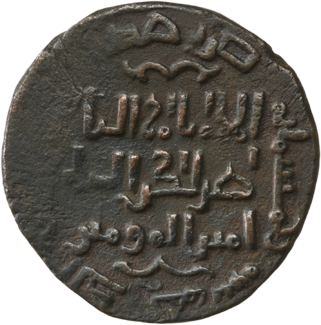
Reverse
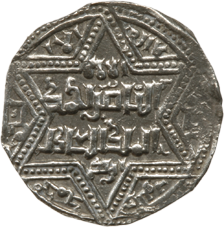
Field within a beaded circle
al-imam al-na / sir li-din allah / amir al-mu’minin with curved ornaments above and below
“the Imam al-Nasir li-Din Allah, Commander of the Faithful”
Margin
duriba hadha’l-dirham sana (sitt wa thamanin) khamsmi‘a
“this dirham was struck the year (six and eighty) and five hundred”
Historical Note
Historical Note
This was a period when the Ayyubid coinage in the east underwent a predictable modification. Instead of the usual small copper fals found in Aleppo, a new denomination, the much larger and heavier copper dirham, was adapted from the neighbouring Artuqid and Zangid states to serve the needs of the new Ayyubid territories in northern Jazira. At that time in Egypt the fals had probably been displaced by glass jetons which had originally started as coin weights, but gradually came to serve as the small change which was widely used by the Fatimids in the markets of Cairo.
While this coin still bears the names of the Abbasid caliph al-Nasir li-Din Allah and Saladin, it goes against strict Islamic tradition by bearing a human figure that harks back to the coinage of the Byzantines. It may, at first sight, seem strange that Saladin, the great warrior against the Crusaders, would tolerate such coins being struck in his name.
Although this piece does not bear a mint name it is likely that Saladin’s figural copper was struck in the Ayyubid territory centred on the town of Mayyafariqin, because by the time it was struck such coinage had been in common use there for nearly fifty years and the astrological symbols were both well understood and accepted.
The seated figure on this coin has been prosaically described as a “turbaned sultan”, but it has also been viewed as the personification of Jupiter, the brightest of the planets, named after the chief of the Roman gods, which was frequently used to depict royalty. The different dynasties of the region had no hesitation in copying one another’s copper dirhams, for this coin, among others, is the prototype for one that was struck by the Artuqid ruler of Mardin, in south-eastern Turkey, Nasir al-Din Artuq Arslan in the years 634, 635 and 637 H, which was identical to it in design.